The AI Accountability Shift: Why Closing the Oversight Gap Is Now a Board Mandate
A week ago, I made a direct argument: most organisations have an AI oversight gap. Adoption is outpacing governance, and the exposure is compounding quietly on the balance sheet.
The response from CISOs, CIOs, and board directors was consistent. The gap is real. The harder question is who closes it, and how fast.
The answer is already moving. AI risk is shifting out of the IT function and onto the board agenda, and the organisations that recognise this first will convert governance from a cost centre into a competitive advantage.
The Board Has Become the Backstop
Three forces have quietly shifted the accountability line.
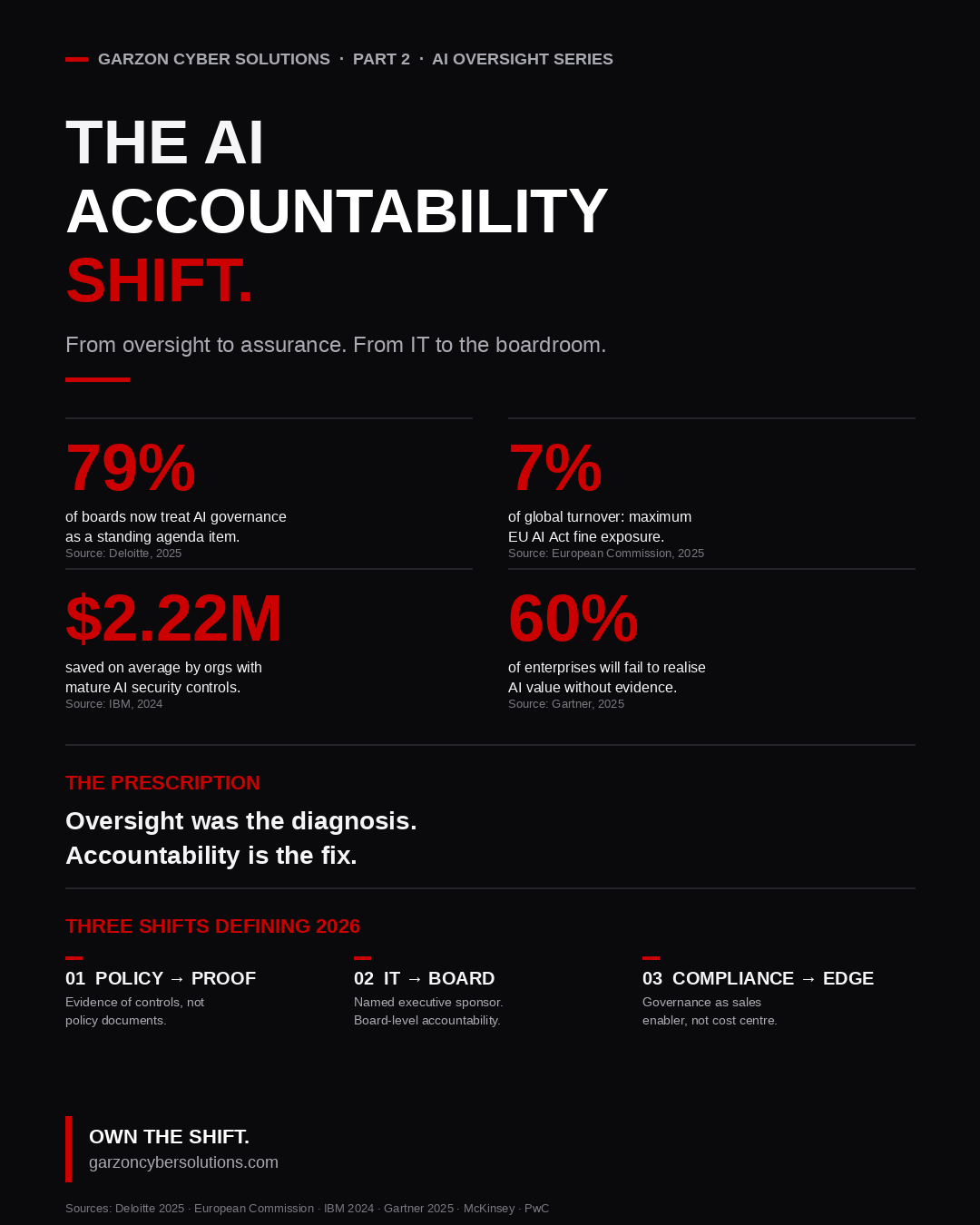
Regulation is now enforceable. The EU AI Act’s prohibited-practice provisions took effect in February 2025, with obligations for general-purpose AI models live from August 2025 and high-risk system requirements arriving in August 2026. According to the European Commission, fines reach up to 7% of global annual turnover, exceeding GDPR in severity.
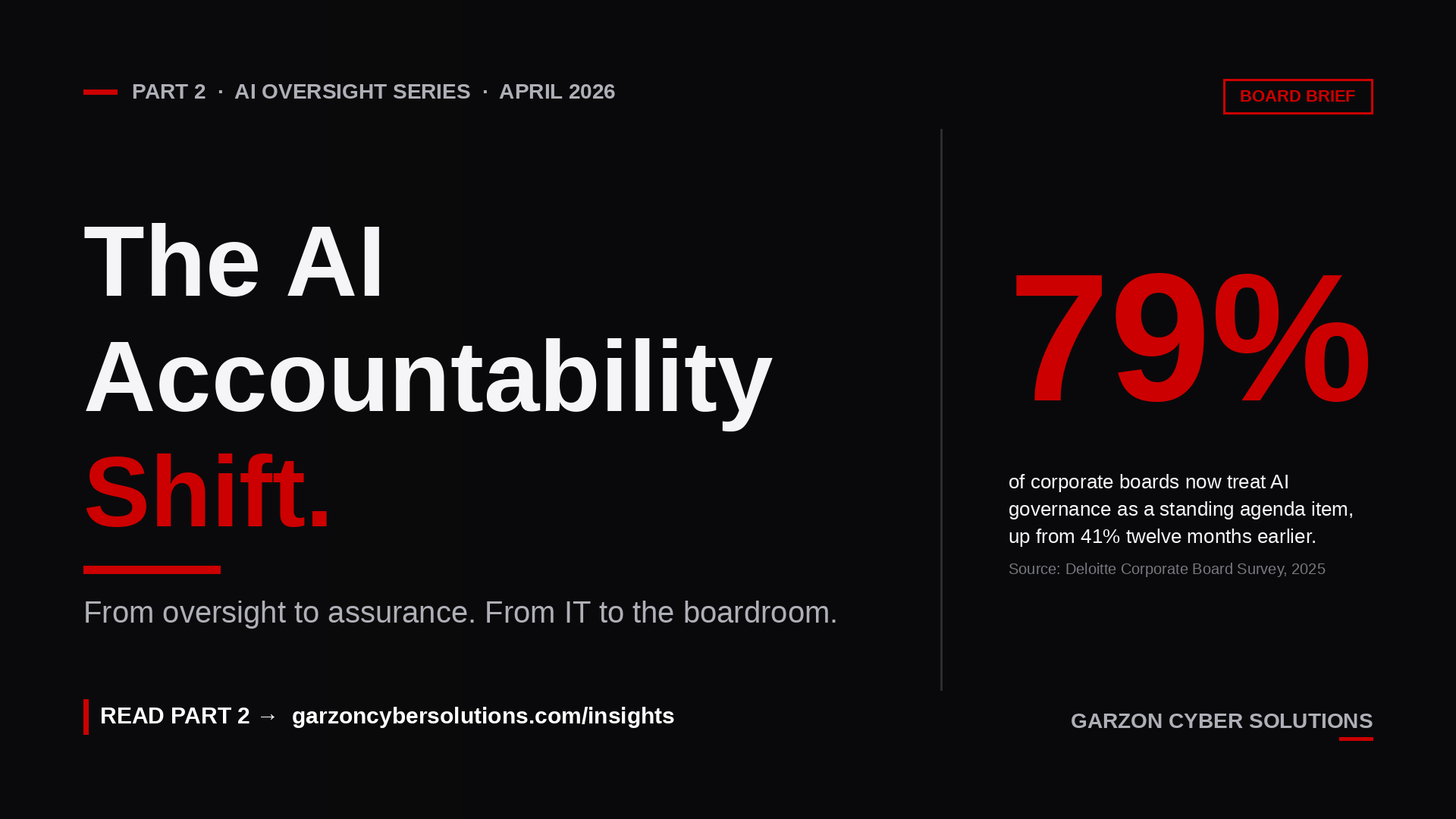
Fiduciary duty has caught up. Deloitte’s 2025 survey of corporate directors found that 79% of boards now treat AI governance as a standing agenda item, up from 41% twelve months earlier. The driver is legal exposure. When AI causes harm, regulators and shareholders look first at the board, not at IT.
Insurers are repricing the risk. Marsh and Aon have both signalled that cyber policies are being re-underwritten to carve out or limit AI-related claims where governance is absent. The message to leadership is simple. Self-insure your AI exposure, or evidence your controls.
The board is no longer the audience for AI governance. It is the accountable party.
Three Shifts Defining the Next 12 Months
1. From policy to proof. Every organisation has an AI policy. Few can produce the artefacts that prove it is operating. Regulators, auditors, and clients are moving past policy documents and asking for model inventories, risk classifications, human-in-the-loop evidence, and incident logs. According to Gartner, by 2027, 60% of enterprises will fail to realise the value of their AI investments because governance controls cannot be evidenced to customers and regulators.
2. From IT to board. AI risk cuts across cyber, legal, compliance, HR, and commercial. No single function owns it end to end. Leading organisations are appointing a named executive accountable for AI risk, reporting into the CEO or board risk committee, with a direct line to the CISO and General Counsel. PwC’s 2025 AI Jobs Barometer identifies this role as one of the fastest-growing executive appointments globally.
3. From compliance to advantage. The organisations treating AI governance as enablement, not overhead, are winning enterprise deals. IBM’s 2024 Cost of a Data Breach report found that organisations with mature AI and automation in their security programmes reduced breach costs by $2.22 million on average. McKinsey’s latest State of AI survey shows that firms generating material EBIT impact from AI are three times more likely to have formal governance embedded at deployment, not bolted on after.
Governance is becoming a sales enabler. It is showing up in RFPs, vendor questionnaires, and cyber insurance renewals.
What Leading Organisations Are Doing Differently
Five moves separate the leaders from the laggards.
- One, a live AI inventory. Every model, tool, and third-party API in use, classified by risk tier, refreshed monthly.
- Two, board-level ownership. A named executive sponsor, quarterly reporting, and a defined escalation path when controls fail.
- Three, integrated controls. AI governance built into existing NIS2, DORA, and ISO 27001 programmes, not managed as a parallel workstream.
- Four, assurance over attestation. Independent testing, red-teaming, and third-party review, because self-certification will not survive regulatory scrutiny or enterprise procurement.
- Five, talent with the right mandate. AI governance leads, model risk specialists, and compliance engineers, recruited as strategic hires rather than filled reactively.
The common thread is treating AI as an enterprise capability with the same rigour applied to finance or operations, not as an experimental sandbox.
The Commercial Case
The argument for accelerating now is not regulatory fear. It is margin protection and market access.
Organisations that move first will price AI risk into their contracts, win enterprise deals that demand governance evidence, and avoid the insurance repricing their competitors are about to face. In our work with CISOs and boards, we consistently see that closing the gap retrospectively runs two to three times the cost of embedding governance from day one.
The AI oversight gap was the diagnosis. The accountability shift is the prescription. The boards that act in the next two quarters will set the governance standard their industries have to follow. The ones that do not will find the standard set for them, at a price they did not budget for.
What’s your board doing about AI accountability right now?
If the answer is “we have a policy,” you are already behind.
At Garzon Cyber Solutions, we build the operating capability that sits beneath the policy. We partner with CISOs, CIOs, and boards to operationalise AI governance as an evidence-led, audit-ready programme, integrated with cybersecurity, compliance, and the specialist talent to sustain it.
One capability. One line of accountability. One board narrative.
Sources
European Commission, EU AI Act Implementation Timeline, 2025
Deloitte, 2025 Corporate Board Survey on AI Governance
Gartner, Predicts 2025: AI Governance and Enterprise Risk
PwC, 2025 AI Jobs Barometer
IBM, Cost of a Data Breach Report 2024
McKinsey & Company, The State of AI 2025
Marsh and Aon, 2025 Cyber Insurance Market Outlook
Garzon Cyber Solutions, Board & CISO Advisory Observations, 2026
Where does this sit on your own risk register?
A short, practical conversation about where the exposure actually is, and what a proportionate response looks like. No obligation and no product pitch.
Start the Conversation →