The AI Assurance Gap: Why Policy Without Proof Is the Biggest Risk on Your Balance Sheet
Two weeks ago, we identified the oversight gap. Last week, we made the case that accountability has shifted from IT to the boardroom. The logical question now is: can your organisation prove it?
The answer, for most, is no.
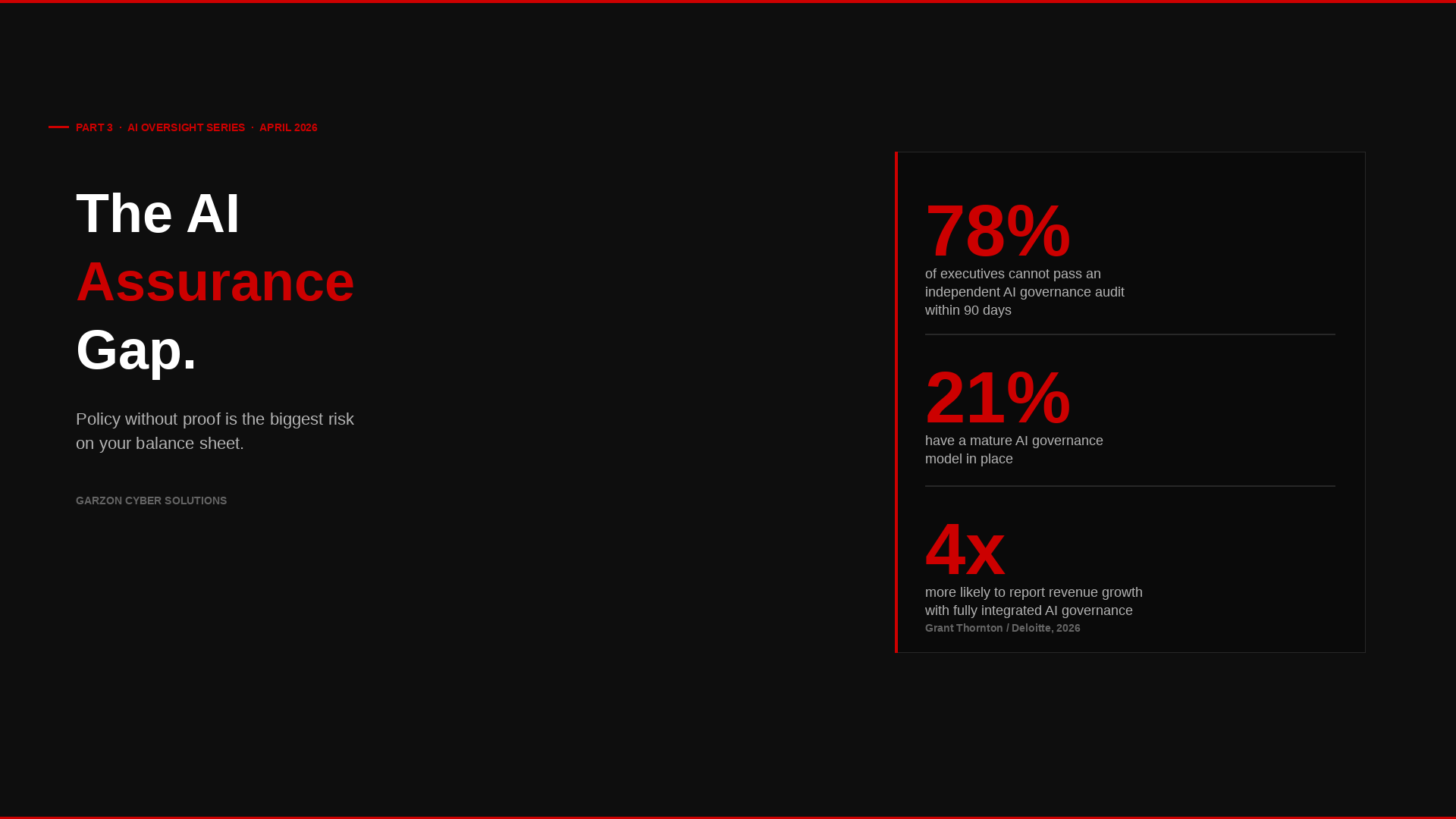
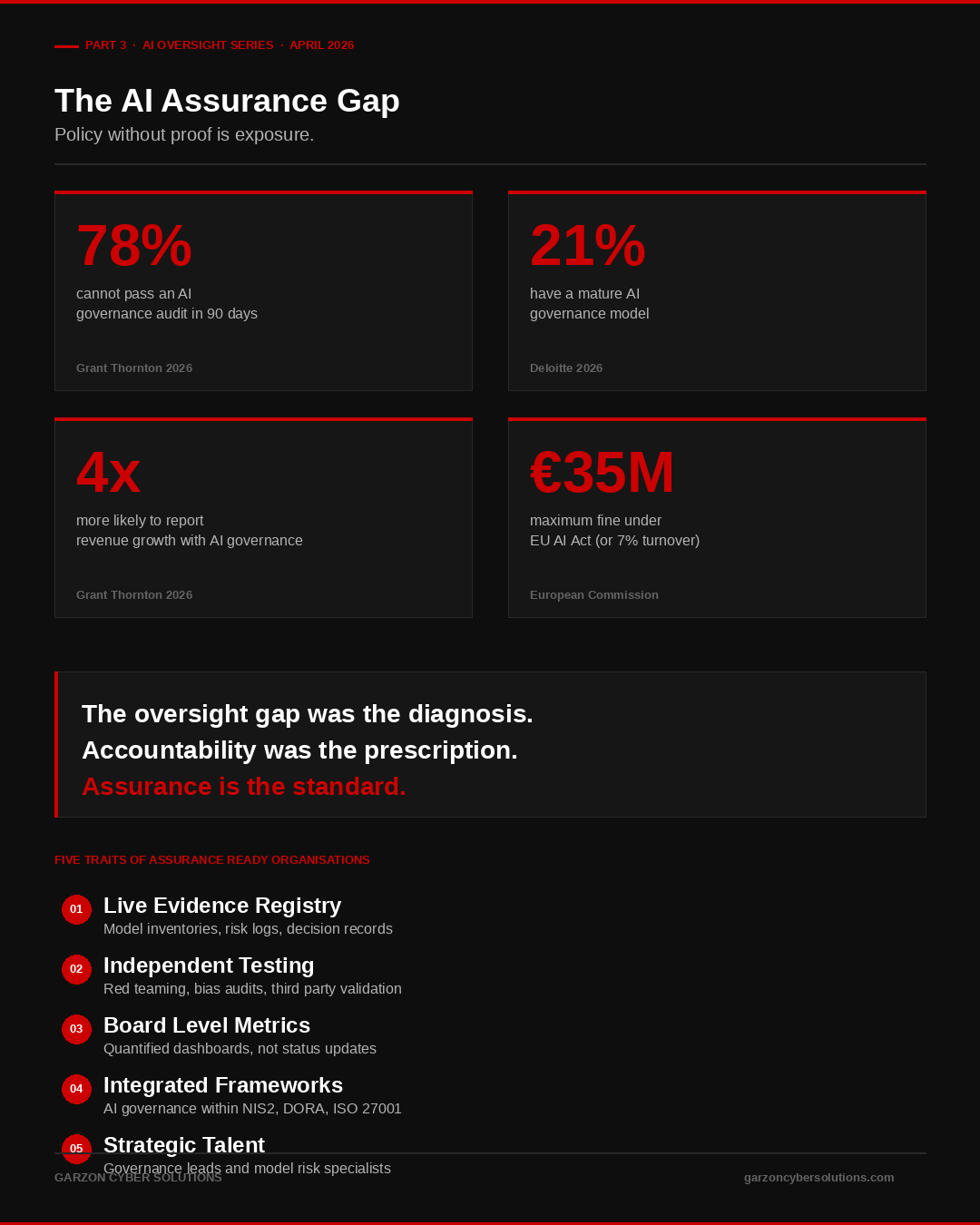
Grant Thornton’s 2026 AI Impact Survey found that 78% of executives lack confidence their organisation could pass an independent AI governance audit within 90 days. That is not a policy problem. It is an assurance problem. Organisations have the documentation. What they cannot produce is the evidence.
The Proof Gap Is Now the Primary Exposure
Three dynamics are converging to make assurance the defining governance challenge of the next 12 months.
1. Regulators have moved from guidance to enforcement. The EU AI Act’s high risk system requirements take full effect on 2 August 2026. Fines reach up to 35 million EUR or 7% of global annual turnover, whichever is higher. Conformity assessment alone takes 6 to 12 months. Organisations starting now are already behind the curve. The window between voluntary preparation and mandatory enforcement has closed.
2. Audit is replacing attestation. Self certification is losing credibility with regulators, insurers, and enterprise buyers. Deloitte’s 2026 State of AI report found that only 21% of organisations have a mature governance model for AI, despite nearly three quarters planning to deploy agentic AI within two years. The gap between ambition and auditability is the single largest risk most boards are not tracking.
3. Governance maturity now correlates directly with financial performance. Grant Thornton’s data shows that organisations with fully integrated AI are nearly four times more likely to report revenue growth than those still piloting (58% versus 15%). They are also ten times more likely to pass an independent governance audit. Governance is no longer a cost of compliance. It is a predictor of commercial performance.
What Assurance Ready Organisations Look Like
The leaders share five observable traits.
One, a live evidence registry. Not a policy binder, but a continuously maintained record of model inventories, risk classifications, decision logs, and human in the loop evidence. Updated monthly, audit accessible in hours.
Two, independent testing. Red teaming, bias audits, and third party validation built into the deployment cycle. Self assessment will not survive regulatory scrutiny or enterprise procurement diligence.
Three, board level reporting with quantified metrics. Governance dashboards that track control effectiveness, incident response times, and risk exposure in commercial terms the board can act on.
Four, integrated frameworks. AI governance embedded within existing NIS2, DORA, and ISO 27001 programmes. Parallel governance structures create duplication, cost, and blind spots.
Five, the right talent in the right seats. AI governance leads, model risk specialists, and compliance engineers recruited as strategic hires. 59% of cyber leaders report critical skills shortages, and governance roles are the hardest to fill because they sit at the intersection of technical, legal, and commercial.
The Commercial Case for Moving Now
The argument is not regulatory fear. It is market access and margin protection.
Organisations that can evidence their AI governance are winning enterprise contracts that now require proof in RFPs and vendor questionnaires. They are securing favourable cyber insurance terms while competitors face exclusions and repricing. And they are deploying AI faster because governance is built into the pipeline, not bolted on as a gate at the end.
In our work with CISOs and boards, the pattern is consistent. The cost of building assurance from scratch after deployment runs two to three times what it costs to embed it from day one. And the reputational cost of failing an audit in a regulated sector is not a line item you can budget for.
The Series Conclusion
Part 1 was the diagnosis: most organisations have an AI oversight gap. Part 2 was the prescription: accountability must sit at board level, not in IT. Part 3 is the standard: policy without proof is not governance. It is exposure.
The EU AI Act enforcement date is 108 days away. The question is no longer whether your board has an AI policy. It is whether your organisation can prove that policy is operating, under scrutiny, in 90 days or less.
If the answer is not yet, the time to act was last quarter. The next best time is today.
At Garzon Cyber Solutions, we build the assurance capability that sits beneath the policy. From AI governance frameworks and audit readiness programmes to the specialist talent that sustains them, we partner with CISOs, CIOs, and boards to make AI governance evidence led, audit ready, and commercially advantageous.
One framework. One evidence base. One board narrative.
Sources
Grant Thornton, 2026 AI Impact Survey
Deloitte, The State of AI in the Enterprise, 2026
European Commission, EU AI Act Implementation Timeline and Article 99 Penalties
ISC2, 2025 Cybersecurity Workforce Study
Garzon Cyber Solutions, Board & CISO Advisory Observations, 2026
Where does this sit on your own risk register?
A short, practical conversation about where the exposure actually is, and what a proportionate response looks like. No obligation and no product pitch.
Start the Conversation →