AI Is Not Replacing Recruiters. It Is Replacing Bad Recruitment.
The cybersecurity talent gap is not closing. According to the ISC2 2025 Cybersecurity Workforce Study, 4.8 million roles remain unfilled globally and the average time to fill a specialist security position now exceeds six months. Traditional recruitment methodologies, built for a market with surplus candidates and stable skill requirements, are structurally incapable of operating at the speed the threat landscape demands.
Artificial intelligence is changing that equation. Not by removing human judgement from the hiring process, but by eliminating the inefficiencies that have made cybersecurity recruitment unacceptably slow, expensive, and imprecise.
The Scale of the Shift
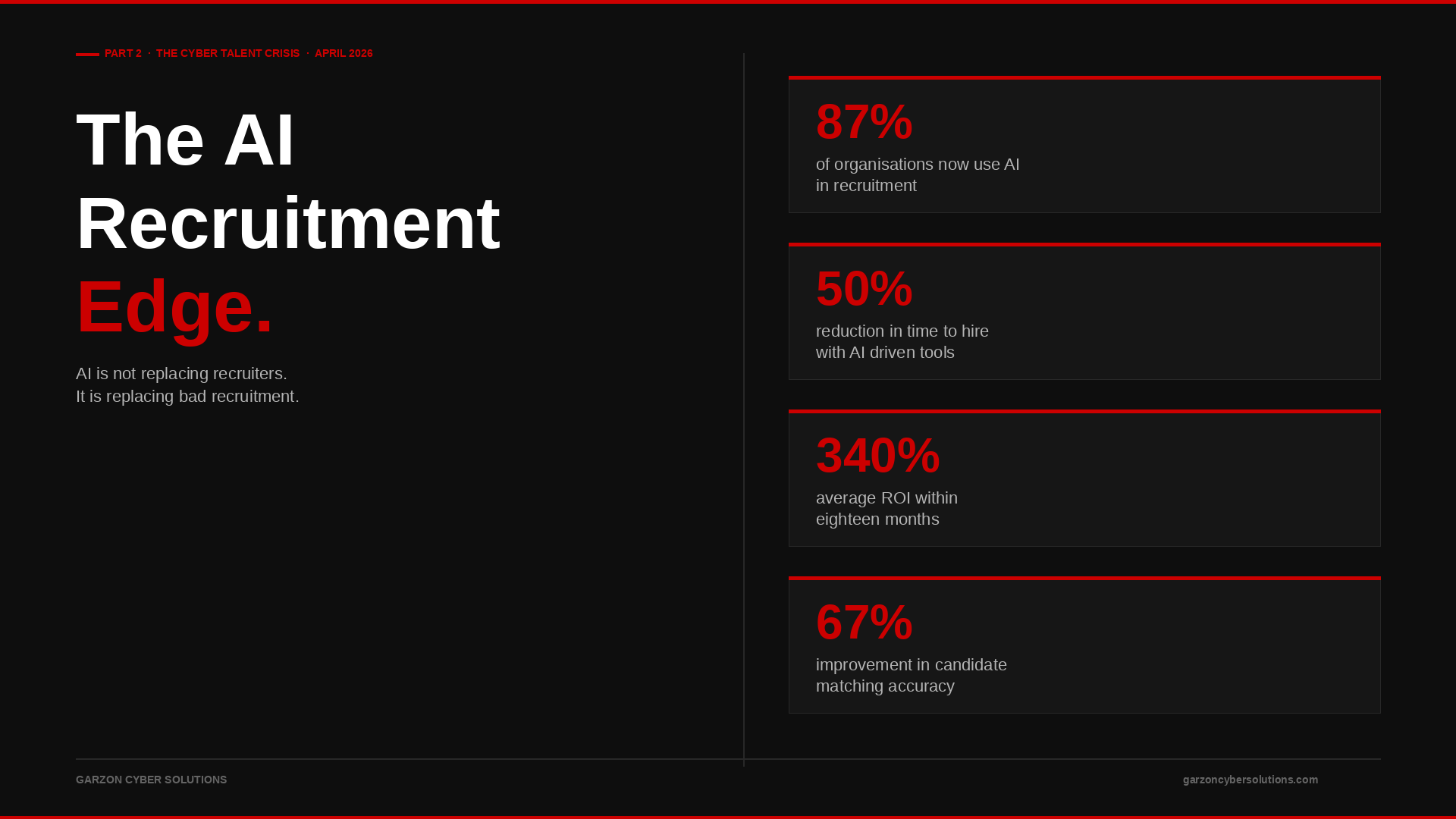
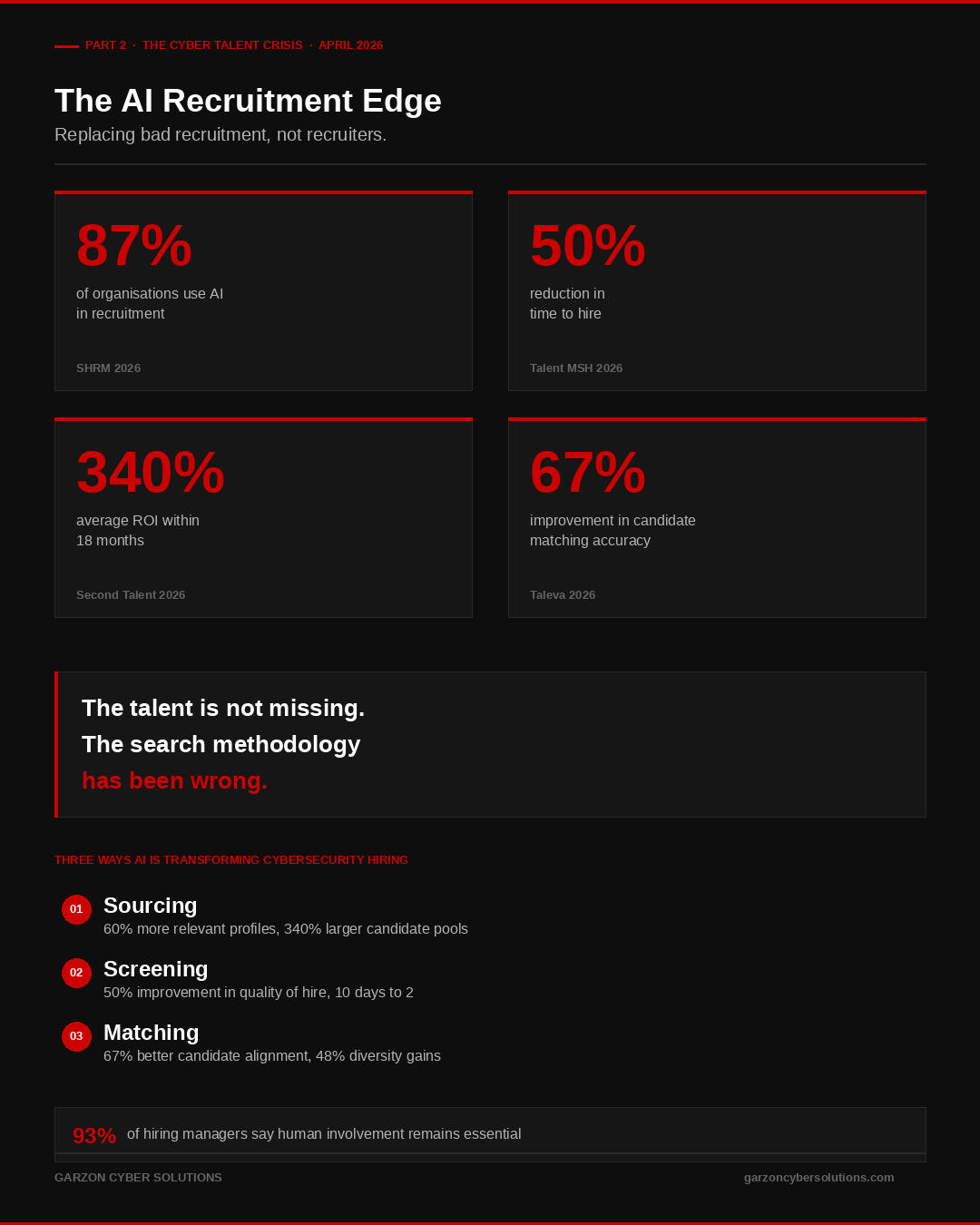
The adoption curve has been decisive. Research from SHRM’s 2026 State of AI in HR report found that 87% of organisations now deploy AI at some stage of the recruitment process, including 99% of Fortune 500 firms. Talent MSH data shows AI usage across human resources functions has climbed to 43% in 2026, up from 26% just two years earlier.
This is no longer an early adopter trend. It is the operational baseline.
The commercial case is equally clear. Organisations implementing AI driven recruitment tools report time to hire reductions of 30 to 50%, cost per hire reductions of up to 30%, and an average return on investment of 340% within eighteen months of deployment. In a market where every unfilled cybersecurity role carries measurable breach exposure, those efficiency gains translate directly to reduced organisational risk.
Three Ways AI Is Transforming Cybersecurity Hiring
The impact is concentrated in three areas where traditional recruitment has consistently underperformed.
1. Sourcing: from keyword matching to capability discovery. Conventional sourcing relies on Boolean queries and keyword filters that systematically exclude qualified candidates. A penetration tester who describes their work as “offensive security assessment” will not appear in a search built around “pen testing.” The result is an artificially narrow candidate pool that reinforces the perception of a talent shortage.
AI powered semantic search changes the dynamic fundamentally. Industry data from Second Talent indicates that semantic sourcing tools find 60% more relevant candidate profiles than traditional Boolean queries while reducing false positive rates by 62%. Candidate pools expand by an average of 340%, and sourcing time drops by 67%.
The talent is not missing. The search methodology has been wrong.
2. Screening: from credential filtering to competency assessment. Most cybersecurity screening processes default to certification checklists and years of experience thresholds. These filters are blunt instruments in a field where a CISSP holder may lack practical incident response capability and a self taught analyst may outperform a five year veteran in cloud security architecture.
AI driven screening tools evaluate candidates against competency frameworks rather than credential lists. They assess demonstrated capability through technical assessments, project portfolios, and contextual analysis of career progression. According to recruitment industry research, organisations using AI assisted screening report a 50% improvement in quality of hire metrics and are 9% more likely to make a successful placement.
3. Matching: from intuition to predictive precision. The final stage of traditional recruitment, matching a candidate to a role, remains heavily dependent on recruiter intuition. In cybersecurity, where the difference between a compliance analyst and a threat intelligence specialist requires deep domain knowledge, intuition based matching produces high failure rates and costly mis-hires.
Predictive analytics are compressing this gap. Data from Taleva’s 2026 AI Recruiting Report shows that predictive matching algorithms improve candidate to role alignment by 67%, while simultaneously increasing diversity hiring effectiveness by 48%. The technology does not replace the hiring manager’s judgement. It ensures the shortlist reaching that hiring manager is materially stronger.
The Human-AI Balance
The most common objection to AI in recruitment is that it removes the human element. The evidence suggests the opposite. SHRM’s research found that 93% of hiring managers consider human involvement essential to the recruitment process, a figure that has not declined as AI adoption has accelerated.
The organisations achieving the strongest results are not automating hiring decisions. They are automating the administrative burden that prevents recruiters from making better ones. Resume screening that previously consumed ten days compresses to two. Interview scheduling that required five days of coordination reduces to one. The recruiter’s time is redirected from process management to candidate assessment and stakeholder engagement.
AI does not replace the recruiter. It replaces the sixty percent of recruitment activity that should never have required a recruiter in the first place.
The Commercial Reality
The financial case for AI augmented cybersecurity recruitment is no longer theoretical. Organisations that have integrated AI across sourcing, screening, and matching report measurably faster hiring cycles, lower cost per hire, and improved retention rates. In a market where IBM estimates that understaffed security teams face breach costs 1.76 million USD higher than their adequately resourced counterparts, the cost of maintaining a manual recruitment process is compounding on the balance sheet.
The cybersecurity talent gap will not be closed by posting more job advertisements or increasing recruiter headcount. It will be closed by organisations that deploy AI to identify, assess, and secure the specialist talent their competitors are still searching for manually.
The question is no longer whether to adopt AI in cybersecurity recruitment. It is whether your organisation can afford the cost of not doing so.
At Garzon Cyber Solutions, we combine specialist cybersecurity recruitment expertise with AI augmented sourcing and assessment to place the talent that generalist recruiters cannot reach. From CISO level appointments to AI governance specialists, we close the roles that define an organisation’s security posture.
The right hire is not a filled seat. It is a closed risk.
Sources: ISC2, 2025 Cybersecurity Workforce Study · SHRM, State of AI in HR 2026 Report · Talent MSH, AI Recruitment Trends & Statistics 2026 · Second Talent, AI in Recruitment Statistics 2026 · Taleva, AI Recruiting Report 2026 · IBM, Cost of a Data Breach Report 2025 · Garzon Cyber Solutions, Recruitment Advisory Observations, 2026
Where does this sit on your own risk register?
A short, practical conversation about where the exposure actually is, and what a proportionate response looks like. No obligation and no product pitch.
Start the Conversation →