April in Review: Four Series, Thirteen Articles, and the Question That Connects Them All
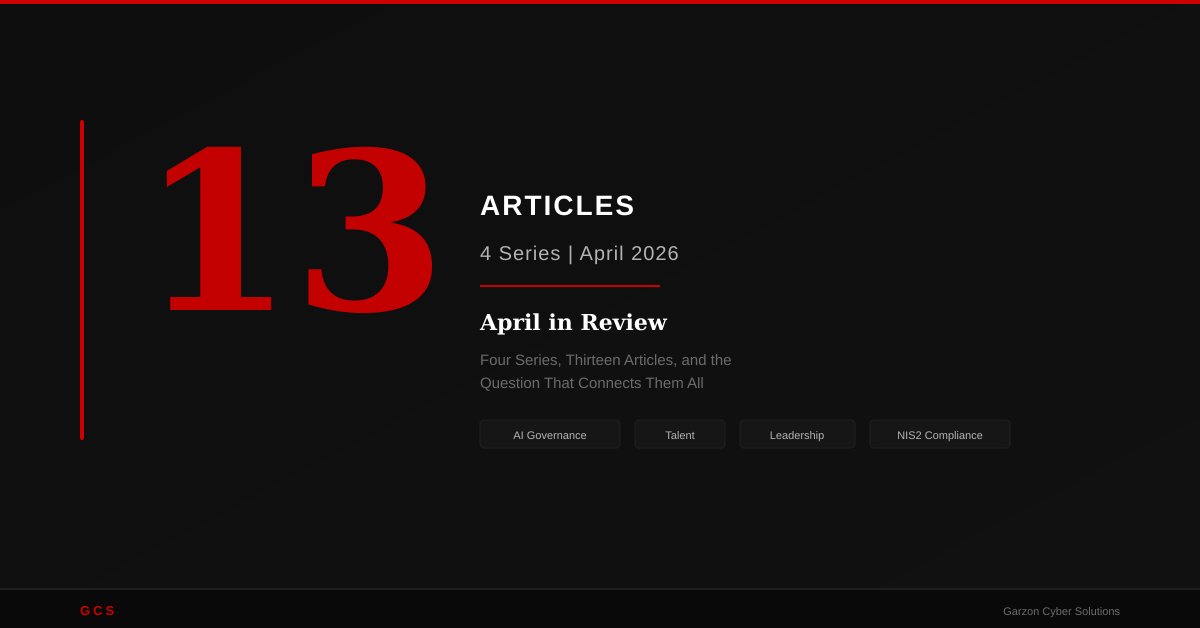
We did not plan to publish thirteen articles in April. The original intention was a short series on AI governance, perhaps three or four pieces, and then move on. But the research kept pulling in the same direction, and by the second week, it was obvious that we were not writing about four separate topics. We were writing about one problem from four different angles.
That problem is convergence. Regulatory pressure, governance failure, talent scarcity, and operational risk are no longer running on separate tracks. They are colliding. And the organisations still treating them as independent line items are the ones most exposed when any one of them arrives.
AI Governance: Where Policy Outpaces Proof
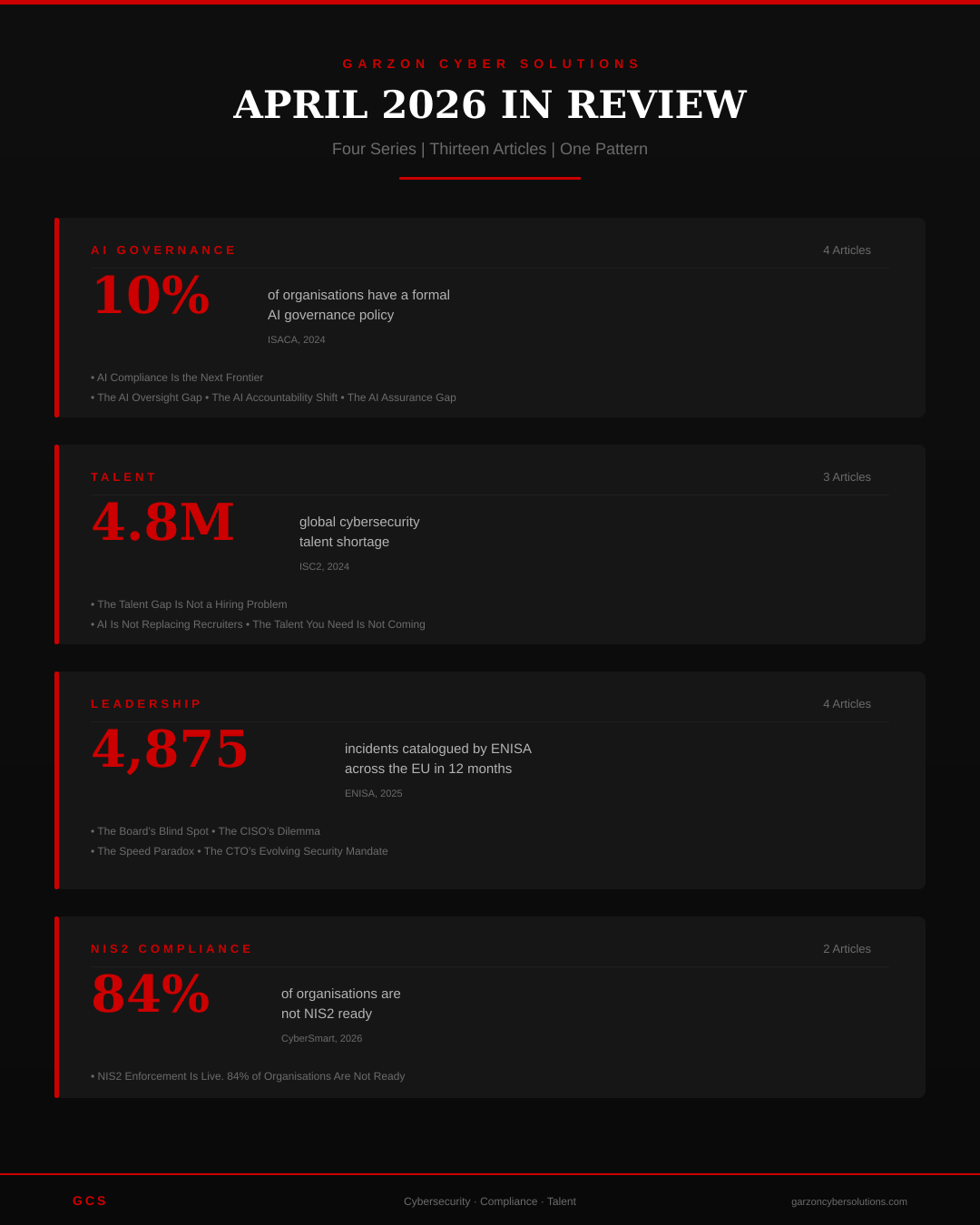
ISACA’s 2024 State of AI report put a number to something most compliance teams already suspected: only 10% of organisations have a formal AI governance policy in place. The EU AI Act entered into force in August 2025. That arithmetic is uncomfortable.
Our four-part AI governance series started there. “AI Compliance Is the Next Frontier” set out the regulatory timeline and what inaction actually costs in commercial terms. What followed was more uncomfortable still. “The AI Oversight Gap” argued that compliance documentation, on its own, fails the moment someone asks for technical evidence to support it. Auditors are not impressed by a policy PDF if the underlying infrastructure cannot substantiate its claims.
“The AI Accountability Shift” turned to the boardroom. Who owns AI risk? In most organisations, nobody can answer that question cleanly, and governance structures were not designed to resolve it. We finished with “The AI Assurance Gap,” which argued that policy without proof is now the single largest unpriced risk sitting on enterprise balance sheets. Not a theoretical risk. A commercial one. Insurers are already asking the questions that most boards have not rehearsed answers for.
Across all four pieces, the finding was the same. Organisations are writing policies faster than they are building the infrastructure to enforce them. That gap will not stay invisible for long.
Talent: A Shortage That Compounds Everything Else
ISC2’s 2024 Workforce Study puts the global cybersecurity talent shortage at 4.8 million professionals. In Europe, the picture is worse. The workforce contracted by 0.7% during the reporting period, the only major region to shrink amid accelerating demand. Those are not numbers that resolve themselves through better job adverts.
“The Talent Gap Is Not a Hiring Problem” was the first piece, and the title was deliberate. Framing the shortage as a recruitment failure misses the point entirely. This is a strategy failure. The organisations losing candidates are the ones that still treat security hiring as a transactional exercise rather than a business-critical leadership function.
“AI Is Not Replacing Recruiters” examined what AI is actually doing to sourcing and assessment, stripped of the hype. The firms that adopt it early will not just improve efficiency. They will secure disproportionate access to a talent pool that is getting smaller every quarter. The final piece, “The Talent You Need Is Not Coming,” was blunt. Build internal capability, contract specialist support, or accept the risk. Waiting for the market to self-correct is not a strategy. It is a bet, and the odds are not improving.
Leadership: Where Governance Actually Breaks Down
This series became the most commercially resonant work of the month, and that surprised us. We expected the NIS2 content to generate the most engagement. Instead, it was the four pieces that examined, role by role, where cybersecurity governance fails inside organisations.
“The Board’s Blind Spot” started with a statistic from ENISA’s 2025 threat landscape analysis: 4,875 incidents catalogued across the EU in a single twelve-month period. Boards that still delegate cybersecurity entirely to the CISO, without understanding what they are delegating, are governing blindly. The article did not argue that boards need to become technical. It argued that they need to understand the risk in the language they already use for every other category on the register.
“The CISO’s Dilemma” was harder to write. Heidrick and Struggles’ 2024 Global CISO Survey reports an average tenure of 26 months. Twenty-six months. The role carries the most accountability and the least structural authority in most enterprises, and the data shows exactly what happens when that imbalance persists.
“The Speed Paradox” tackled something that engineering leaders rarely want to hear. Shipping code faster than your security team can review it is not velocity. It is risk accumulation dressed up as productivity. And “The CTO’s Evolving Security Mandate” completed the series with a straightforward argument: under NIS2, technology strategy and security governance cannot operate as parallel functions. The CTO is as exposed as the CISO. Infrastructure decisions are now compliance decisions, whether the org chart reflects that or not.
NIS2 Compliance: The Directive Meets Reality
CyberSmart’s 2026 research across 670 business leaders in nine European countries produced the headline figure that shaped our NIS2 series: 84% of in-scope organisations are not compliant. That is not primarily a technology gap. It is governance, training, and operational discipline.
“NIS2 Enforcement Is Live. 84% of Organisations Are Not Ready” laid the foundation. The full four-part series examines what the directive means for the board, the CISO, the CTO, and the frontline workforce. Parts one and two were published in April. Parts three and four followed in early May, completing the series.
What April Actually Told Us
Thirteen articles. Four series. One pattern kept repeating regardless of which angle we approached it from.
Organisations that separate cybersecurity from governance, compliance from operations, and talent from strategy are building structures that will not hold. NIS2, the EU AI Act, DORA, and the broader market shift toward evidence-based governance maturity are not applying pressure independently. They are converging on the same organisations at the same time, and the ones without integrated capability will feel it all at once.
May is not about whether to act. It is about whether the people, frameworks, and operational discipline exist to act at the speed the market now requires.
Garzon Cyber Solutions works with organisations to build exactly that: the cybersecurity advisory, compliance architecture, and specialist recruitment capability that turns regulatory obligation into operational readiness.
Where does this sit on your own risk register?
A short, practical conversation about where the exposure actually is, and what a proportionate response looks like. No obligation and no product pitch.
Start the Conversation →