The Talent Gap Is Not a Hiring Problem. It Is a Strategy Problem.
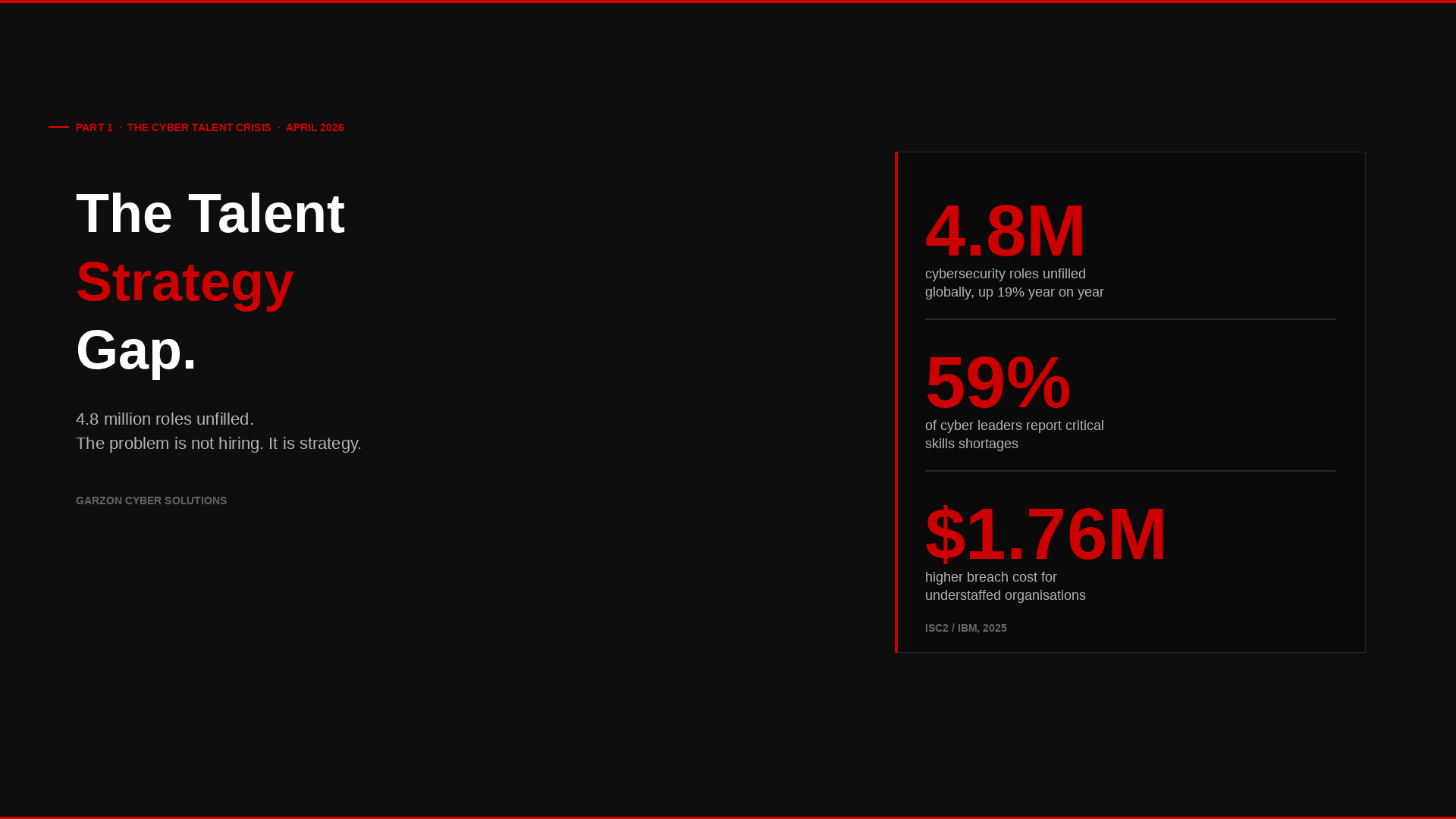
According to the ISC2 2025 Cybersecurity Workforce Study, 4.8 million cybersecurity roles remain unfilled globally, a figure that has climbed steadily for five consecutive years. Most organisations continue to treat this as a recruitment challenge. It is a strategy problem. The organisations that have recognised the distinction are building teams while their competitors remain constrained by vacancies they cannot close.
The Numbers Behind the Crisis
The scale of the gap should concern every board in every sector.
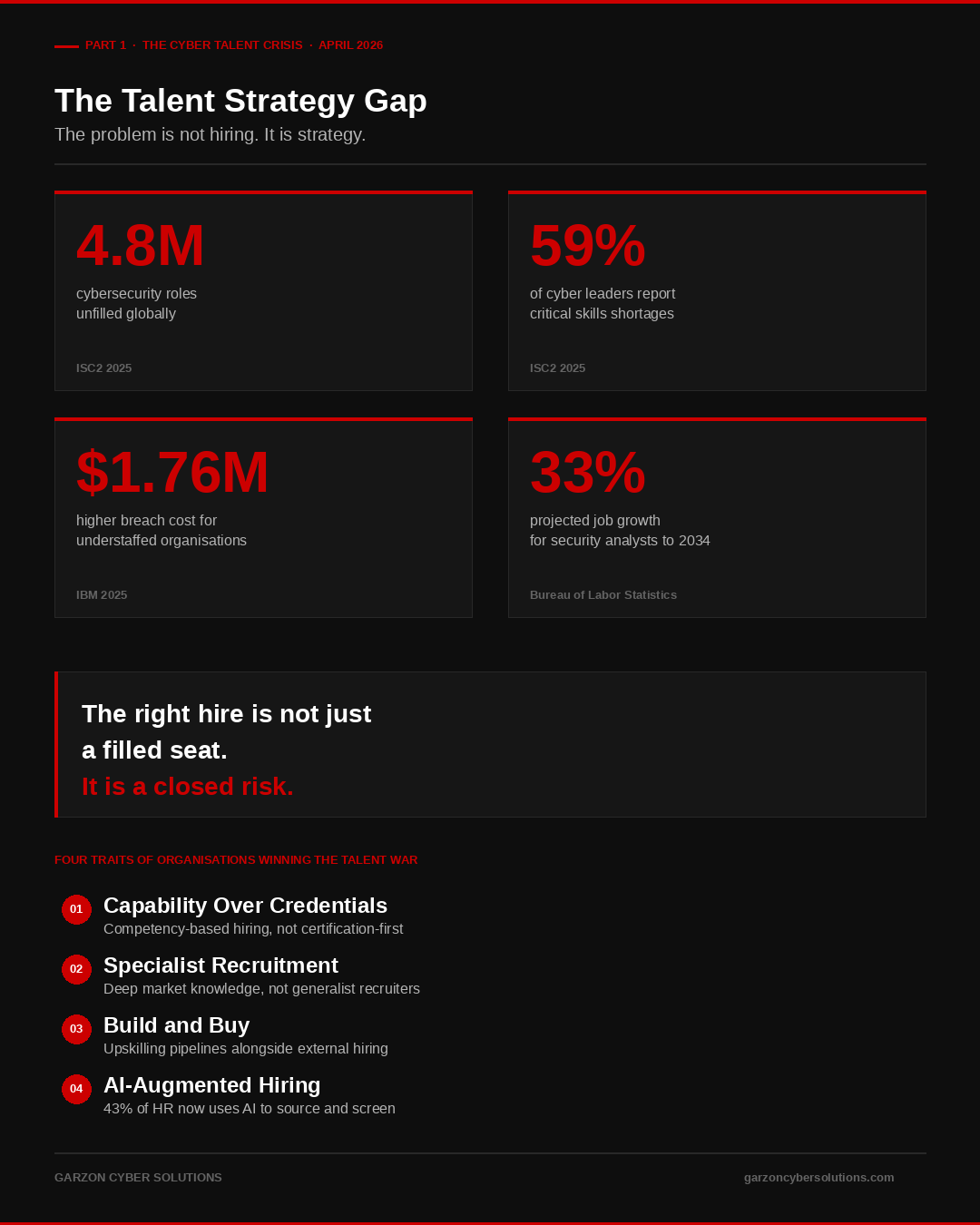
In the United States alone, over 470,000 cybersecurity roles remain open. In the United Kingdom, the median cybersecurity salary has reached approximately 46,000 GBP, yet ISC2 reports that 59% of cybersecurity leaders continue to cite critical or significant skills shortages.
For the first time in the study’s three-year history, skills gaps have overtaken headcount shortages as the industry’s primary workforce challenge. Organisations are not simply missing people. They are missing the right capabilities.
The financial impact is equally clear. IBM’s 2025 Cost of a Data Breach report found that organisations with significant security staffing shortages face breach costs that are, on average, 1.76 million USD higher than their adequately staffed counterparts.
Why Traditional Recruitment Is Failing
Three structural failures are compounding the problem.
1. Job specifications are written for candidates who do not exist. Most cybersecurity job descriptions read as aspirational wish lists rather than hiring strategies. Organisations routinely require five or more years of experience in technologies that have existed for three. They demand certifications that show limited correlation with on-the-job performance. They benchmark compensation against enterprise salary bands they cannot match. The result is predictable: roles remain open for six to nine months while the threat landscape evolves in weeks.
2. Demand for AI skills is outpacing supply. ISC2’s workforce data identifies artificial intelligence and machine learning as the number one skill requirement in cybersecurity, cited by 41% of security teams. New AI-specific security roles, including AI Threat Hunter, AI Security Architect, and AI Governance Specialist, are growing at over 25% annually. The talent pipeline has not kept pace. Organisations are competing for a candidate pool that barely exists, using recruitment methodologies designed for a market that no longer operates in the same way.
3. Budget constraints have overtaken talent availability as the primary barrier. For the first time, economic pressures and budget reductions have surpassed a lack of qualified candidates as the principal driver of staffing shortages. Organisations recognise the need for specialist talent but cannot secure the budget to acquire it. The cost of inaction, measured in breach exposure, regulatory risk, and operational drag, compounds on the balance sheet quarter by quarter.
What Leading Organisations Are Doing Differently
The organisations that are successfully filling their cybersecurity teams share four observable traits.
First, they hire for capability rather than credentials. Leading firms have shifted from certification-first hiring to competency-based assessment. They evaluate what candidates can demonstrably do, not which accreditations they hold. This approach widens the pipeline and accelerates time to hire.
Second, they treat recruitment as a strategic function rather than an administrative one. Cybersecurity hiring requires deep market knowledge, technical fluency, and the ability to assess candidates against evolving threat landscapes and regulatory requirements. The organisations achieving results are engaging specialist recruiters who understand the distinction between a compliance engineer and a penetration tester.
Third, they build talent as well as buying it. Forward-thinking organisations invest in upskilling programmes, internal mobility pathways, and apprenticeship pipelines alongside external recruitment. They are developing the capabilities they require rather than depending solely on a constrained external market to produce them.
Fourth, they are deploying AI to recruit, not merely recruiting for AI. Research from Talent MSH shows that artificial intelligence usage across human resources functions has climbed to 43% in 2026, up from 26% in 2024. AI-powered sourcing, screening, and candidate matching are compressing time to shortlist while improving quality of hire. The technology driving skills demand is also the most effective tool for addressing it.
The Commercial Reality
Data from the Bureau of Labor Statistics projects 33% employment growth for information security analysts from 2024 to 2034, approximately six times the average across all occupations. The AI-in-cybersecurity market is valued at 30.9 billion USD in 2025 and, according to industry estimates, is growing at 22 to 24% annually, roughly double the growth rate of the broader cybersecurity market.
This is not a temporary hiring squeeze. It is a structural shift in how the global economy values security talent. Organisations that build a coherent talent strategy now, one that integrates specialist recruitment, AI-augmented hiring processes, and deliberate capability development, will establish a compounding advantage over those that continue to post vacancies and wait for the market to deliver.
The question for every CISO and board member is direct. Is your organisation treating cybersecurity talent as a hiring problem to be managed, or as a strategic capability to be built? The gap between those two approaches is already visible on the balance sheet.
At Garzon Cyber Solutions, we place the specialist cybersecurity, AI, and compliance talent that organisations cannot afford to get wrong. From CISO-level appointments to AI governance specialists, we combine deep market knowledge with technical fluency to close the roles that generalist recruiters cannot fill.
The right hire is not a filled seat. It is a closed risk.
Sources
ISC2, 2025 Cybersecurity Workforce Study
IBM, Cost of a Data Breach Report 2025
US Bureau of Labor Statistics, Occupational Outlook Handbook 2024
Talent MSH, AI Recruitment Trends & Statistics 2026
Garzon Cyber Solutions, Recruitment Advisory Observations, 2026
Where does this sit on your own risk register?
A short, practical conversation about where the exposure actually is, and what a proportionate response looks like. No obligation and no product pitch.
Start the Conversation →