The Contract You Lost Before You Knew It Existed
There is a conversation happening in procurement departments across the UK right now. Most startup founders will never hear it. It sounds something like this: “Strong product. Failed the security questionnaire. Next.”
No rejection email. No feedback call. No courtesy note explaining what went wrong. The opportunity simply vanishes before it reaches the founder’s inbox. And here’s the uncomfortable part: the founder’s sales team will log it as “no response” and move on to the next prospect, never realising the deal was dead before it started.
This is the reality facing a growing number of high-growth businesses in 2026. Not a cybersecurity breach. Not a ransomware attack. Something far more mundane, and far more costly: a compliance gap that quietly disqualifies them from the contracts they’ve spent months pursuing.
The procurement gate nobody warned you about
Five years ago, a startup could win enterprise work on the strength of its product, a sharp demo, and a well-connected founder. Security questionnaires existed, but they were a formality. Someone in IT signed them off. The deal progressed.
That world has gone.
Enterprise procurement teams in financial services, healthcare, defence, and technology now operate with a non-negotiable baseline. Cyber Essentials certification at minimum. ISO 27001 for anything touching sensitive data. SOC 2 for companies selling into North American markets. The UK Government mandated Cyber Essentials for all central government suppliers several years ago, and private sector procurement has followed with its own, often stricter, requirements.
What’s shifted in the past eighteen months is enforcement. Procurement teams aren’t asking whether a vendor holds these certifications. They’re filtering out vendors who don’t, before a human being ever reviews the proposal. Supplier qualification has become automated. Cybersecurity compliance sits alongside financial stability checks as a binary pass or fail.
Think about what that means for a startup with a strong, competitive product. The technology is irrelevant if the business can’t clear the compliance threshold. The sales team isn’t losing on price or product fit. They’re losing deals they never knew existed, because the procurement system removed them at the first gate.
The scale of the problem
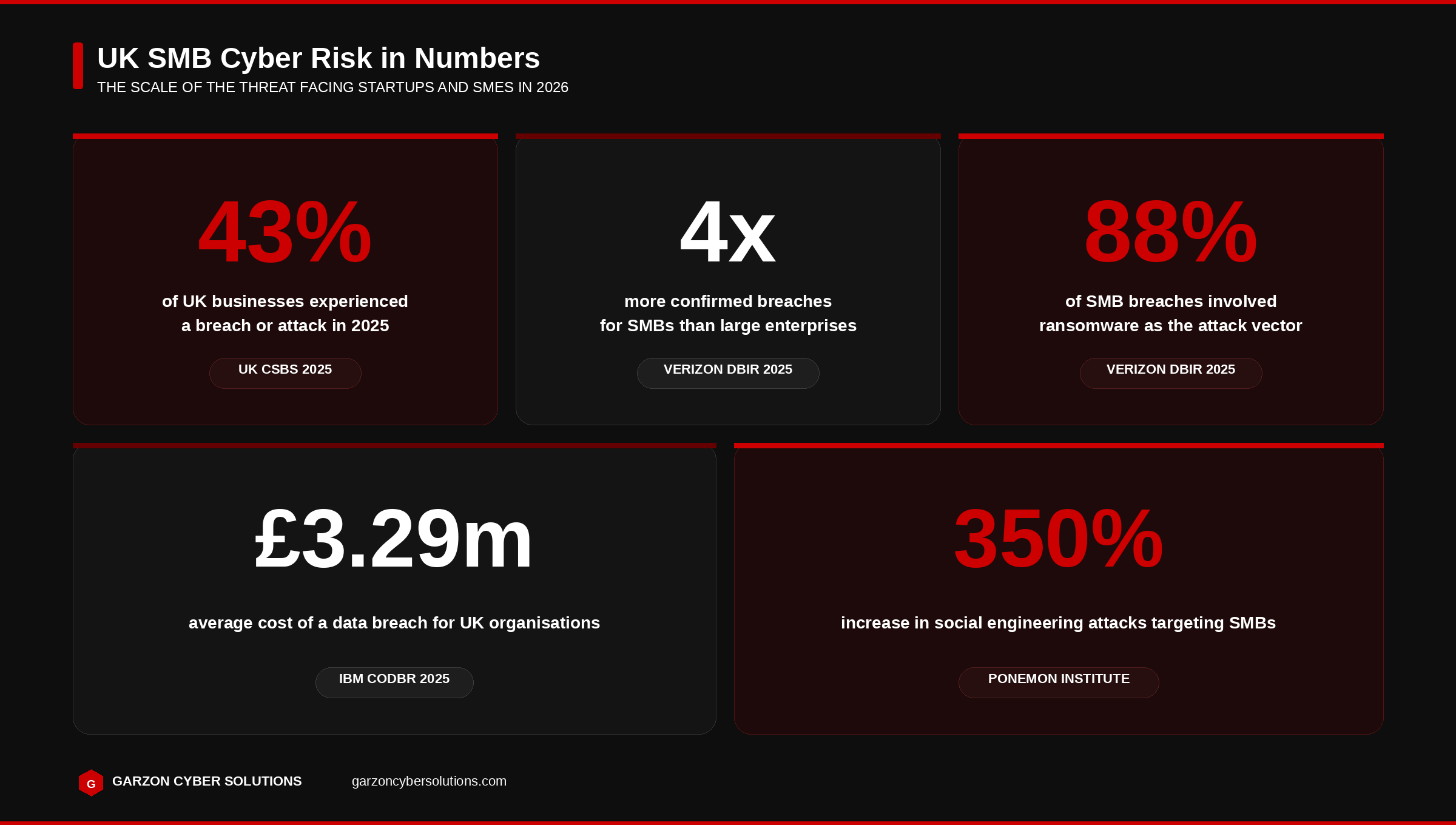
The UK Government’s Cyber Security Breaches Survey 2025 reports that 43% of UK businesses experienced a breach or attack in the preceding twelve months. That’s roughly 612,000 companies. The headline gets attention, but the figure that should concern founders more is this: the vast majority of those businesses lacked the basic governance structures that enterprise buyers now treat as standard.
Verizon’s 2025 Data Breach Investigations Report paints a sharper picture for smaller companies. SMBs experienced approximately four times more confirmed breaches than large organisations, with 88% of those breaches involving ransomware. The report logged 3,049 SMB incidents and 2,842 confirmed breaches. Not near-misses. Confirmed compromises.
Financially, the exposure is significant. IBM’s 2025 Cost of a Data Breach Report places the UK average at £3.29 million per incident. For businesses under 500 employees, the realistic range sits between £95,000 and £980,000 depending on severity, sector, and how quickly the breach is contained. The Ponemon Institute’s research suggests employees at small businesses experience 350% more social engineering attacks than those at larger organisations, and receive targeted malicious emails at a rate of one in every 323.
Those are the direct costs. The commercial opportunity cost is harder to quantify but arguably more damaging.
Enterprise buyers now require evidence of active cybersecurity governance from every supplier handling personal or commercially sensitive data. In regulated sectors, that requirement cascades through the supply chain: a startup that can’t demonstrate compliance doesn’t just lose a single contract. It loses access to the entire procurement ecosystem of that enterprise client, and every business in their supply chain. One gap in governance, and an entire market closes.
What enterprise buyers actually want
There’s a common misconception among early-stage companies that meeting cybersecurity standards requires a large internal team, expensive tooling, and months of preparation. The reality is more accessible than most founders expect.
Procurement teams want evidence of governance. Not perfection. They want to see that the business has considered information security in a structured way, that policies and controls exist, and that someone is accountable for maintaining them. The bar is surprisingly achievable for a well-organised company.
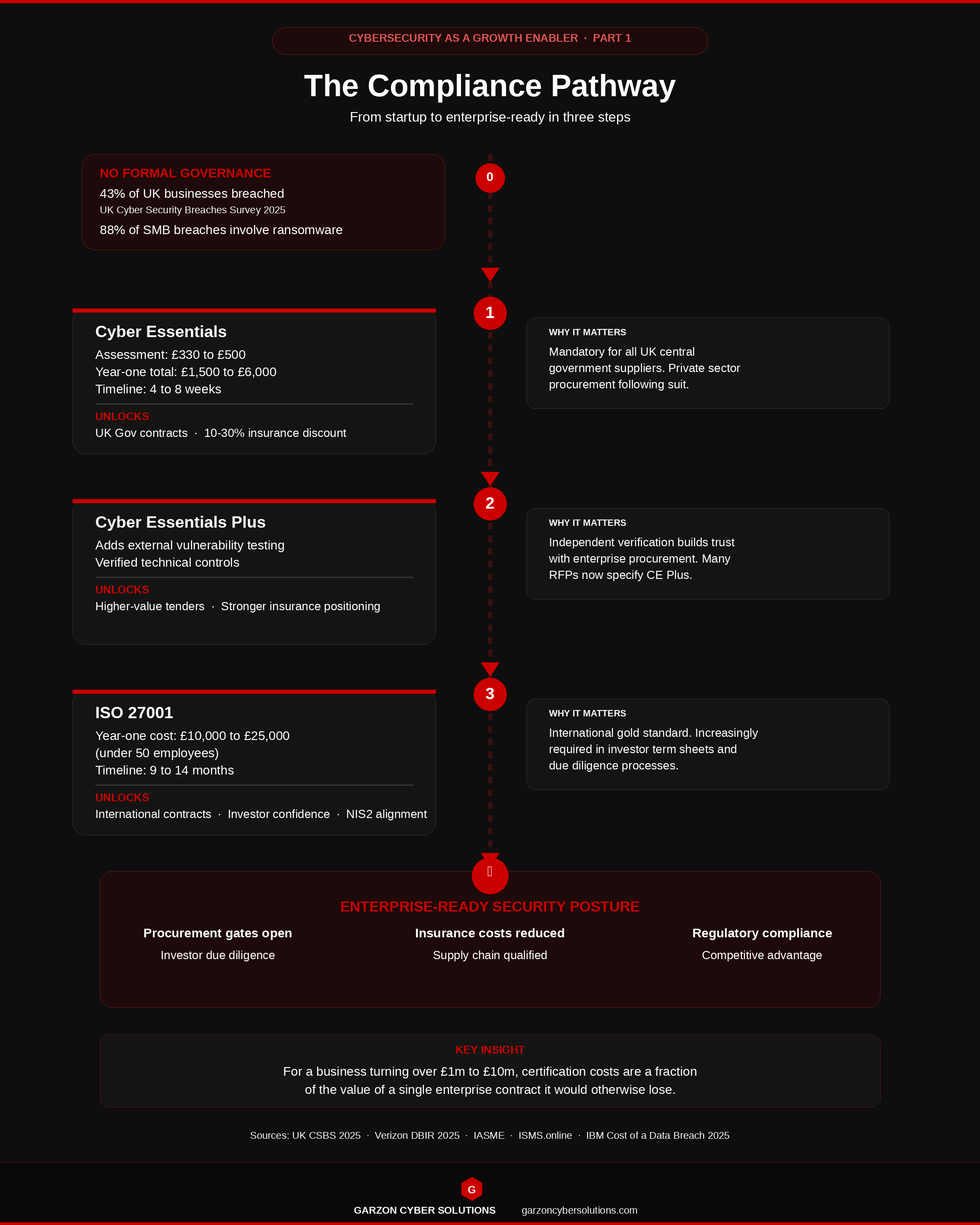
Cyber Essentials, the UK Government-backed scheme administered through IASME, costs between £330 and £500 for the assessment itself. Total year-one costs typically range from £1,500 to £6,000 once preparation and remediation are included. For a business turning over £1 million to £10 million, that’s a fraction of the value of a single enterprise contract it would otherwise lose.
ISO 27001, the international standard for information security management, represents a more substantial commitment. Certification typically takes nine to fourteen months and costs between £10,000 and £25,000 in year one for organisations under fifty employees. But the return is proportionate. ISO 27001 satisfies the due diligence requirements of most enterprise buyers, it’s recognised internationally, and it increasingly features in investor term sheets as a pre-condition for funding rounds.
The point isn’t that every startup needs ISO 27001 on day one. It’s that a clear, commercially justified pathway exists: Cyber Essentials first, then Cyber Essentials Plus, then ISO 27001 as the business scales and contract ambitions grow. Treating that pathway as a strategic investment rather than regulatory overhead changes the economics entirely.
The insurance equation has shifted too
The cyber insurance market tells a parallel story. UK premiums for SMEs now sit between £500 and £1,500 per year for basic cover, according to CyberSmart’s 2025 market analysis. But here’s the catch: most insurers in 2026 require multi-factor authentication, endpoint detection and response, regular tested backups, and Cyber Essentials certification as preconditions for underwriting a policy at all.
ISMS.online reports that businesses holding Cyber Essentials certification receive a 10% to 30% discount on premiums, with some policies bundling £25,000 of free cyber insurance with the certification. Meanwhile, 62% of UK small businesses now carry cyber insurance, up from 49% in 2024, suggesting the market is maturing rapidly.
The commercial logic has inverted. The businesses investing in basic security governance aren’t just protecting themselves against breaches. They’re reducing their insurance costs, satisfying procurement requirements, and qualifying for contracts that competitors without certification cannot access. Cybersecurity spend is no longer a sunk cost. It’s an investment with a measurable, near-term return.
The regulatory direction is unambiguous
For businesses operating in the UK and EU, the trajectory is clear and it points in one direction.
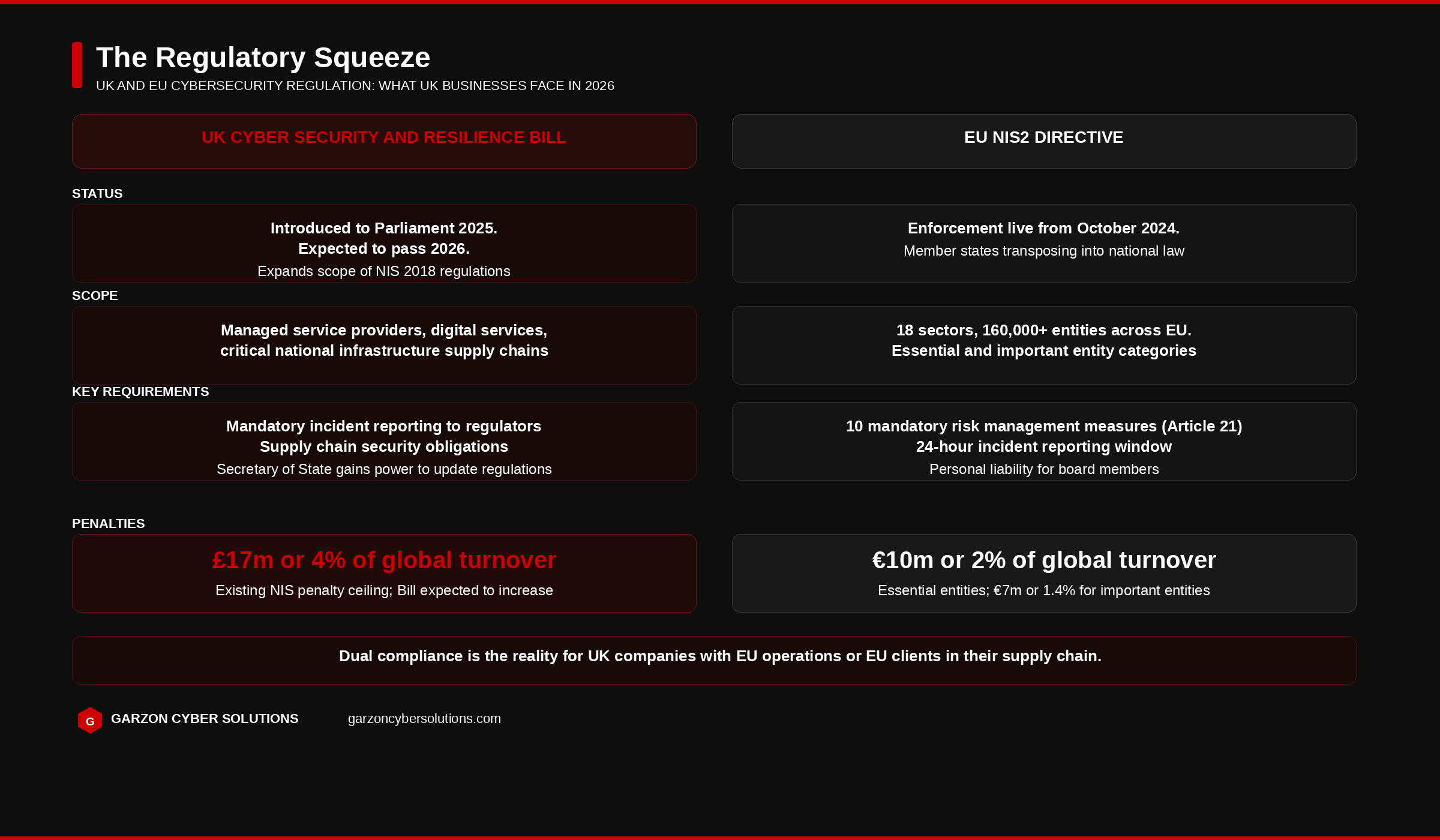
The UK Cyber Security and Resilience Bill is progressing through Parliament and expected to receive Royal Assent in 2026. It will expand the scope of regulated entities to include managed service providers, data centres, and a broader range of digital services. Mandatory incident reporting within 24 hours. Significantly increased enforcement powers and penalties. Small and micro businesses are not automatically exempt; those deemed vital to essential services or digital infrastructure will fall within scope.
Across the Channel, the EU’s NIS2 Directive has already taken effect, bringing approximately 160,000 organisations into scope. Requirements cover risk management, supply chain security, and incident reporting. Non-compliance carries fines of up to €10 million or 2% of global annual turnover for essential entities.
UK startups and SMEs with European clients face the practical reality of dual compliance. The UK’s regime will diverge from NIS2 in certain areas, meaning businesses need to navigate both frameworks. Those with a structured security posture already in place will find this manageable. Those starting from scratch will face a choice between rapid, costly remediation and market exclusion.
The UK Government’s 2025 Breaches Survey found that only 14% of businesses formally review the cybersecurity risks posed by their supply chains. Enterprise buyers and regulators are both moving to close that gap. The businesses that act now will hold a meaningful competitive advantage. Those that wait will find themselves on the wrong side of a compliance threshold that gets harder to clear with every passing quarter.
The reframe that changes everything
When cybersecurity is positioned as a cost, it competes with product development, sales hires, and marketing spend for budget. It gets deferred. It becomes the thing the business will address “once we’ve closed the next round” or “when we have more headcount.”
When cybersecurity is positioned as a growth enabler, the conversation shifts. Certification becomes the mechanism that opens procurement gates. A documented security posture becomes the differentiator in competitive tenders. Incident response planning becomes the evidence that gives investors confidence at the due diligence stage.
The startups and SMEs winning enterprise contracts in 2026 aren’t the ones with the most sophisticated security operations centres. They’re the ones that made a structured, proportionate investment in governance and basic controls early enough that security became part of how they operate, not something bolted on under pressure three days before a procurement deadline.
For founders and CEOs, the question is no longer whether to invest in cybersecurity. It’s whether the business can afford the contracts it’s already losing by not doing so.
The deals are there. The question is whether procurement lets you compete for them.
Is your business procurement-ready?
A focused conversation about where you sit on the compliance pathway, what enterprise buyers require, and the fastest route to get there.
Discuss More →Sources: UK CSBS 2025 · Verizon DBIR 2025 · IBM Cost of a Data Breach Report 2025 · Ponemon Institute · IASME · CyberSmart Market Analysis 2025 · ISMS.online · UK Cyber Security and Resilience Bill · EU NIS2 Directive
Garzon Cyber Solutions specialises in cybersecurity, compliance, and specialist technology recruitment for startups and SMEs scaling into enterprise markets.
Part 2 of this series will examine how CTOs can build security that scales with the business, not against it.