Your Bank Details Are Part Of The Deal.
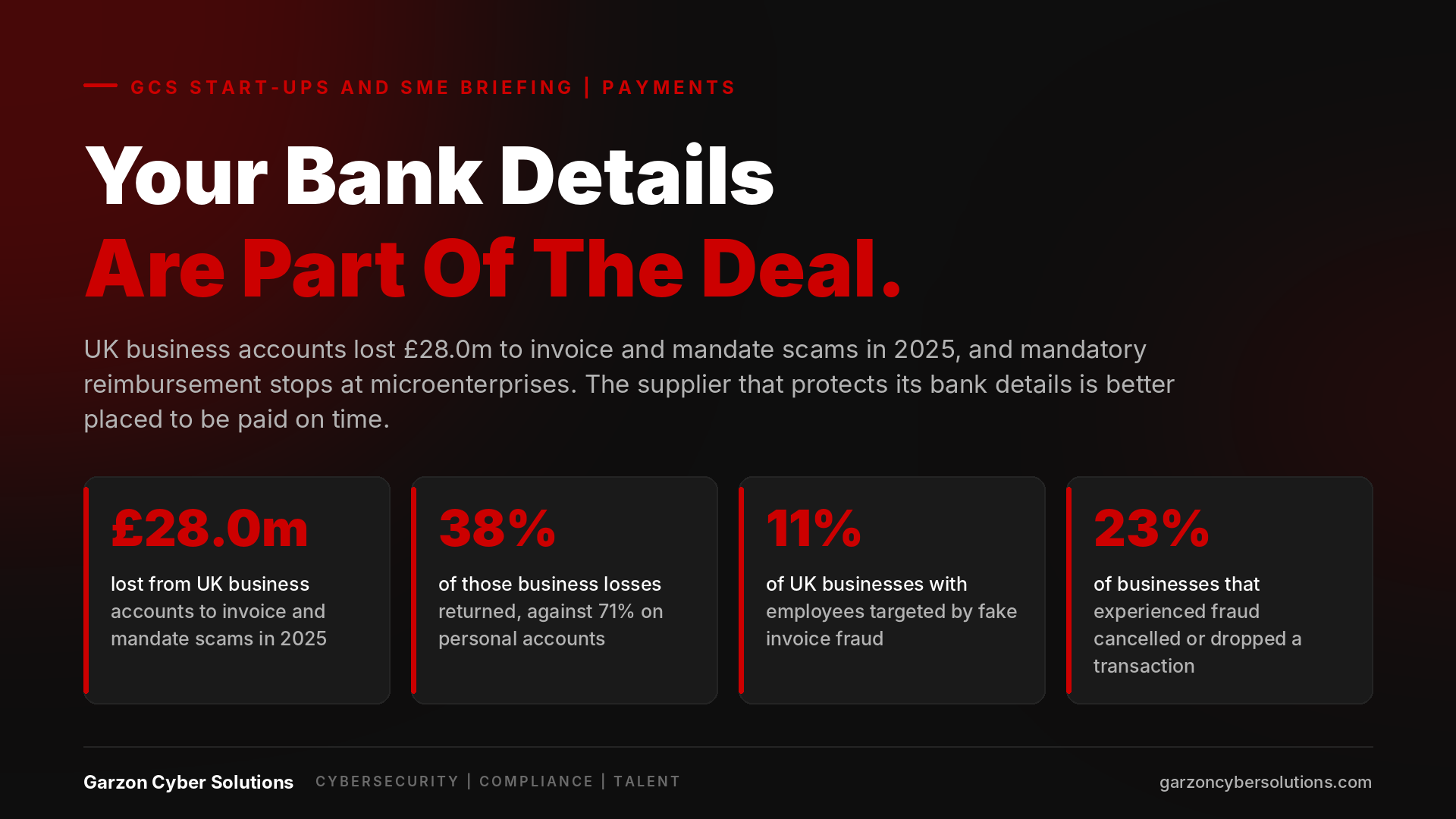
For a company of twenty to two hundred people, the most expensive email of the year may not be a breach notice. It may be a polite request, apparently from a supplier or from the company itself, to pay an invoice into a new bank account. UK Finance recorded £28.0m lost from business accounts to invoice and mandate scams in 2025, and only 38% of it was returned, against 71% on personal accounts. The mandatory reimbursement rules introduced in October 2024 protect individuals, microenterprises and small charities, which can leave a company of fifty people outside them, depending on its size when it opened its business account. Our view is that the bank details on an invoice have become part of the sale: the last control between revenue earned and revenue received. Large buyers such as the NHS already tell their finance teams to verify them before they pay. In our assessment, the supplier that can show how its own details are protected is better placed to be onboarded quickly and paid on time, and the one that cannot risks having its cash held while somebody checks.
invoice and mandate scams in 2025
against 71% on personal accounts
targeted by fake invoice fraud
cancelled or dropped a transaction
Situation
Payment diversion is not a new fraud, and on the industry's own figures it is not a growing one. UK Finance's Annual Fraud Report 2026, published on 15 June 2026, recorded 2,305 invoice and mandate scam cases in 2025 with losses of £41.3m, the lowest loss and case totals it has ever reported. That is welcome, and it should not be overstated in either direction. The same report shows where the remaining loss now sits. Business accounts carried £28.0m of it, 68% of the total, across 1,217 cases. Divided out, that is roughly £23,000 per business case, against roughly £12,000 on a personal account. UK Finance explains the concentration plainly: businesses make genuine high value payments more often, which makes a fraudulent one harder to spot.
UK Finance describes the mechanism in the same report. In an invoice or mandate scam the victim tries to pay a legitimate payee and the criminal intervenes to redirect the payment, including by posing as a supplier and claiming that its bank details have changed. It often involves intercepting emails or compromising an email account. This is a cyber event that ends as a finance event, which is why it tends to fall between the two functions that would each need to act.
The Home Office's Economic Crime Survey 2024, published in November 2025, gives the view from the business side. An estimated 27% of UK businesses with employees experienced fraud in the preceding twelve months, around 389,000 businesses. Fake invoice fraud was the most common type, experienced by 11% of businesses, followed by mandate fraud, where fraudsters get a business to change bank details unwittingly, at 7%. The survey counts attempts as well as completed frauds. Some 40% of victims said their most recent fraud was cyber facilitated, most commonly through phishing. Medium and large businesses reported a higher mean total cost of fraud over the year than smaller ones, £4,890 against £1,960.
The Home Office's Fraud Strategy 2026 to 2029, dated March 2026, records that the National Crime Agency reported payment diversion fraud among the fraud types causing the highest harm in the UK in 2025. The Cyber Security Breaches Survey 2025/2026, published by DSIT and the Home Office on 30 April 2026, found that 43% of businesses identified a breach or attack in the previous year, rising to 65% of medium businesses. Of those that did, 88% experienced phishing and 28% experienced someone impersonating the organisation or its staff in emails or online.
The protection most people assume exists stops short of this reader. The reimbursement requirement set by the Payment Systems Regulator, in force for payments made on or after 7 October 2024 and mirrored by the Bank of England for CHAPS, applies to individuals, microenterprises and charities with annual income under £1m, for Faster Payments and CHAPS transfers up to £85,000. Under the Payment Services Regulations 2017, which adopt the EU definition, a microenterprise employs fewer than ten people and has a turnover or balance sheet total of no more than €2m, tested at the time the contract for payment services is entered into. The PSR reports that 88% of the value of reimbursable Faster Payments claims was returned between October 2024 and March 2026. A company that already had ten or more staff when it opened its business account falls outside the requirement. Its bank may still return money, but on UK Finance's figures for invoice and mandate scams, 38% of business account losses were returned in 2025. UK Finance's business category also includes some microenterprises and small charities that are in scope, so 38% is not a rate for firms outside the scheme alone, but it is the best published guide.
Insight
The governing point is that payment diversion runs in two directions, and the second is the one founders rarely price.
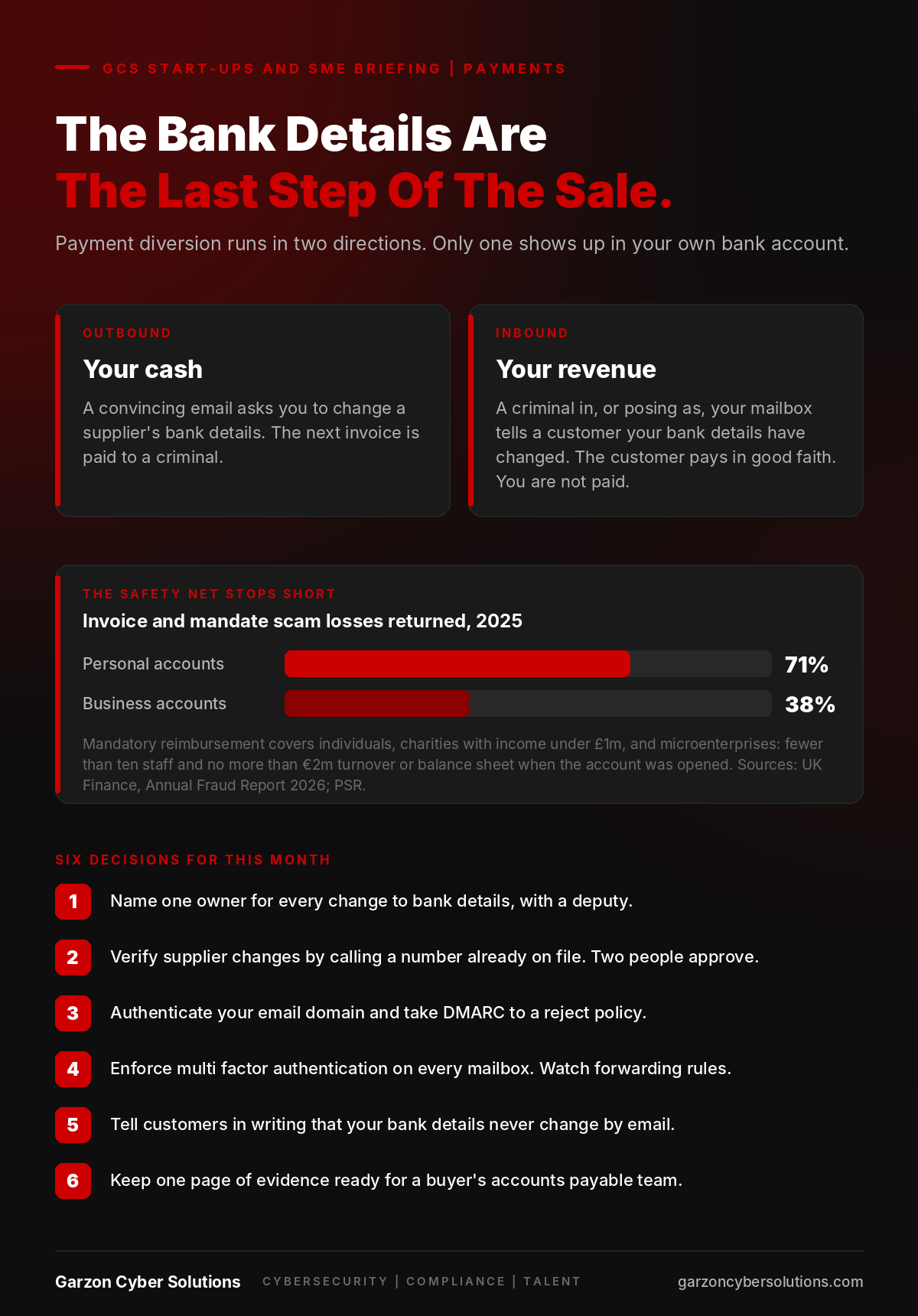
The first direction is familiar. The company receives a convincing request to change a supplier's bank details and pays the next invoice to a criminal. The loss is the company's own cash.
The second direction is the one that touches revenue. A criminal who compromises the company's mailbox, or sends mail that convincingly appears to come from its domain, can tell the company's customers that its bank details have changed. The customer pays, in good faith, and the company is not paid. Who bears that loss is a question for the contract and, where the contract is silent, a dispute. Either way the company has an unpaid receivable, a customer whose finance team now has an incident to explain internally, and a relationship that has been made harder to renew.
Some large buyers have already reached this conclusion and built for it. The NHS Counter Fraud Authority's Payment Diversion Fraud guidance, version 3.0 dated July 2026, tells NHS organisations to verify every request to change supplier details independently, using contact details already held on file and never those supplied in the request. Depending on risk, it suggests asking for a bank amendment form signed by the supplier's finance director or company secretary and asking the supplier to confirm the amount and date of its last three transactions. New details are also to be checked through Confirmation of Payee. The NCSC's phishing guidance looks the other way and suggests organisations consider telling their suppliers and customers what to look out for, offering the example that their bank details will not change at any point.
That is what a supplier can increasingly expect to be asked for, whether or not anyone has written it into a questionnaire. When the buyer's accounts payable team asks a supplier to confirm a change, the supplier with a named owner, a documented procedure and an email domain that cannot easily be spoofed is likely to answer quickly. The supplier without them risks a hold on its own payment.
The Economic Crime Survey adds the commercial consequence. Of businesses that experienced fraud, 23% cancelled or did not proceed with a business transaction or activity in response to their most recent one, and 31% changed internal processes. The Fraud Strategy, citing the same survey, records that 10% of businesses that experienced fraud reported a loss of sales or revenue and 2% lost a supplier. Our reading is that fraud changes how victims behave towards their counterparties, and a supplier whose name was used is among the counterparties most likely to feel it.
So we read payment diversion as a question of revenue protected and cash velocity rather than of fraud awareness. The bank details on an invoice are the last step of a sale. Protecting them is a modest cost against the exposure, and evidencing them should shorten the time between invoice and cash.
Options
A founder has four realistic positions.
Rely on the bank. Keep current processes, use Confirmation of Payee where the bank offers it, and accept the residual risk. It costs nothing this quarter. It also rests on reimbursement that, for most companies above microenterprise size, is not mandatory.
Train the finance team. Run awareness sessions on invoice fraud and require staff to be suspicious of change requests. It is necessary and inexpensive. On its own it leaves the email domain spoofable and the inbound direction unaddressed, because training a company's own staff does nothing for its customers.
Install a bank details control in both directions. Write a short change protocol for supplier details, with independent call back to numbers already on file and two people to approve; authenticate the company's email domain with DMARC, moving to a reject policy; enforce multi factor authentication on every mailbox; and tell customers in writing that the company's bank details will never change by email, and how a genuine change would be confirmed. The effort is measured in weeks, with the email authentication work spread over a few months.
Fold it into a certification programme. Treat the control as part of a wider Cyber Essentials or ISO 27001 effort, so the payment process is documented, tested and audited alongside access control and email security.
Trade-offs
Relying on the bank is free until the first loss, and the first loss on UK Finance's 2025 averages is roughly £23,000 on a business account, with no assurance of return. The option also does nothing for the customer who pays a criminal in the company's name.
Training is the cheapest visible action, and it is the one most likely to be mistaken for the whole answer. A well trained team may still fail to detect a perfectly spoofed email from a domain that has not published a DMARC policy, and cannot protect a customer's accounts payable clerk at all.
The two way control carries real friction. A call back can slow a genuine change, and a few customers will find a written statement about bank details unusual. DMARC also needs care: the NCSC recommends starting at a policy of none, monitoring, and moving through quarantine to reject. It reports that many organisations move on from none after about six to eight weeks, and from quarantine to reject after about three months. Rushing it can block legitimate mail from invoicing and marketing platforms that send on the company's behalf.
Folding the control into certification is the most durable and the slowest. In our assessment, a first ISO 27001 programme takes a growing company several months, and the payment risk does not wait for the audit. The trade-off is a sequencing question rather than a choice between the two.
Recommendation
We recommend the third option now, and starting the fourth within two quarters. In practice that is six decisions a chief executive can take this month.
1. Name one owner for bank details. One person, usually in finance, owns every change to supplier and company bank details, with a deputy. Changes outside that route are refused.
2. Adopt a written change protocol. Every request to change supplier details is verified by calling back on a number already held on file, never one in the request, and approved by two people before the next payment runs.
3. Authenticate the domain. Publish SPF, DKIM and DMARC records, monitor them, and set a date to reach a DMARC policy of reject, as the NCSC recommends.
4. Lock the mailboxes. Enforce multi factor authentication on every email account, review mailbox forwarding rules, and alert on new ones. UK Finance notes that this fraud often involves intercepting emails or compromising an email account.
5. Tell customers how you are paid. Put a line on every invoice and in every onboarding pack stating that the company's bank details will not change by email, and how a genuine change would be confirmed.
6. Keep the evidence. Record the protocol, the DMARC status and the MFA coverage in a single short document that can be sent to a buyer's accounts payable or supplier onboarding team on request.
Why
Three reasons favour this sequence.
First, the exposure is asymmetric. The control costs weeks of attention and modest technical work. The loss it is designed to prevent averaged about £23,000 per business case in 2025, of which business accounts saw 38% returned, plus a receivable that may become a dispute.
Second, it answers what buyers already do. The NHS Counter Fraud Authority's procedure is one published example of how a large buyer verifies a supplier's bank details. In our assessment, a supplier whose own process mirrors it is likely to be easier to onboard and quicker to pay, because the buyer's checks find what they expect. Large businesses are also more likely to review the cyber security risks their suppliers pose: the Cyber Security Breaches Survey found 48% of large businesses reviewing the risks posed by their immediate suppliers, against 15% of businesses overall.
Third, the same work serves other audiences. Cyber Essentials, in version 3.3, already requires multi factor authentication wherever it is available and always on cloud services, and email security and access control are recurring subjects in enterprise security questionnaires and cyber insurance proposal forms. The evidence built for payment protection is reused rather than rebuilt.
Risks
False confidence. A protocol on paper that the finance team bypasses under month end pressure is worse than none, because it reassures the board. Test it: send a simulated change request and see whether the call back happens.
Customer friction. A minority of customers will resist a call back or a signed form. The answer is to agree the protocol at onboarding, when it reads as professionalism rather than suspicion.
Email disruption. A DMARC reject policy set before every legitimate sending service is authenticated will stop genuine invoices from being delivered. Follow the staged approach and keep someone watching the reports.
Decay. The control depends on one or two people and on email settings that drift. When the owner leaves, the protocol often leaves with them, and the next finance hire inherits a document rather than a habit.
Voice and video impersonation. A call back defeats most email fraud, because the criminal does not normally control the number on file. The NHS Counter Fraud Authority notes that fraudsters increasingly make contact by video call, and a call back is weaker if the criminal can also convincingly imitate a known contact. The answer is to call the number on file, never the one that called, and to keep the second approver.
Next Move
The decisions above are deliberately small. Delivered in the right order, they become one capability rather than six separate projects.
First, the security foundations, delivered with specialist technology partners. Email authentication brought to a reject policy without disrupting legitimate mail, multi factor authentication across every mailbox, monitoring for forwarding rules and suspicious sign ins, and the account hygiene that makes a mailbox compromise less likely and faster to detect. This is the layer that protects both the company's own payments and its customers' payments to it.
Second, the compliance and certification layer, mapped to what insurers, buyers and assessors ask for. The bank details protocol written to the standard a large buyer's accounts payable team expects, the evidence document that answers supplier onboarding and security questionnaires, and the alignment of that evidence with Cyber Essentials, ISO 27001 or SOC 2 so that one body of work answers the insurer, the enterprise buyer and the assessor.
Third, the person who owns it, recruited on contingency. Controls that depend on one person decay when that person leaves. Where the company needs an IT and security lead, a finance systems owner or a governance hire to hold this capability, we run the search personally on contingency: nothing is payable until the candidate accepts and starts.
We are not a bank, a law firm or a fraud investigator, and a loss that has already happened needs the bank and Report Fraud, or Police Scotland, first. Our work is the security, the evidence and the people, delivered in that order, so that the last step of every sale is protected by a process with an owner.
Confidence note
Confirmed. From UK Finance's Annual Fraud Report 2026, published 15 June 2026: 2025 invoice and mandate scam losses of £41.3m across 2,305 cases, the lowest it has reported; £28.0m and 1,217 cases on non personal accounts, 68% of losses; £10.6m returned on those accounts and £9.4m of £13.3m on personal accounts; and the description of how the scam works. That the PSR reimbursement requirement applies from 7 October 2024 to individuals, microenterprises and charities with income under £1m, with an £85,000 maximum, and the PSR's reported 88% reimbursement rate to 31 March 2026. The microenterprise definition and its timing test in regulation 2 of the Payment Services Regulations 2017. The Cyber Essentials version 3.3 multi factor authentication requirement. The Economic Crime Survey 2024, Fraud Strategy 2026 to 2029 and Cyber Security Breaches Survey 2025/2026 figures as published. The NHS Counter Fraud Authority and NCSC guidance as described.
Assessed. The per case averages of roughly £23,000 and £12,000 and the 38% and 71% return rates are our arithmetic on UK Finance's tables, by value rather than by case. That large buyers beyond the NHS verify supplier bank details in the way the NHS guidance describes is our reading of published guidance, not a measured trend, and so is the view that a supplier with a documented protocol is onboarded and paid faster. That a company above microenterprise size receives less than consumers in practice rests on UK Finance's aggregate figures, not on any individual bank's policy. That email security and access control recur in security questionnaires and insurance proposal forms is our reading of publicly available forms, not a survey. Who bears the loss when a customer pays a criminal posing as its supplier depends on the contract and the facts; we offer no legal view.
Not known. How much payment diversion goes unreported: the Economic Crime Survey found that only 32% of businesses that experienced fraud reported their most recent one externally. How losses split by company size within UK Finance's business category. How often UK cyber insurance policies cover social engineering payment losses, and on what limits, since we have not found a published market figure.
If your largest customer received an email tomorrow asking it to pay you into a new account, what would stop it, and who would know?
We put the security foundations in place with specialist technology partners, map the evidence to what insurers, buyers and assessors are asking for, and recruit the person who owns it on contingency. Cybersecurity, compliance and talent, delivered in that order, as one capability.
Start the Conversation →Sources: UK Finance, Annual Fraud Report 2026, 15 June 2026 · UK Finance, Fraud Report 2026 press release, 15 June 2026 · Payment Systems Regulator, APP fraud reimbursement protections, accessed 25 November 2026 · Payment Systems Regulator, APP scams reimbursement dashboard, Q1 2026, 30 July 2026 · The Payment Services Regulations 2017, SI 2017/752, regulation 2 · Home Office, Economic Crime Survey 2024, November 2025 · Home Office, Fraud Strategy 2026 to 2029, CP 1523, March 2026 · DSIT and Home Office, Cyber Security Breaches Survey 2025/2026, 30 April 2026 · NHS Counter Fraud Authority, Payment Diversion Fraud guidance, Version 3.0, July 2026 · NCSC, Cyber Essentials: Requirements for IT infrastructure, version 3.3, April 2026 · NCSC, Email security and anti-spoofing guidance · NCSC, Phishing attacks: defending your organisation, version 2.0, reviewed 13 February 2024