New EU Products Will Carry A Five Year Promise.
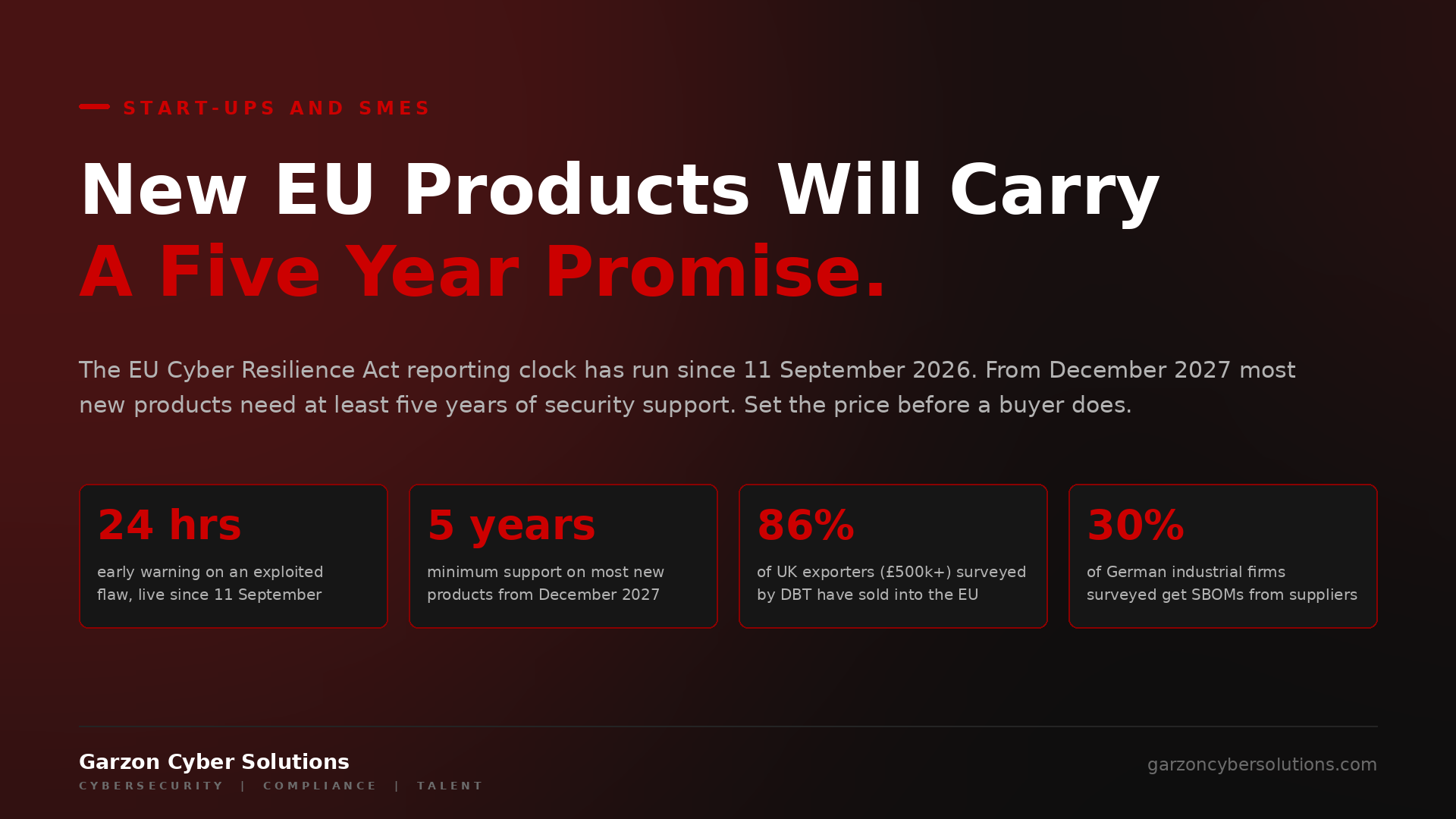
Since 11 September 2026, most companies that manufacture installable software or a connected product sold in the European Union has been working to a 24 hour clock. Under the Cyber Resilience Act, a manufacturer that becomes aware of an actively exploited vulnerability in its product must send an early warning to the EU's reporting platform within 24 hours, including for products already on the EU market. On 11 December 2027 the remaining obligations follow, among them a support period of at least five years on most new products, with the end date stated at the point of sale. Most founders will file this under compliance. We think it is a pricing and contract decision. From December 2027 the EU manufacturers and importers who buy from UK suppliers carry their own duties to check what they integrate or import. Many will ask the supplier, and the supplier with the answer ready is the one whose deals keep moving.
flaw, live since 11 September
new products from December 2027
surveyed by DBT have sold into the EU
get SBOMs from their suppliers
Situation
The Cyber Resilience Act, Regulation (EU) 2024/2847, entered into force on 10 December 2024 and applies in stages. It covers products with digital elements made available on the EU market, which Article 3(1) defines as a software or hardware product and its remote data processing solutions, including software or hardware components placed on the market separately. It applies whatever the manufacturer's country of establishment. A UK company making and selling an installable application, a device, firmware or an on-premise platform to EU customers sits inside it in the same way as a company in Munich.
Provisions on conformity assessment bodies applied from 11 June 2026, and the first obligations on manufacturers went live on 11 September 2026. Article 14 requires a manufacturer to notify any actively exploited vulnerability in its product through the Single Reporting Platform established by ENISA: an early warning within 24 hours of becoming aware of it, a fuller notification within 72 hours, and a final report no later than 14 days after a corrective or mitigating measure is available. Severe incidents affecting the security of the product follow the same 24 and 72 hour pattern, with a final report within one month, and impacted users must be informed. Article 69(3) applies these duties to every in-scope product placed on the market before 11 December 2027, so the installed base is covered, not only what ships next year.
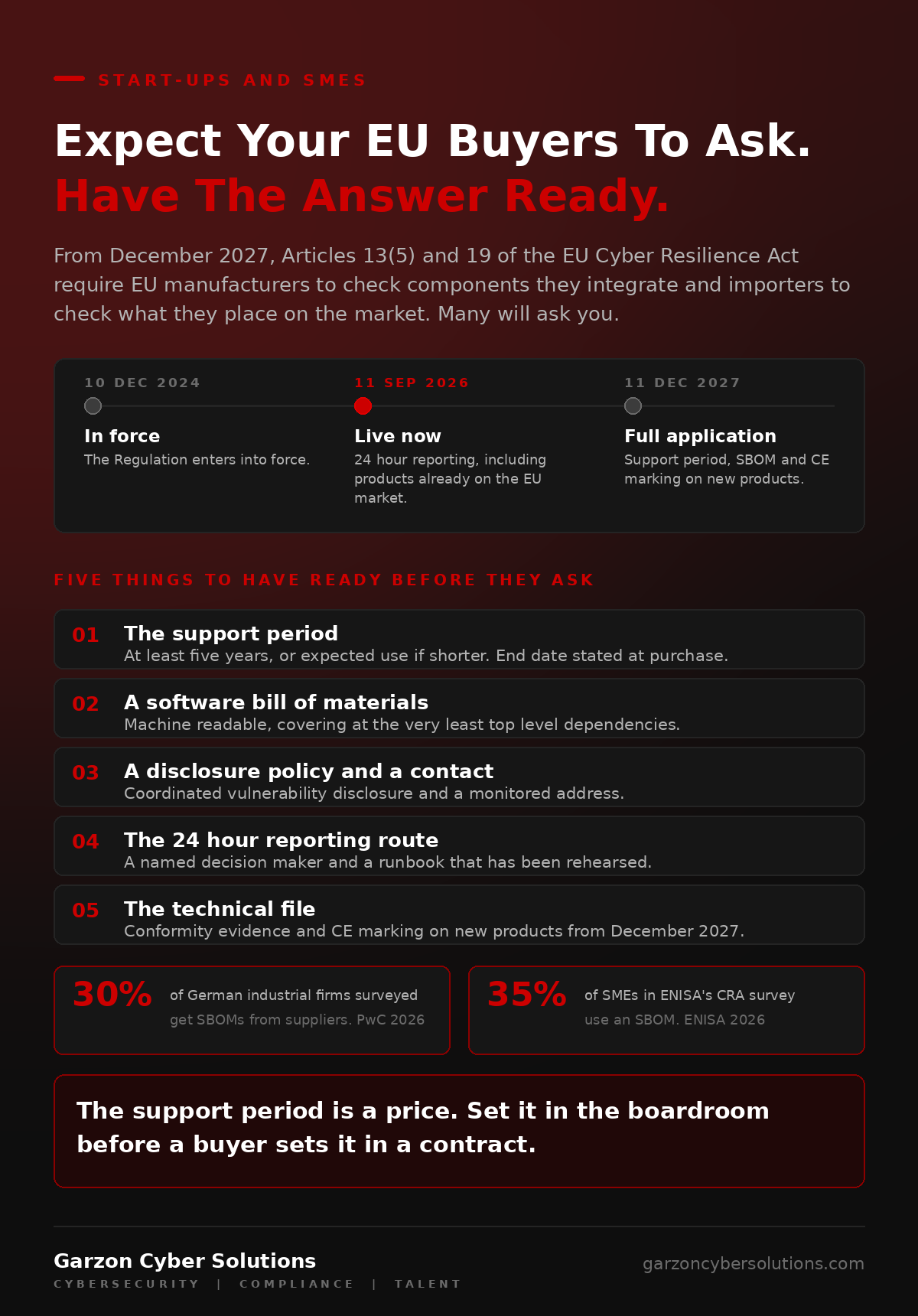
The second stage arrives on 11 December 2027, when new products placed on the EU market must meet the essential requirements in Annex I, pass conformity assessment and carry the CE marking. For a smaller supplier, the commercial weight sits in three places. Article 13(8) sets the support period at a minimum of five years, unless the product is expected to be in use for less time, and Article 13(19) requires its end date, at least to the month and year, to be specified at the time of purchase. Annex I Part II requires a machine readable software bill of materials covering at the very least the top level dependencies, a coordinated vulnerability disclosure policy and a contact address for reporting vulnerabilities. Security updates must be free of charge, unless a manufacturer and a business user agree otherwise for a tailor made product, and Article 13(9) keeps each update available for at least ten years or the rest of the support period, whichever is longer.
Article 64 sets the maximum fines Member States must provide for. Non-compliance with the essential requirements or with Articles 13 and 14 carries fines of up to €15m or 2.5% of total worldwide annual turnover, whichever is higher, and Article 64(5) requires authorities to take account of the size of the business. Article 64(10) appears intended to spare micro and small manufacturers fines for missing the 24 hour early warning, although it is drafted as a derogation from paragraphs 3 to 9 while the fines for Article 14 sit in paragraph 2. The reporting duty itself applies whatever the company's size. A small enterprise under the EU definition employs fewer than 50 people with turnover or balance sheet of no more than €10m, and group or investor links can take a company over those thresholds. A company of 60, 120 or 200 people is not small.
Scope needs care in three places. Recital 12, and the Commission's guidance as read by commentators such as Pinsent Masons in August 2026, place standalone software as a service generally outside the Act unless it is remote data processing that a product needs to function, although NIS2 may apply to cloud providers instead. Products under sector rules, such as medical devices and motor vehicles, are excluded. And the manufacturer's duties, including Article 14 reporting, stay with the manufacturer: an EU importer or distributor takes them on only if it places the product on the market under its own name or trademark or substantially modifies it, and otherwise carries its own narrower checks under Articles 19 and 20.
The supporting standards are still settling. IBF Solutions, which tracks CE marking standards, reported on 16 November 2026 that a Commission implementing decision of 10 November extended the deadlines for certain horizontal standards and for all product specific standards by a total of three months. The dates in the Regulation did not move.
Readiness is thin on both sides of the transaction. PwC's Product Security Survey 2026, published on 11 September, found that 3% of 100 German industrial companies considered themselves fully compliant, only around half had begun active implementation, 27% created software bills of materials for most or all of their portfolio and only 30% received them from their suppliers. ENISA's SME CRA Survey Report of 24 June 2026, drawn from 194 voluntary respondents, mostly EU SMEs, found 35% using a software bill of materials and 41% running a vulnerability management process, with documentation and conformity assessment the most cited challenges at 66% each. ENISA says its sample is not representative and PwC's covers 100 firms, so we treat both as indicative.
At home, the Software Security Code of Practice, published by DSIT on 7 May 2025 and developed with the NCSC, sets out 14 voluntary principles for software vendors. The Cyber Security Breaches Survey 2025/2026 found it recognised by 22% of UK businesses and 51% of large ones. Its principles overlap substantially with the CRA's requirements, so much of the same work serves both.
Insight
The Act will reach most UK suppliers through a purchase order before it reaches them through a regulator.
Two provisions do the work from December 2027. Article 13(5) requires an EU manufacturer to exercise due diligence when it integrates third party components, so that they do not compromise the cybersecurity of its product. Article 19 requires an importer of a non-EU manufacturer's product to ensure that the conformity assessment has been carried out, the technical documentation drawn up, the CE marking applied and the identification, contact and end of support information provided. Neither duty strictly requires asking the supplier, and the recitals mention other checks such as CE marking and update history. On our reading, asking will usually be the quickest route. If only 30% of German industrial firms surveyed receive bills of materials from suppliers today, the requests are coming, and we expect them in 2027 renewal and procurement cycles rather than in the final weeks before the deadline.
That changes what the obligation is. A five year support period is not a policy statement. It is a commitment to fund security updates for what has been sold, for at least five years in most cases, and because those updates must be free to users, the cost belongs in today's product price rather than a later update fee. A supplier that has not set it will have it set in the buyer's contract template, at the moment the buyer has the most negotiating power. A supplier that has set it, priced it and can show how it will be honoured controls the term.
The same logic applies to speed. An importer that receives a complete answer can approve the supplier and move on. One that receives a promise to follow up has a reason to hold the order or to qualify an alternative. If German industry is typical, and only 3% of the firms PwC surveyed rated themselves fully compliant, most buyers have not finished their own work, and the supplier who makes the buyer's conformity easier is the supplier the buyer keeps.
That is why we read the CRA as a question of revenue protected and revenue unlocked. The Department for Business and Trade's national exporting survey, published on 19 August 2026, found that 86% of the businesses it surveyed with turnover of £500,000 or more that had exported had sold into the EU. For a UK product company with an EU revenue line, the Act is now part of the terms on which that revenue renews.
Options
A founder has four realistic positions.
Wait for the standards. Some supporting standards are not final and the Commission guidance is non-binding. A company can meet the reporting duty at the legal minimum and revisit the rest in mid 2027. It costs least this financial year.
Narrow the EU exposure. Withdraw product lines from the EU, sell through a partner who places the product on the market under its own name and so becomes the manufacturer under Article 21, or move customers to a hosted service that falls outside the CRA, although it may fall within NIS2. It reduces the obligation by reducing the business it applies to.
Lead with the evidence buyers will ask for. Stand up the 24 hour reporting route now, build the small set of artefacts an importer or integrating manufacturer is likely to ask for, set and price the support period, and put the pack into the sales process. Full conformity work follows on the products that carry the most EU revenue.
Run a full conformity programme now. Commission a gap assessment against every Annex I requirement across the whole portfolio, build the technical file for each product and prepare for assessment well ahead of December 2027.
Trade-offs
Waiting costs more than it appears. The reporting duty is already live and covers the installed base. More important commercially, waiting hands the timetable to buyers: the first CRA clause arrives in a renewal, and the work gets done at the worst price, in a hurry, with a deal on hold.
Narrowing the exposure is a legitimate choice for a product with marginal EU sales. Applied broadly, it gives up the market most UK exporters have sold into, and the hosted route only works where the product is in fact a service rather than a remote function of something the customer installs.
The full programme produces the most complete position but front loads cost against standards that are still settling, and in a company of 20 to 200 people it competes with the product roadmap for the same engineers. For a business with one or two products and a large EU customer base it can be right. For most, it is more than buyers will ask for in 2027.
Leading with the evidence costs less than the full programme and more than waiting. Its weakness is sequencing: the technical file still has to be built before December 2027. Its strength is that its artefacts also serve buyers, insurers and UK customers applying the Code of Practice, so the spend pays back before the deadline arrives.
Recommendation
We recommend the third option, run as six decisions over the next two quarters.
- Decide what is in scope, by revenue. List every product sold into the EU, its revenue there, and whether it is software or hardware the customer runs, or a hosted service. Take legal advice on the borderline cases. This step prevents both overspending and false comfort.
- Stand up the 24 hour route. Name the person who decides that a vulnerability is actively exploited and their deputy, set the out of hours path, give the people who will report access to the reporting platform, and confirm which national CSIRT you report through. A UK manufacturer with no EU establishment follows the Article 14(7) order: authorised representative, then importer, then distributor, then the Member State with most users. Write the runbook and rehearse it once. Article 14 is the only manufacturer obligation that already applies.
- Publish a vulnerability disclosure policy and a security contact. Together they are a short document and a monitored address. Annex I requires both from December 2027, and a buyer's security team can check them quickly.
- Set and price the support period, product by product. Five years is the floor unless expected use is shorter, and updates must be free to users, so the cost belongs in the product price. The board should decide the term, the cost of honouring it and how it appears in price and contract before a buyer's template decides it.
- Produce bills of materials for the products that carry the most EU revenue. Machine readable, covering at the very least the top level dependencies, and regenerated on each release.
- Assemble one evidence pack and give it to sales. Map it to the CRA and to the UK Software Security Code of Practice, and reuse the same artefacts for ISO 27001 or SOC 2 where the company holds or is pursuing them. Answer the next EU questionnaire from it.
The technical file and conformity assessment then follow for in-scope products during 2027, sequenced by EU revenue.
Why
Three reasons, all commercial.
The first is control of terms. The support period and its end date will appear in contracts whether the supplier sets them or not. Set in advance, they are priced, consistent across customers and defensible. Set in negotiation, they are conceded one customer at a time.
The second is deal velocity. In our view, procurement stalls more often on a missing answer than on a missing control, usually because the person who could give it is busy shipping product. An evidence pack is built to shorten that answer from weeks to days.
The third is reuse. The disclosure policy, the bill of materials, the vulnerability handling process and the reporting runbook serve four audiences: the EU importer, the UK customer reading the Code of Practice, the cyber insurer and the certification assessor. A full conformity programme, started first, serves mainly one.
For companies above the small enterprise thresholds there is a fourth, narrower reason. They cannot rely on the Article 64(10) exemption at all, so for them the 24 hour route carries the most direct exposure.
Risks
Scope can be misjudged in both directions. Treating a product as a service when it depends on installed software, or treating a hosted platform as a product when it is not, wastes money or leaves exposure. This is where legal advice earns its fee.
The standards and guidance may move. Some supporting standards are not final, some of their drafting deadlines were extended this month, and the Commission guidance is non-binding. The dates in the Regulation, and the obligations that already apply, are not in question.
A support period is a liability. Five years of security updates on what has been sold has a cost, and an underpriced commitment is a margin problem that outlasts the contract that created it.
The reporting route will be tested on a bad day. An exploited vulnerability does not wait for business hours, and a runbook nobody has rehearsed will miss the 24 hour deadline. Rehearse it on a quiet week, before an incident does the rehearsing.
Evidence decays. A bill of materials from last spring describes a product that no longer exists. If the pack is not regenerated on release, it will mislead the buyer it was built to reassure.
Next Move
We run this as one sequence rather than three purchases.
First, the security foundations, delivered with specialist technology partners: vulnerability management, detection and response, and the product security tooling that makes a 24 hour decision possible and keeps a bill of materials current. Second, the compliance and certification layer, mapped to what insurers, buyers and assessors are asking for: the CRA evidence pack, the disclosure policy and the reporting runbook, aligned with ISO 27001, SOC 2 and the UK Software Security Code of Practice so that much of the same evidence is reused across them. Third, specialist recruitment for the person who owns product security afterwards, on contingency, with nothing payable until the candidate accepts and starts.
We are not a law firm, and scope decisions under the Act deserve legal advice. Our work is the security, the evidence and the people, delivered in that order so the obligation becomes a sales asset with an owner rather than a project that ends in December 2027.
Confidence note
Confirmed. From the text of Regulation (EU) 2024/2847: entry into force on 10 December 2024; the 11 June 2026, 11 September 2026 and 11 December 2027 application dates; the Article 14 deadlines and duty to inform users; Article 69(3); Articles 13(5), 13(8), 13(9), 13(19) and 19 as described; the Annex I Part II requirements cited; and the Article 64 fine ceilings and size factor. That the Commission published guidance on 27 July 2026, and the ENISA, PwC Germany, DSIT, Cyber Security Breaches Survey and Department for Business and Trade figures as published on the dates given.
Assessed. That EU manufacturers and importers will ask suppliers, and push CRA terms into contracts during 2027, is our reading of Articles 13(5) and 19 and the readiness figures, not an observed trend. That standalone software as a service is generally outside scope rests on Recital 12, the definition of remote data processing and the Commission's guidance as read by commentators; borderline products need advice. The three month extension to standards deadlines is as reported by IBF Solutions on 16 November 2026; we have not read the implementing decision. The PwC and ENISA samples are small or voluntary. The DBT 86% figure covers businesses with turnover of £500,000 or more that had exported, not the technology sector specifically. That CRA evidence also serves insurers, UK buyers and assessors is our judgement, not a formal mapping. Article 64(10) appears intended to spare micro and small manufacturers fines for missing the 24 hour early warning, but as drafted it derogates from paragraphs 3 to 9 while Article 14 fines sit in paragraph 2; we have not seen that tested.
Not known. How actively national market surveillance authorities will enforce the reporting duty in its first year, and whether any will publish early cases. When the first CRA harmonised standards will be cited in the Official Journal, and when the rest will follow. How many UK companies sell in-scope products into the EU. What a five year support commitment costs for a typical UK product company, since that depends on release cadence and the dependency estate.
If your largest EU customer asked this week how long you will support what they bought, who would answer, and what would that answer cost you?
We put the security foundations in place with specialist technology partners, map the evidence to what insurers, buyers and assessors are asking for, and recruit the person who owns it on contingency. Cybersecurity, compliance and talent, delivered in that order, as one capability.
Start the Conversation →Sources: European Parliament and Council, Regulation (EU) 2024/2847, the Cyber Resilience Act, Official Journal, 20 November 2024 · European Commission, Cyber Resilience Act reporting obligations, Shaping Europe's Digital Future, accessed 18 November 2026 · European Commission, Commission publishes new guidance to support timely Cyber Resilience Act implementation, 27 July 2026 · ENISA, SME CRA Survey Report, 24 June 2026 · PwC Germany, Product Security Survey 2026, press release, 11 September 2026 · IBF Solutions, Current status of standardisation for the Cyber Resilience Act, 16 November 2026 · Pinsent Masons, Out-Law Analysis, Cyber Resilience Act: major shift in EU cybersecurity compliance, 25 August 2026 · Department for Science, Innovation and Technology, Software Security Code of Practice, GOV.UK, 7 May 2025 · Department for Science, Innovation and Technology and Home Office, Cyber Security Breaches Survey 2025/2026, GOV.UK, 30 April 2026 · European Parliament and Council, Directive (EU) 2022/2555, NIS2, Official Journal, 27 December 2022 · Department for Business and Trade, National survey of registered businesses' exporting behaviours, attitudes and needs 2025, GOV.UK, 19 August 2026 · European Commission, Recommendation 2003/361/EC concerning the definition of micro, small and medium-sized enterprises, 6 May 2003