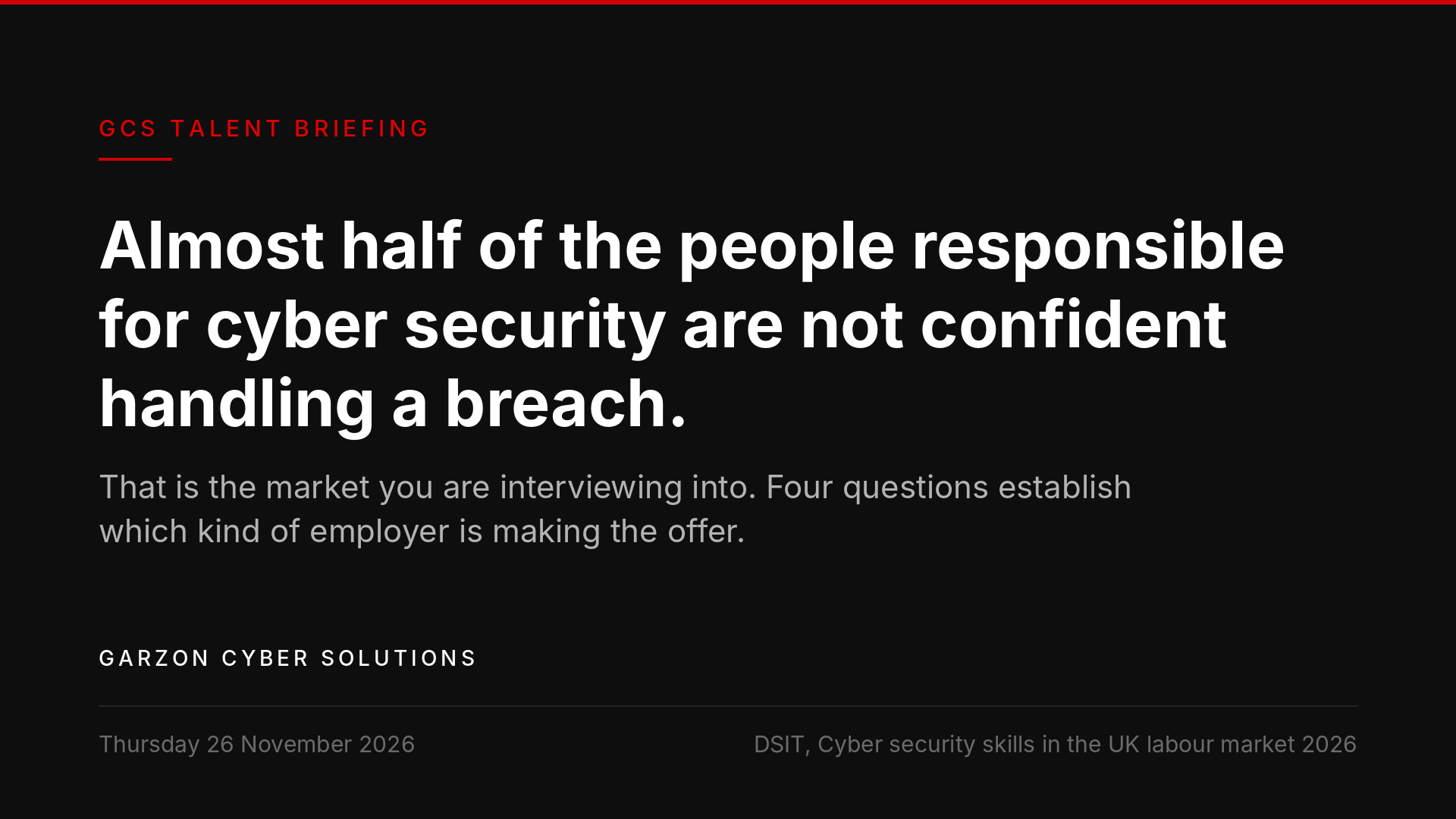
Almost Half of the People Responsible for Cyber Security Are Not Confident Handling a Breach. That Is the Market You Are Interviewing Into.
Candidates are trained to prepare for scrutiny. The more valuable discipline is applying it in the other direction. Two government studies published this year set out, in numbers, how many UK businesses have asked someone to own cyber security without building the structures that make the job possible. For a practitioner weighing an offer, establishing which kind of employer is making it is the most useful hour of preparation available.
The finding
The Department for Science, Innovation and Technology published Cyber security skills in the UK labour market 2026 on 29 September 2026. Its summary records that "Almost half of individuals responsible for cyber security in UK businesses and charities (47% each), lacked the confidence to deal with cyber security breaches or attacks, and had not outsourced this function." Fieldwork ran from 8 August to 27 October 2025.
The same report finds 57% of businesses, around 808,000 of them, carrying what it classifies as a basic technical skills gap, up from 49% the year before. Basic refers to the technical ground covered by the government-endorsed Cyber Essentials scheme together with adjacent fundamentals, not advanced specialist work. The widest single gap is detecting and removing malware. Some 35% of businesses outsource at least one aspect of cyber security, a figure the report describes as consistent with previous years.
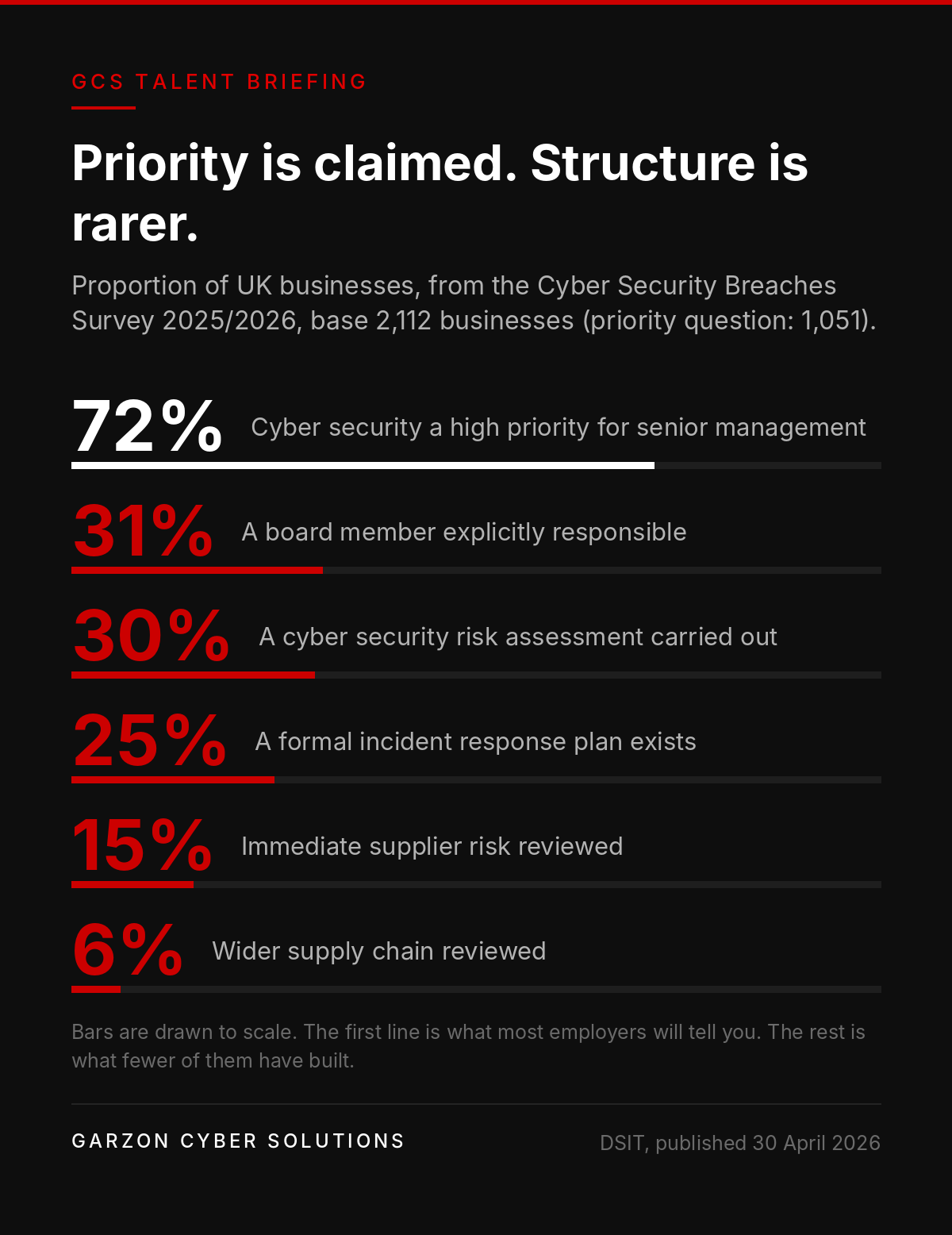
Set that against the governance picture in the Cyber Security Breaches Survey 2025/2026, published by DSIT on 30 April 2026, with a full business sample of 2,112. Cyber security is a high priority for senior management in 72% of businesses, a question asked of a split sample of 1,051. A board member with explicit responsibility for it exists in 31%. A formal incident response plan exists in 25%, rising to 57% of medium businesses and 76% of large ones. Some 30% had carried out a cyber security risk assessment, 36% held a formal cyber security policy, and 33% had a business continuity plan covering cyber. Staff training or awareness activity in the previous twelve months reached 19% of businesses, against 84% of large ones. Reviews of immediate supplier risk reached 15%, and of the wider supply chain 6%. Around 18% of businesses did not know whether they adhered to Cyber Essentials, Cyber Essentials Plus or ISO 27001.
What it means for a practitioner
Read as policy, this is a national capability problem. Read as a career document, it says something more immediate: priority is the most widely held position in the market and the least informative one. Roughly seven in ten businesses will tell you, accurately, that senior management treats security as a high priority. Fewer than a third have put a named board member behind that statement, and a quarter have a formal plan for what happens during an incident.
That distance is where careers stall. A practitioner who joins an organisation in the first group but not the second is not being hired to run a security function. They are being hired to be the function, and to be the reason an answer exists when a customer, an insurer or a regulator asks for one. The work is real and often interesting. What it frequently lacks is the thing that compounds into a career: a decision the practitioner owned, with a budget behind it and a record of the outcome.
This matters commercially, not just professionally. Our assessment, formed from how these roles are written and priced rather than from any survey of career outcomes, is that market value in security is built from evidence of consequential decisions. It is why architects, incident leads and people who have carried a certification through to audit tend to command more than their years alone would suggest. Activity does not produce that evidence. A year spent closing tickets inside an organisation with no plan, no risk assessment and no supplier remit produces a competent practitioner with nothing to show an interviewer except tenure. A year spent inside an organisation that has built the structures produces a practitioner with a defensible record, even at the same salary.
The 47% figure makes the point sharper, because it describes the person a candidate is likely to report to or replace. Where the individual responsible for security lacks confidence handling a breach and the function has not been outsourced, there is no internal apprenticeship. Nobody is going to teach the incoming practitioner how the organisation responds under pressure, because the organisation does not know. That is an argument for asking, before accepting, where the knowledge in the building actually sits.
Where the structures concentrate
The averages conceal a split that matters when choosing between employers of different sizes. Incident response plans sit at 25% of businesses overall but 57% of medium businesses and 76% of large ones. Formal policies run at 36% overall, 75% in medium businesses and 89% in large. Risk assessments reach 30% overall and 72% of large businesses. Training in the last twelve months reaches 19% overall and 84% of large businesses.
The practical reading is not that large organisations are better employers. It is that in a large organisation the structures usually exist and the candidate's question is whether the role carries any authority inside them. In a smaller organisation the structures often do not exist, and the candidate's question is whether building them is in the remit or merely expected. Both are workable. They are different jobs, they develop different evidence, and they should not be priced the same way. A practitioner who wants a record of design and build decisions is better served by the second, provided the mandate is written down. One who wants depth in a specialism, with peers to learn from, is better served by the first.
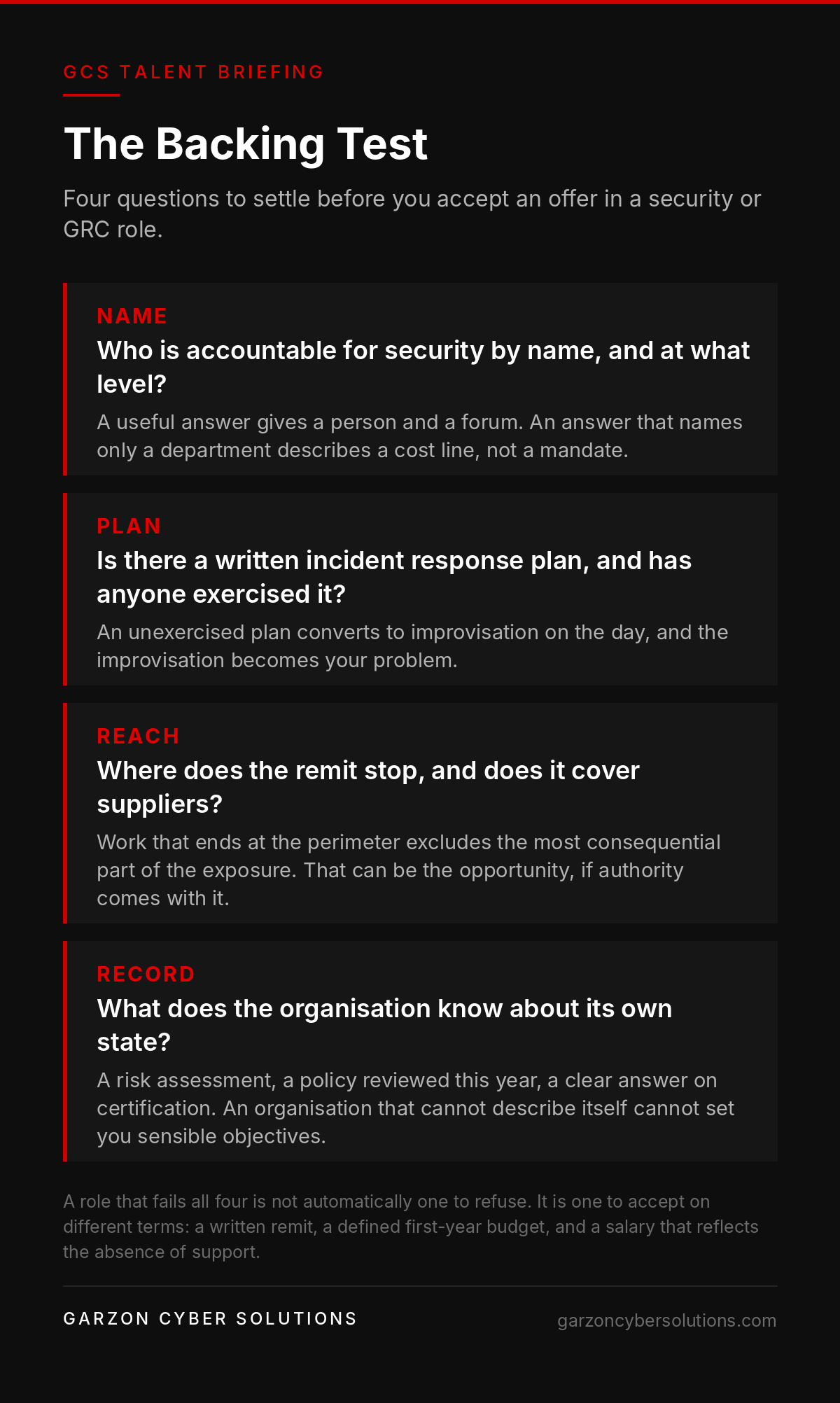
The Backing Test
Four questions settle most of this, and each maps to something an employer can answer in an interview or cannot.
Name. Who is accountable for security by name, and at what level? The useful answer identifies a person and a forum: a named board member, an executive committee that receives security on a fixed cycle. An answer that names only a department describes a cost line, not a mandate. Fewer than a third of UK businesses can give the first answer, so the question is a genuine filter rather than a formality.
Plan. Is there a written incident response plan, when was it last exercised, and who leads it? The existence of a document is the low bar. The test is whether anybody has rehearsed against it, because an unexercised plan converts to improvisation on the day and the improvisation becomes the new practitioner's problem. At 25% of businesses overall, a candidate should expect a no from most employers and should price the answer accordingly.
Reach. Where does the remit stop? Security work that ends at the perimeter while the commercial risk sits in suppliers and third parties is a role defined to exclude the most consequential part of the exposure. With 15% of businesses reviewing immediate supplier risk and 6% looking further down the chain, a candidate who asks this question is usually asking about ground nobody has yet claimed. That can be the opportunity in the role, provided it comes with authority.
Record. What does the organisation know about its own state? A risk assessment, a policy reviewed in the last twelve months, a clear answer on certification status. These are not impressive achievements. They are evidence that the organisation can describe itself accurately, and an organisation that cannot describe itself cannot set a practitioner sensible objectives. Roughly 18% of businesses do not know whether they adhere to Cyber Essentials, Cyber Essentials Plus or ISO 27001.
A role that fails all four is not necessarily one to refuse. It is one to accept on different terms: a shorter horizon, a title and salary that reflect the absence of support, an explicit written remit, and a defined budget for the first twelve months. The mistake is accepting an unbacked role on backed-role terms.
The career economics
The cost of a wrong move has risen, because moving again is harder than it was. The 2026 Barclay Simpson cyber security salary survey reports candidate confidence in the job market falling: 21% described themselves as very confident, against 34% the year before, while those not at all confident rose from 19% to 27%. Asked about the challenges of securing a new role, 62% of candidates cited advertised salaries or day rates being too low, and 44% too few jobs being advertised.
The same guide names career development as the single most selected reason for moving, chosen by 31% of respondents, and separately describes remuneration as the leading factor, with 70% placing it in their top three. The two measures ask different questions, one for a single main reason and one for a ranking, so both are worth carrying rather than choosing between them. What they share is a conclusion: candidates are moving for progression in a market where the next move is slower to arrive. Progression is precisely what an organisation with no plan, no named owner and no supplier remit is least equipped to provide, whatever it pays.
Employers are still hiring. Some 83% said they were likely to recruit during 2026, and 88% described finding skilled talent as challenging. Demand is not the constraint. The constraint is that a candidate accepting the first well-paid offer in a weak market may be buying twelve months of activity rather than twelve months of evidence.
Three questions to ask yourself
- If this role ended in eighteen months, what decision would I be able to name as mine, with a measurable outcome behind it?
- In this organisation, who would I learn the response from, and has that person done it before?
- Am I being paid for the absence of support, or am I being paid as though the support exists?
The strategic takeaway
Diligence runs in both directions, and in a market where candidate confidence has fallen sharply, the candidate who screens back is the one making a commercial decision rather than accepting a salary. The data says most UK organisations treat security as a priority and a minority have built the structures that let a practitioner succeed inside it. Establishing which you are joining takes four questions. Discovering it afterwards takes a year.
Confidence note
Confirmed. All figures attributed to DSIT come from Cyber security skills in the UK labour market 2026, published 29 September 2026 (fieldwork 8 August to 27 October 2025), and the Cyber Security Breaches Survey 2025/2026, published 30 April 2026 (fieldwork August to December 2025, full business sample 2,112). Bases differ by question within the Breaches Survey: the senior management priority figure of 72% comes from a split sample of 1,051 businesses, while the governance measures quoted here run on the full 2,112. Every figure quoted for businesses is the business figure, not the charity one, and the two surveys report charities separately throughout. The Barclay Simpson figures come from the web edition of its 2026 cyber security salary survey and recruitment trends guide. Respondents could select more than one challenge, so the 62% and 44% figures are not exclusive.
Assessed. The link between an organisation's governance structures and a practitioner's career progression is our assessment, as is the claim that evidence of consequential decisions is what prices a security career. Both are drawn from how these roles are written and advertised. The surveys measure organisational capability; they do not measure career outcomes for individuals, and no source cited here claims that link.
Not known. The published summary does not give the base for the 47% confidence finding. The Barclay Simpson guide does not state its sample size or fieldwork dates, and its companion PDF summary reports different percentages for the candidate challenges question than the web edition quoted here. We found no breakdown in either DSIT survey of governance findings by whether the organisation was hiring, so the distribution of these conditions across live vacancies is unknown. The 35% outsourcing figure comes from the skills study and is not comparable with the separate external-provider measure in the Breaches Survey, which asks a different question.
Register your interest
Garzon Cyber Solutions runs cybersecurity and technology recruitment across the UK, EU and Americas on a contingency basis. We are a young firm and the founder runs the search work personally, which means a candidate conversation here is with the person who will represent them, not with a coordinator.
No CV goes to a hiring company without explicit permission for that specific role. If you would like to be considered for cybersecurity, GRC, cloud and technology roles as they come to us, register your interest through the Garzon Cyber Solutions Website.
Weighing an offer in a security or GRC role?
Register your interest and you will speak with our founder, who runs the search work personally. Recruitment is contingency only, and no CV goes to a hiring company without your explicit permission for that specific role.
Register Your Interest →Department for Science, Innovation and Technology, Cyber security skills in the UK labour market 2026, 29 September 2026. Department for Science, Innovation and Technology and the Home Office, Cyber Security Breaches Survey 2025/2026, 30 April 2026. Barclay Simpson, 2026 Salary Survey and Recruitment Trends Guide: Cyber Security.
Garzon Cyber Solutions delivers cybersecurity advisory, compliance certification and specialist technology recruitment as one integrated capability for organisations in the UK, EU and beyond.