The UK Cyber Skills Gap Figure Has Been Withdrawn. What Replaced It Is Harder to Hire Against.

For years, UK cyber security hiring plans leaned on a single published number: the national workforce gap. This year the government's own research dropped it, and one of its stated reasons was that demand for roles has fallen. That sounds like good news for anyone hiring. It is, at one end of the market. At the other it is the mechanism quietly dismantling the entry level that produces experienced practitioners, and the bill for that arrives several years from now.
The data
Cyber security skills in the UK labour market 2026, commissioned by DSIT from Ipsos and Perspective Economics, was published on 29 September 2026. The change with the longest reach sits in Chapter 2, and it has had very little attention.
"Previous versions of this study have provided an estimate of the workforce gap in the UK." The report then withdraws it: the estimate "has been removed as the estimate inevitably makes various assumptions, which are necessitated by the limitations of the available data, and due to reduced demand for roles." The report notes that ISC2's workforce study has dropped its own gap estimate for similar reasons.
A government-commissioned research team has withdrawn a number the market has been planning against, and has given two reasons for it: the assumptions were too heavy for the available data, and demand has fallen. The second reason deserves as much attention as the first.
What remains are four estimates, and they are the inputs every hiring plan now rests on.
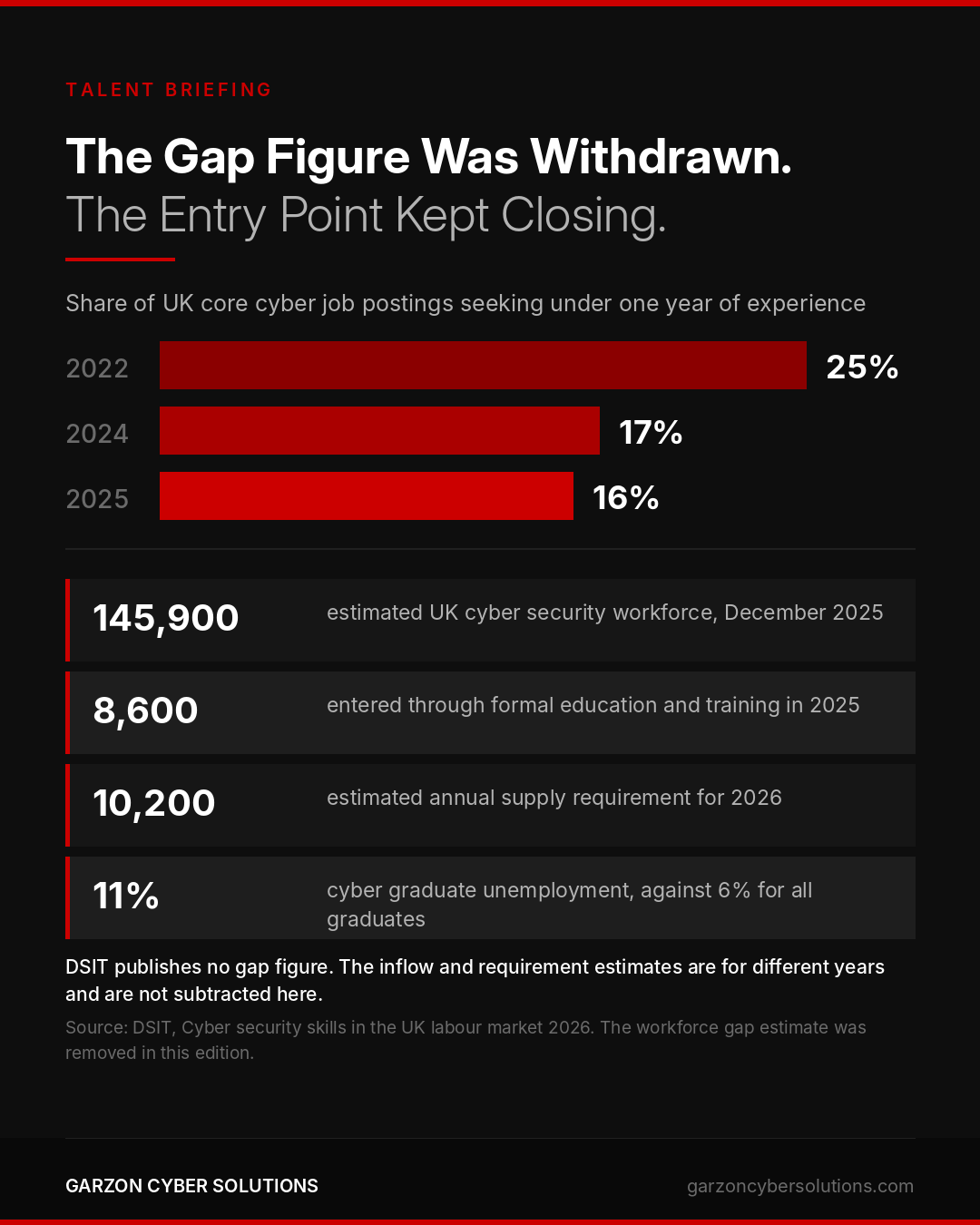
The workforce stands at "an estimated 145,900 individuals in the cyber security workforce" as of December 2025, up 2%. The report calls this "an experimental estimate" and a broad pool covering both people in cyber roles and the wider recruitment pool, a wider definition than the 69,589 employed by businesses selling cyber products and services.
Formal supply, in the report's words: "In 2025, we estimate that approximately 8,600 individuals entered the cyber security workforce through formal education and training pathways."
Attrition: "We estimate, based on survey data, that approximately 4% of the workforce may leave in each given year", which gives "approximately 5,800 individuals will leave" in 2026.
Demand: a 3% growth rate, borrowed from the cyber sector's own headcount growth, "suggests a need for approximately 4,400 new people in 2026". Together, "this suggests a total supply requirement of approximately 10,200 per year for the cyber security workforce in 2026".
Two cautions belong here, not in a footnote. The first is that those figures span different years. Inflow of 8,600 is 2025; the requirement of 10,200 is 2026. Subtracting one from the other produces a tidy shortfall, and that subtraction is precisely what DSIT declined to publish. We will not publish it either.
The second concerns a figure that is easy to misread. The 4% models exit from the cyber workforce altogether, through retirement or a change of career, and expressly "does not capture frictional unemployment such as redundancies". Separately, 14% of employees in the cyber security sector left their role in the period surveyed, 9% of them voluntarily. Those measure different things: someone moving between cyber employers appears in the second and not the first, so role churn running ahead of workforce exit is ordinary. Turnover has moved from 11% across 2022 to 2024, to 12% in 2025, to 14% in 2026, figures the report calls lower bounds and says are "not statistically significant".
The entry point is closing
The supply side is where the figures stop being ambiguous.
Entry-level demand has fallen in each successive study: roles seeking under a year of experience were 25% of core cyber postings in 2022, 17% in 2024 and 16% in 2025. Apprenticeships moved the same way. England recorded 500 cyber apprenticeship starts in 2024/25, down 15% from 590, with achievements down to 290, and the report's estimate of UK apprenticeship entrants fell from 600 to 500. The report also cut its estimate of annual entrants through professional certification and technical accreditation from 2,500 to 1,500, "as a conservative figure due to less data being available". The separate estimate for retraining and upskilling programmes, at about 1,200 a year, is unchanged.
The universities, meanwhile, are producing more people than before and fewer of them arrive. Cyber enrolments rose 9% to 24,770 and graduates about 14% to 7,950 in 2023/24. For the preceding cohort, 11% of cyber graduates were unemployed against 6% across all graduates, and only 30% of those in work had entered a cyber security occupation.
Employers described the consequence themselves. Participants said that as routine monitoring and reporting were automated, "entry-level opportunities were being reduced", hardest on Security Operations Centre analyst roles that "have historically served as key training opportunities". One large employer outside the cyber sector put it directly: "if you don't have enough entry-level roles, where do you get seniors from later?" Another described a SOC "being replaced with AI for diagnostics and triages", leaving "no low entry point to gain that skill". The report's summary of the mood is that "employers felt the pathway to becoming an experienced cyber security professional was narrowing".
At the same time the entry-level market "was described as saturated in the past 12 months", with employers "overwhelmed with applications from junior candidates who lacked the right skills". Both are true at once. There is no shortage of people wanting in, and a shortage of places where they can become useful.
These are qualitative findings from 51 interviews on a sample the report says "was not representative", so read them as texture, not measurement.
Why this matters commercially
The withdrawn figure changes what a hiring plan can honestly claim. A plan that justified paying above band on national scarcity no longer has a published number behind it.
What the evidence supports is narrower and more useful. A slack market is not uniformly slack. The flood is at the entry level, where the report describes saturation and employers overwhelmed by junior applicants. The grades that take five to ten years to produce are not being replenished, and no quantity of junior applications substitutes for one of them. For anyone hiring at that level, the flood is not help. It is noise in the channel, and it lengthens the search rather than shortening it.
Regulatory. The Cyber Security and Resilience Bill has not become law. It completed Lords third reading on 2 November 2026, and as at the morning of 24 November 2026 the Parliament record listed Commons consideration of Lords amendments for that day, with Royal Assent neither granted nor scheduled. The direction is consistent with obligations already binding firms with EU operations: NIS2 Article 20(2) requires Member States to ensure members of management bodies of essential and important entities follow training, and DORA Article 5(4) requires members of a financial entity's management body to keep their own knowledge current enough to assess ICT risk. Neither reaches a purely domestic UK organisation and neither addresses vacancies. The pattern is what matters: duties attaching to identified people with current competence, which is a stock of people, not a budget line.
Operational. Role churn in the cyber sector runs at 14%, of which 9% is voluntary. Those are sector employers rather than in-house security functions, so reading the figure across to your own team is an assumption and should be named as one. If it holds, a twenty person function replaces roughly two people a year, and replaces them from a market whose junior cohort is thinning.
Transactional. Where diligence looks past tooling to ownership, a function staffed entirely by people hired finished, with no internal route, reads as a dependency on a market the seller does not control. We would expect that question to be asked more often as the supply position becomes better understood.
Commercial. Some 57% of UK businesses now report a basic technical skills gap, up from 49%. Among cyber sector businesses, 38% say gaps among job applicants have affected their business goals, against 24% saying the same of existing staff. The direction matters more than the levels: DSIT reports the applicant complaint unchanged since it was first measured in 2020, while the complaint about existing employees has trended upwards, from 18% in 2021 to 24% in 2026. The problem that is growing is inside the building.
Building is a hiring decision
The obvious response to a closing entry level is to build your own. The report records employers reaching that conclusion and then stopping.
A large cyber security business told the researchers it would love to bring in apprenticeship schemes and placements. It then explained what prevented it: there was no senior employee it could attach them to.
That is the part most build-versus-buy discussions miss. An internal pipeline is not an alternative to hiring. It is a structure that has to hang off somebody, and that somebody is a senior practitioner with the standing and the time to mentor. Deciding to build does not remove a hiring requirement. It concentrates it into one harder hire, in exactly the grade the market is not replenishing.
Employers named the other barriers too: the cost in time and money, and juniors leaving for higher salaries once trained, which they said made the investment hard to justify. Both are real, and neither is solved by announcing a build and under-resourcing it.
So the honest framing is not build or buy. It is which single hire makes building possible, and whether you make it while hiring is still easy.
The Conversion Ledger
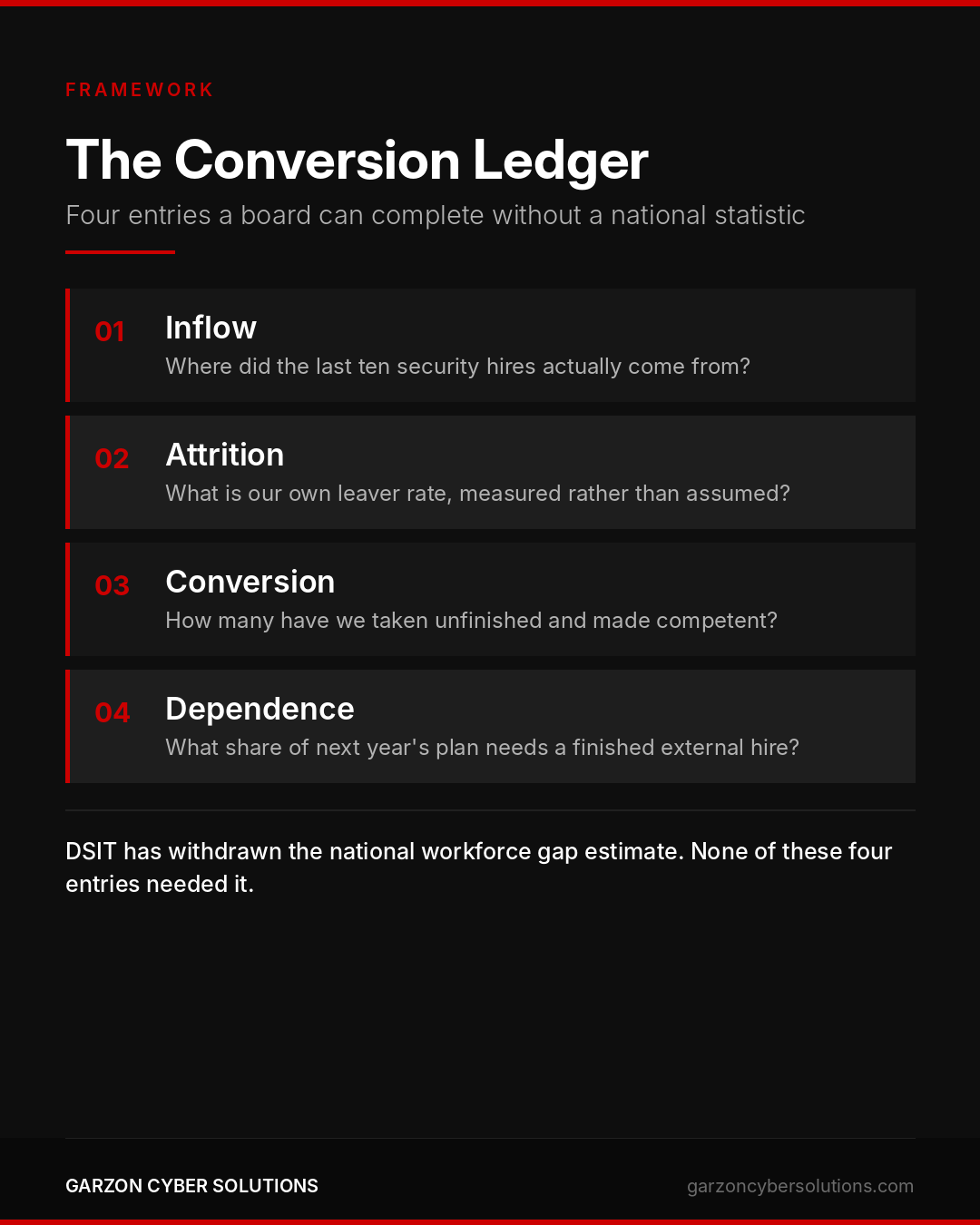
A board cannot act on a national gap figure, and now does not have one. It can act on four entries describing its own position, each from records it already holds.
Inflow. Where did the last ten security hires actually come from? Finished external hires, internal moves, apprentices, converts from IT or audit. A plan with one route is a plan with one point of failure.
Attrition. What is our own annual leaver rate, measured rather than assumed? Set it against the 4% the national model uses and the 14% over 18 months the same study found in the cyber sector, and work out which is closer to us.
Conversion. How many people have we taken unfinished and made competent in the last two years? If the answer is none, we are wholly dependent on other organisations doing it, at a moment when fewer of them are.
Dependence. What share of next year's security plan assumes hiring a finished person from the external market? That share is the part of the plan with no fallback.
What leaders should do now
- Stop quoting a national shortage figure in business cases. The research team that produced it has withdrawn it, and a case built on a retired statistic will not survive a sceptical finance director. It no longer needs one: the grade-level evidence is stronger than the headline ever was.
- Measure your own attrition before accepting anyone's model. Two numbers, leavers and headcount, over three years. That single calculation tells you more about your exposure than any national estimate.
- Decide deliberately whether you are a builder or a buyer, and price both. Buying is straightforward in a slack market, which is what 2026 is at the junior end, and harder in the grades that take years to produce. Building costs money and time, the trained person may leave, and it requires a senior hire to anchor it. What is not legitimate is assuming you are a buyer without pricing it, or announcing you are a builder without funding the person who would run it.
- If you build, fix retention first. Juniors leaving for higher salaries once trained is what employers told the report makes the investment hard to justify. That is a pay and progression problem, and cheaper to solve than a second failed programme.
- Put one entry route in place before you need it, and name its owner first. An apprentice, a placement, or a converted internal hire from IT or audit. One route in operation is worth more than an intention, and with apprenticeship starts falling there is less competition for the people entering them than there was. Identify who will supervise it before you advertise it, because that is the constraint employers reported, not the supply of applicants.
Three questions for the board
- What is our own measured annual attrition in the security function, and how does it compare with the 4% the national model assumes?
- Of the people operating our named security controls today, how many did we hire finished, and how many did we develop?
- If no suitable external candidate were available for six months, which controls would be operating without a competent owner?
The strategic takeaway
Withdrawing a statistic is an unusual thing for a research team to do, and the stated reasons are worth taking at face value: the assumptions were too heavy, and demand has fallen.
The second reason cuts both ways. Hiring in 2026 is easier than it has been for years: postings are down, employers report being inundated, and the entry-level market is described as saturated. Anyone buying finished people now is in a good position.
That same slackness is closing the entry level. Fewer junior roles, fewer apprenticeships, more unemployed graduates. The cost does not land in this budget year. It lands when the people who would have become the senior practitioners of the early 2030s turn out not to exist, and no budget at that point produces them faster.
That is the shape of the risk: not a shortage to hire against today, but a conversion rate a board is either managing or ignoring. The firms that will be comfortable are the ones that made one deliberate senior hire while hiring was still easy.
Confidence note
Confirmed. All DSIT figures and quotations above, as published in Cyber security skills in the UK labour market 2026 on 29 September 2026: the withdrawal of the workforce gap estimate and its stated reasons, and that ISC2 has omitted its own for similar reasons; the 145,900 workforce estimate at December 2025, which the report calls experimental; the 8,600 formal inflow for 2025; the 4% workforce exit rate and 5,800 projected leavers; the 3% growth assumption and 4,400 new roles; the 10,200 annual supply requirement; the 14% sector role churn with 9% voluntary, and the 11%, 12% and 14% turnover series; the entry-level posting series of 25%, 17% and 16%; the apprenticeship figures and the certification estimate revision; the enrolment, graduate, 11% unemployment and 30% occupation figures; the 57% and 49% skills gap figures; the 38% and 24% applicant and employee figures and their differing trends; and the 51 qualitative interviews. The Cyber Security and Resilience Bill completed Lords third reading on 2 November 2026, and as at the morning of 24 November 2026 Commons consideration of Lords amendments was listed for that day, per the UK Parliament bills record.
Assessed. That a contracting entry level will tighten the supply of experienced practitioners in later years is the inference employers themselves drew in the DSIT interviews, and this briefing adopts it. It is a reasoned expectation, not a measured finding, no published series tracks it, and the interview sample of 51 was not representative. Reading the sector's 14% role churn across to an in-house security function is likewise an assumption. The commercial exposures above describe how regulatory, operational, transactional and commercial practice can be expected to treat a function with no internal development route. They are reasoned positions, not dataset findings, and none is legal advice.
Not known. The size of the UK cyber workforce gap. DSIT has withdrawn its estimate and ISC2 has omitted its own, and this briefing does not substitute one, including by subtracting the 8,600 inflow from the 10,200 requirement, which mixes two reference years and reinstates by arithmetic exactly what the research team removed on purpose. Also not known: how many of the 8,600 entrants reach core cyber roles; what the senior supply position will be in the early 2030s, which is the risk this briefing argues for and which no series measures; and the outcome of the parliamentary stage listed for today, which had not been recorded when this was written.
Where Garzon Cyber Solutions fits
The interest should be stated. We run a recruitment practice, so we benefit when organisations hire externally. The argument above points the other way for some readers, and it should still be put.
We are a young firm. We publish our own research, and our recruitment work is run personally by our founder. Security and technology hiring would be delivered on a contingency basis, with nothing payable unless and until a candidate accepts and starts, and no CV would be sent to a hiring company without the candidate's explicit permission for that specific role.
Here is a concrete offer. Send us the last ten hires into your security function, with the route each came through and how long each seat sat open, and we will complete the Conversion Ledger and send back what the four entries show. It uses data you already hold and about fifteen minutes of your time. If it shows you are well covered, that is worth knowing and it costs you nothing.
Where it shows a gap at the senior end, that is the hire our recruitment practice exists to make, and we would want to talk about it. Where it shows the gap is internal, you will have a clearer case for the budget than a national statistic ever gave you.
For the full research series, visit the Garzon Cyber Solutions Website.
If no suitable external candidate were available for six months, which of your security controls would be operating without a competent owner?
Send us the last ten hires into your security function, with the route each came through and how long each seat sat open, and we will complete the Conversion Ledger and send back what the four entries show. It uses records you already hold and about fifteen minutes of your time. Security and technology hiring is contingency only, with nothing payable unless and until a candidate accepts and starts.
Start the Conversation →Department for Science, Innovation and Technology, Cyber security skills in the UK labour market 2026, research by Ipsos and Perspective Economics, published 29 September 2026, with job postings analysis drawn from Lightcast data for January to December 2025, higher education data from HESA and Jisc, and apprenticeship data from the Department for Education covering England. UK Parliament, Cyber Security and Resilience (Network and Information Systems) Bill, stage record for Bill 4035. Directive (EU) 2022/2555 (NIS2), Article 20(2). Regulation (EU) 2022/2554 (DORA), Article 5(4).
Garzon Cyber Solutions delivers cybersecurity advisory, compliance certification and specialist technology recruitment as one integrated capability for organisations in the UK, EU and beyond.