It Only Had To Arrive.
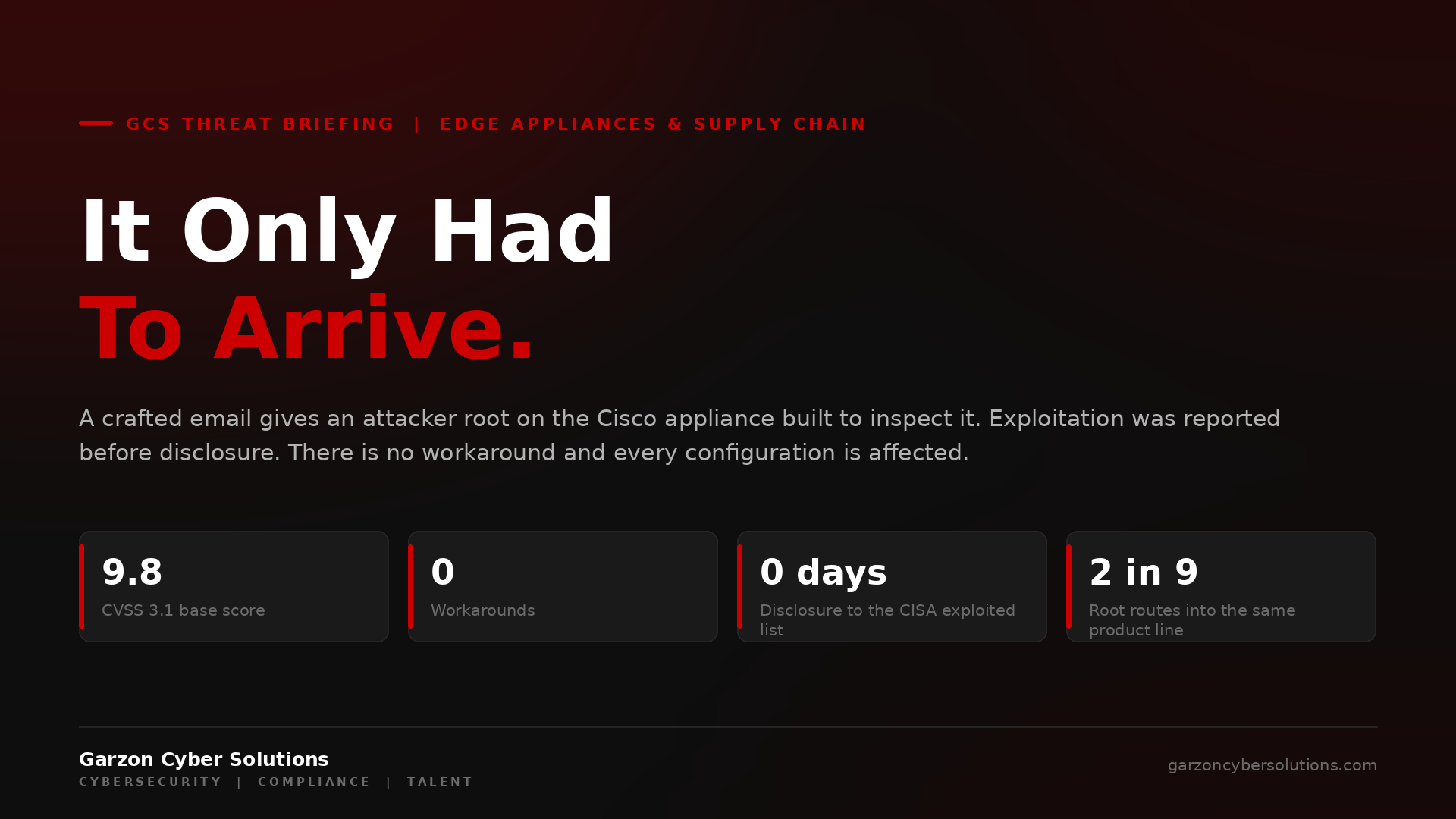
At 16:00 GMT on Monday 14 September, Cisco published an advisory for a vulnerability in its Secure Email Gateway that lets an unauthenticated attacker run commands as root by sending a crafted email through the appliance. No user opens anything. No link is clicked. No login is attempted. The message only has to arrive, and the device whose job is to inspect it executes the payload. Cisco says it became aware of active exploitation in September, before the advisory existed. There is no workaround. Every physical and virtual Secure Email Gateway is affected "regardless of device configuration". CISA added it to the Known Exploited Vulnerabilities catalogue the same day.
Most organisations that own one of these appliances will read that paragraph as a patching instruction, and it is. But the reason this one belongs in front of a leadership team rather than only a change board is structural. The email security gateway is the single device in the estate that reads every inbound message in clear text, holds the credentials that connect it to the mail platform and the directory, and sits in front of the SOC's own visibility. An attacker with root on it owns the company's correspondence and, as Cisco's advisory notes, can remove the evidence that they were ever there. That is not an IT problem with a patch. It is a concentration risk with a patch.
What happened
The record is short because the story is a day old. What is established comes from Cisco's own advisory, CISA's catalogue entry, and the CVE record.
- Late November 2025The precedent. Attackers begin compromising Cisco Secure Email Gateway and Secure Email and Web Manager appliances through CVE-2025-20393, a CVSS 10 flaw in the same AsyncOS software, installing a Python backdoor and a log-purging tool. Cisco Talos assesses with moderate confidence that the actor, tracked as UAT-9686, is China-nexus. Cisco observed that campaign only on appliances with the spam quarantine port exposed to the internet, a non-standard configuration. Cisco discovers it on 10 December 2025 during a support case; a fix follows in January 2026.
- Date not disclosedDuring the resolution of a Cisco Technical Assistance Center support case, Cisco finds CVE-2026-76461, an SQL injection flaw in the gateway's email parsing logic. Separately, the advisory records that "the Cisco PSIRT became aware of active exploitation of this vulnerability" in September 2026. Cisco has not said which day, or how many customers.
- Before 14 September 2026Cisco upgrades every appliance in its own Secure Email Cloud service to the fixed release, 16.5.0-780, and contacts the cloud customers on whose devices it found "indicators of possible compromise". It describes itself as "engaged in remediation and recovery operations" for those tenants.
- 14 September 2026, 16:00 GMTAdvisory cisco-sa-esa-inj-2bLVGmhX is published as version 1.0, Final. CVSS 9.8. No workarounds. Fixed releases are 15.5.5-0141, 16.0.4-3021 and 16.5.0-780. The advisory states the flaw affects the gateway "regardless of device configuration" and does not affect Secure Email and Web Manager or Secure Web Appliance. The CVE record lists 23 affected builds from 13.0.0-392 to 16.0.4-016.
- 14 September 2026CISA adds CVE-2026-76461 to the Known Exploited Vulnerabilities catalogue, the only entry in that day's batch, giving federal agencies until 17 September to patch. The Dutch NCSC publishes advisory NCSC-2026-0368 the same day. The EU vulnerability database assigns EUVD-2026-77625.
- 15 September 2026, 05:00 BSTNo public attribution, no named victim, no public proof of concept, and no UK NCSC advisory at the time of writing. Coverage so far is the vendor, the national CERTs and specialist outlets.
Why this one is different
Critical vulnerabilities in perimeter appliances are now a monthly event. Three things separate this one from the run.
The vector is the job. Nine months ago, the same product's zero-day needed a non-standard configuration: a spam quarantine port that a deployment guide never told anyone to expose. Organisations that had followed the manual were, so far as Cisco observed, not reachable. This time the exploit rides on the mail flow itself. Receiving email from the internet is what the appliance exists to do, so the exposure cannot be firewalled, disabled or filtered away. Cisco's advisory does not offer a workaround because, for a mail gateway, "stop accepting mail from strangers" is not one. The only two states are patched and exposed.
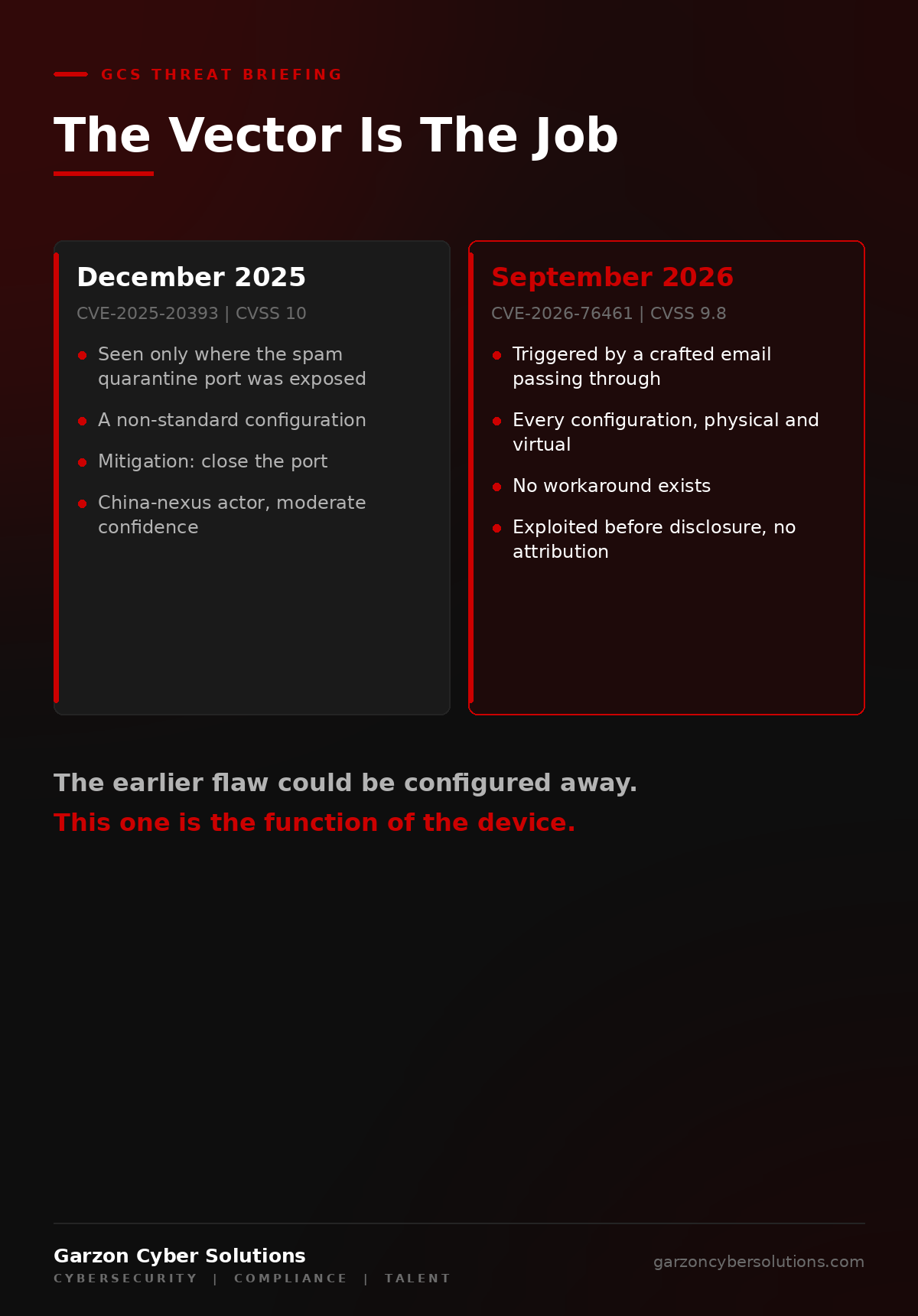
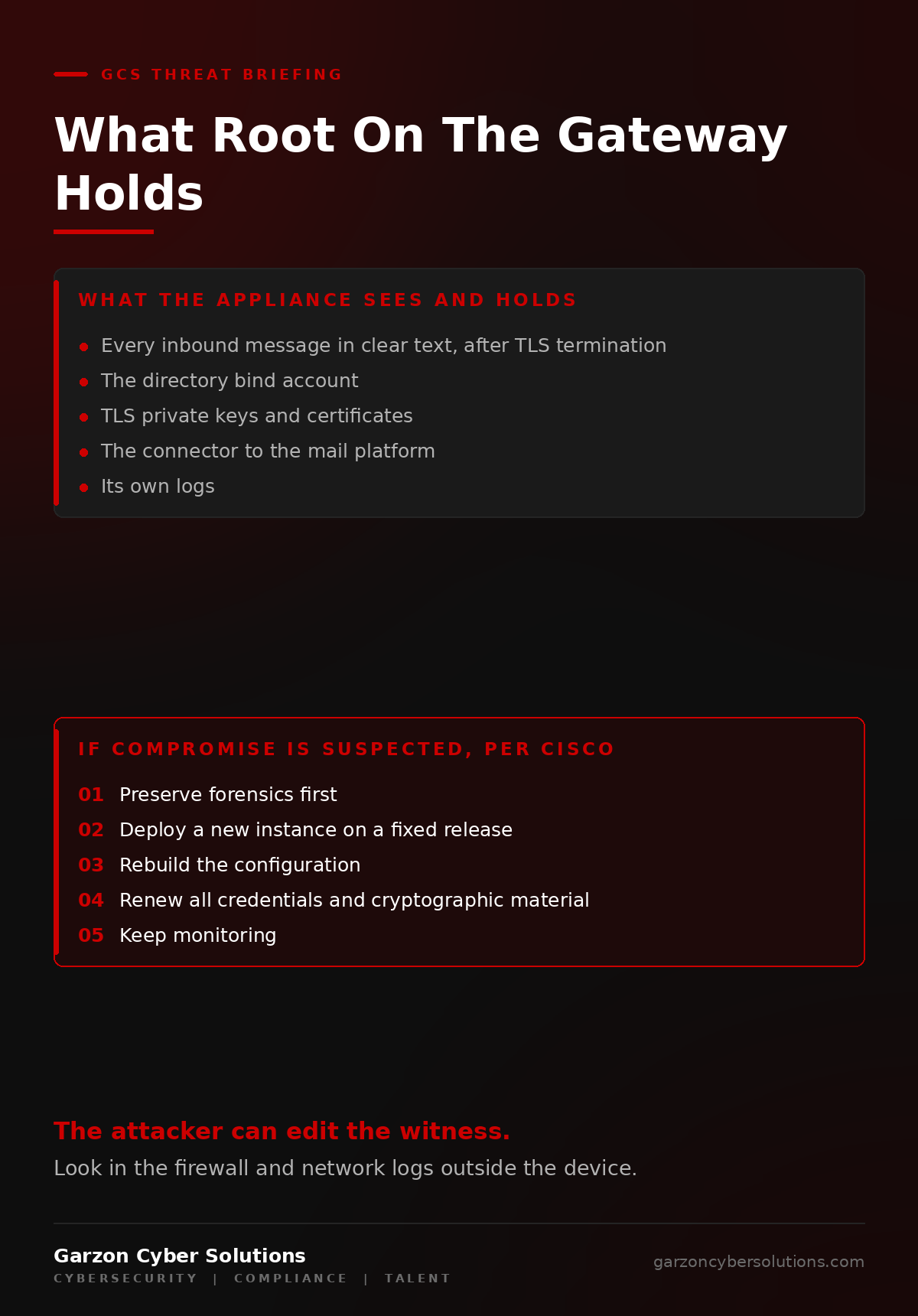
Root on the gateway is root on the correspondence. A mail gateway decrypts inbound TLS, parses every message, and holds whatever it needs to do its work: a directory bind account, TLS private keys, and often a connector to Microsoft 365 or Exchange. An attacker who owns it can read what arrives, alter what is delivered, quarantine the warning from the security vendor, and harvest the credentials that reach further in. Cisco's advisory is unusually direct about the consequence: because the attacker holds root, "evidence of exploitation and indicators of compromise may be removed or hidden", and administrators should look for the intrusion in firewall and network logs outside the device. The standard incident question, "what did they touch?", is being asked of a witness that the intruder was able to edit.
The vendor patched itself first, and told the customers it could see. Cisco upgraded its entire cloud fleet before publishing and has contacted the cloud tenants where it found signs of compromise. That is the right thing to do and it draws a line through the customer base. Organisations on Cisco's hosted service were protected before they knew there was a problem. Organisations running the appliance on their own premises, or behind a managed service provider who installed it years ago, started the clock at 16:00 GMT on 14 September and will only learn they were hit if they go looking. The gap between disclosure and the exploited list has collapsed to zero. The gap between disclosure and your patch is now the whole of the risk, and it is entirely yours.
The commercial exposure for UK organisations
Regulatory. Root on a mail gateway is presumptive access to personal data, which puts the 72-hour clock under UK GDPR Article 33 within reach the moment compromise is suspected, not confirmed. Financial entities in the EU carry DORA's incident classification and initial notification duties; essential and important entities under NIS2 have a 24-hour early warning. On the supply side, the Cyber Resilience Act's Article 14 reporting obligation for actively exploited vulnerabilities applied from 11 September 2026, three days before this advisory, which will raise the volume and speed of vendor disclosures reaching UK buyers from EU-regulated manufacturers. The information will arrive faster. The duty to act on it has not moved.
Financial. Cisco's guidance for a suspected compromise of a virtual appliance is not a patch. It is: preserve forensics, deploy a new instance, rebuild the configuration, renew every credential and cryptographic material on the device, and keep monitoring. For a physical appliance it is a call to Cisco's support centre with remote access enabled. Either route is days of specialist time, an incident response retainer drawn down, and a rotation exercise that touches the directory and the mail platform. Cyber insurers increasingly condition cover on documented patch timelines for catalogued vulnerabilities; an appliance still on 16.0.4-016 in October will be a difficult conversation.
Contractual. For a large share of the UK mid-market, the gateway was installed and is nominally maintained by a managed service provider. The questions are whether the contract names edge-appliance patching as the provider's obligation, on what timeline, with what evidence, and who is notified within hours when a vendor publishes a catalogued critical. If the answer to any of those is silence, the risk sits with the customer and the provider holds the access.
Governance. Boards ask about laptops and servers. Few ask how many internet-facing security appliances the company runs, who owns each one, and what happened the last time one of them had a critical advisory. Those devices are privileged workloads on the perimeter and they are, by construction, outside the endpoint tooling the SOC relies on. The December campaign against the same product installed a tool whose only purpose was deleting log lines. That is the adversary's view of these devices: high value, low observation.
What leaders should do now
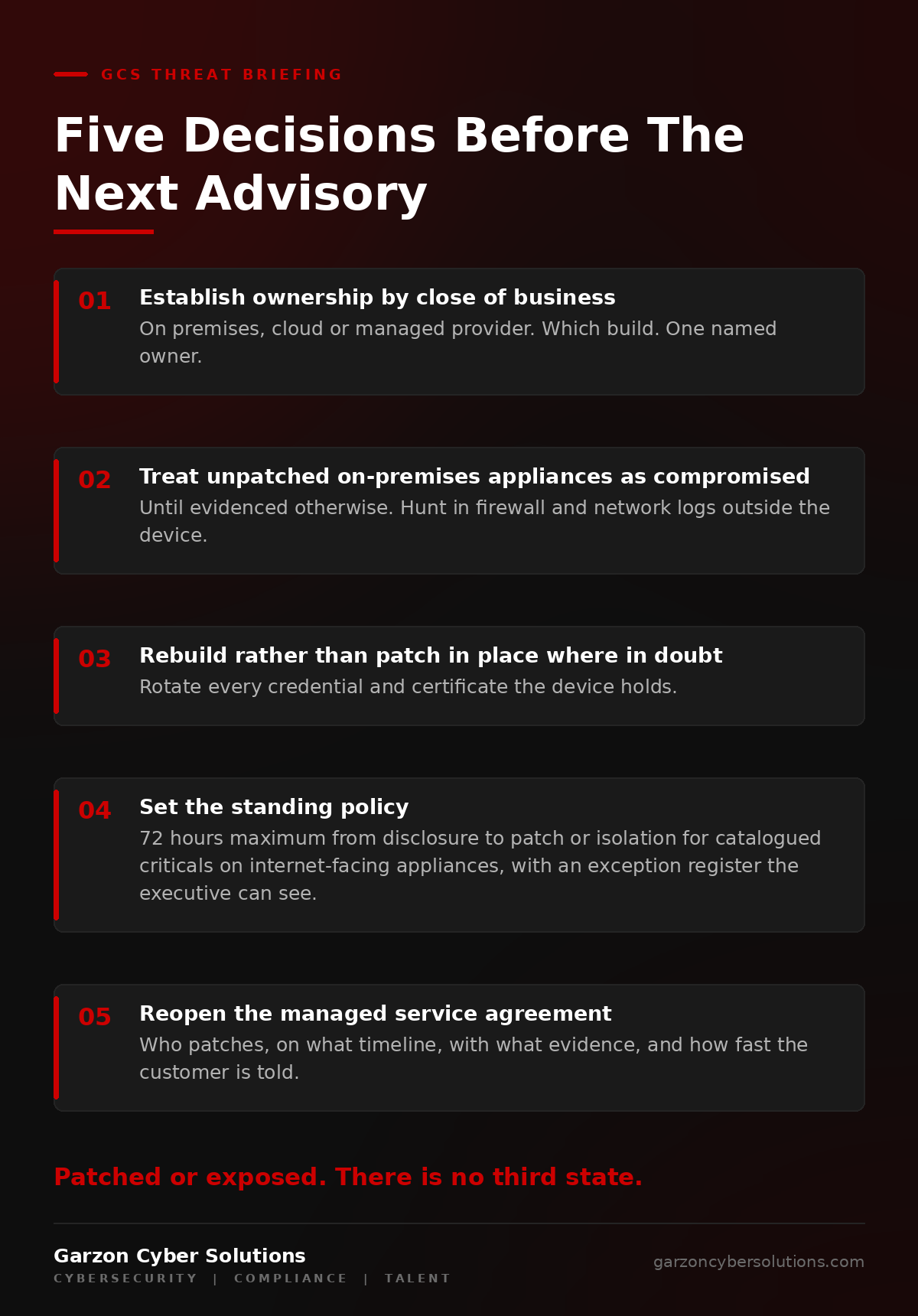
- Establish ownership by close of business today. Does the organisation run Cisco Secure Email Gateway on premises, through Cisco's cloud service, or through a managed provider, and which software build is it on? One named person answers that question and owns the device from now on. If nobody can answer it within a working day, that is the finding.
- Treat every unpatched on-premises appliance as compromised until evidenced otherwise. Cisco's advisory says exploitation began before disclosure and that root access lets the attacker hide the evidence. Run the vendor's log check, then do what Cisco recommends and look outside the device: firewall and network logs for unexpected outbound connections from the appliance, uploads to unfamiliar addresses, downloads it had no reason to make.
- Rebuild rather than patch in place where there is any doubt, and rotate everything the device holds. For virtual appliances Cisco's guidance is a fresh instance, a rebuilt configuration and renewed credentials and certificates. Apply that to the directory bind account, TLS keys and any mail platform connector. A patched appliance with a live backdoor and unrotated credentials is not remediated.
- Set the standing policy for catalogued criticals on internet-facing appliances. A maximum of 72 hours from vendor disclosure to patch or isolation, an exception register visible to the executive, and a named approver for any exception. The policy should exist before the next advisory, and on the evidence of the last nine months there will be one.
- Reopen the managed service agreement this week. Confirm in writing who patches edge appliances, on what timeline, what evidence of completion is provided, and how quickly the customer is told when a vendor publishes a catalogued critical. Where the contract is silent, amend it. Where the provider cannot answer, that is a supplier risk to record.
Three questions for the board
- How many internet-facing security appliances does this company run, who owns each one by name, and how long did the last catalogued critical take to patch?
- If the device that reads our email had been rooted in the first week of September, what could the attacker have read, which credentials would they now hold, and have we rotated them?
- What does our managed service contract say happens in the first 72 hours after a vendor publishes an exploited critical, and when did we last test that it happens?
The strategic takeaway
The security appliance market sold a proposition: put a hardened box at the edge and it will inspect what comes in so the rest of the estate does not have to. That proposition is now being exploited in reverse. The box that inspects everything is the box worth owning, and twice in nine months the route in has been the traffic it was built to process. Organisations that treat these devices as fit-and-forget infrastructure will keep discovering intrusions through vendor support cases. Organisations that treat them as what they are, privileged workloads with an owner, a patch clock, a rebuild plan and a credential inventory, will spend a bad afternoon rather than a bad quarter. The difference is not a product. It is whether anybody in the building is accountable for the device that reads the mail.
Confidence note
Confirmed. The existence, severity and mechanics of CVE-2026-76461; that it affects Cisco Secure Email Gateway physical and virtual regardless of configuration and not Secure Email and Web Manager or Secure Web Appliance; that there are no workarounds; the fixed releases; that Cisco became aware of active exploitation in September 2026; that the flaw was found during a Cisco TAC support case; that Cisco has upgraded all Secure Email Cloud devices and contacted cloud customers where indicators of possible compromise were identified; and Cisco's recovery and hardening guidance. All from Cisco advisory cisco-sa-esa-inj-2bLVGmhX, version 1.0, 14 September 2026. The CISA KEV listing on 14 September is from CISA. The 23 affected builds are from the CVE record as published by the CNA. The Dutch NCSC advisory NCSC-2026-0368 is from advisories.ncsc.nl. The CRA Article 14 application date of 11 September 2026 is from ENISA and the European Commission. The December 2025 precedent, CVE-2025-20393, its CVSS 10 score, the spam quarantine exposure condition, the 10 December discovery date and the tooling deployed are from Cisco's advisory cisco-sa-sma-attack-N9bf4 and Cisco Talos as reported by Help Net Security on 17 December 2025. The fix for that flaw on 16 January 2026 is from Help Net Security and BleepingComputer on that date.
Assessed. The attribution of the December 2025 campaign to a China-nexus actor, UAT-9686, is Cisco Talos's assessment at moderate confidence, not a finding. What a mail gateway holds, and what root access on it permits, is our characterisation of the product class from its documented function; Cisco has not published what the September 2026 attackers did after exploitation. That MSP-managed appliances are widespread in the UK mid-market is our commercial observation, not a measured figure.
Not known. Who is exploiting CVE-2026-76461, since when, how many appliances or organisations are affected, whether any UK or EU victim exists, whether a public proof of concept exists, and whether the September 2026 activity is linked to the December 2025 campaign. Cisco has said none of this and no independent researcher had published on it at the time of writing.
Who in your company owns the device that reads the mail?
Garzon Cyber Solutions is built to put questions like this on the risk register with a named owner, map the controls to what regulators, customers and insurers actually ask for, and place the people who keep the answer current. Cybersecurity, compliance and talent, delivered in that order, as one capability.
Start the Conversation →Cisco Security Advisory cisco-sa-esa-inj-2bLVGmhX, "Cisco Secure Email Gateway SQL Injection Vulnerability", version 1.0, 14 September 2026 · CISA, "CISA Adds One Known Exploited Vulnerability to Catalog", 14 September 2026 · NVD, CVE-2026-76461 · Nationaal Cyber Security Centrum (Netherlands), advisory NCSC-2026-0368, 14 September 2026 · Cisco Security Advisory cisco-sa-sma-attack-N9bf4, "Reports About Cyberattacks Against Cisco Secure Email Gateway And Cisco Secure Email and Web Manager", December 2025 · Help Net Security, "Cisco email security appliances rooted and backdoored via still unpatched zero-day", Zeljka Zorz, 17 December 2025 · Help Net Security, "Cisco fixes AsyncOS vulnerability exploited in zero-day attacks (CVE-2025-20393)", 16 January 2026 · ENISA, Single Reporting Platform, frequently asked questions (CRA Article 14 reporting from 11 September 2026) · Cyber Security News, "Hackers Exploit Critical Cisco Secure Email Gateway Vulnerability in the Wild to Run Malicious Code", 15 September 2026
Garzon Cyber Solutions delivers cybersecurity advisory, compliance certification and specialist technology recruitment as one integrated capability for organisations in the UK, EU and Americas. We are a young firm and we publish our own research. Founder Jonathan Garzon spent his career selling cybersecurity, compliance and technology to security and technology buyers, working alongside marketing and technical colleagues, before building GCS around a single argument: delivered in the right order, security, compliance and the people to sustain them stop being three cost lines and become one commercial capability.