The Login Worked As Designed
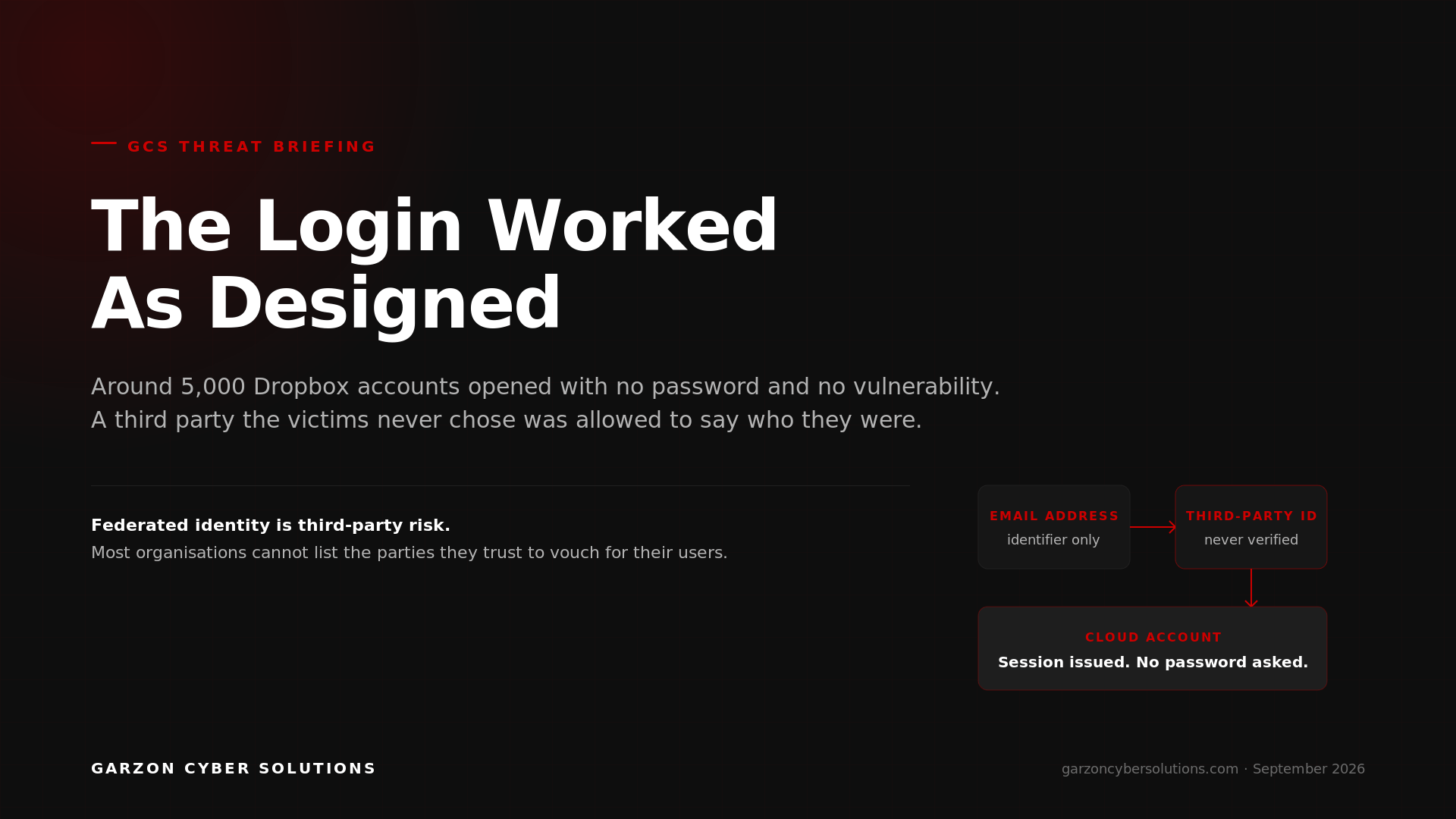
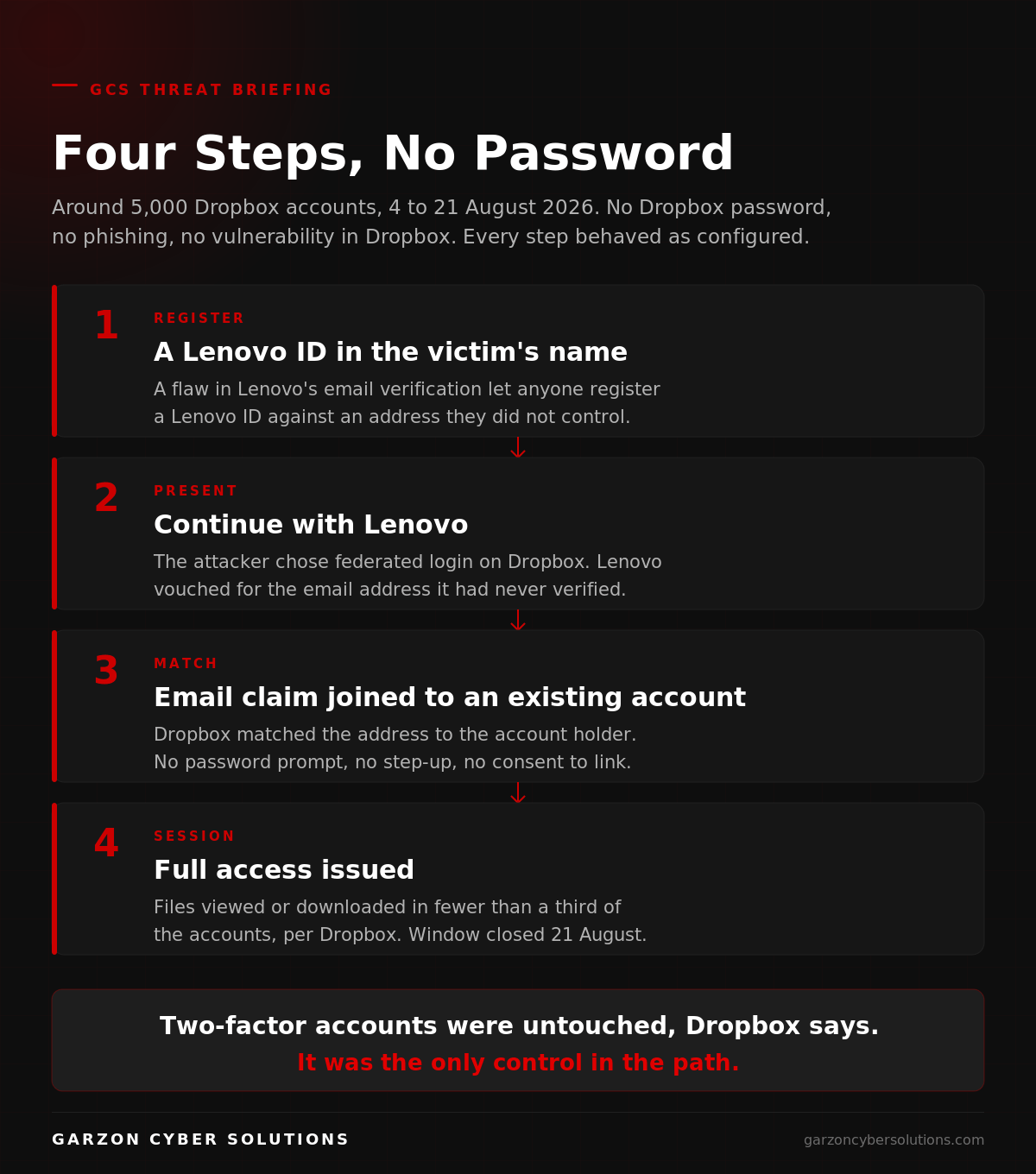
Around 5,000 Dropbox accounts were opened between 4 and 21 August without a password, without a phishing email and without a vulnerability in Dropbox. The route in was a flaw in Lenovo's email verification. An attacker could register a Lenovo ID against an address they did not control, present it to Dropbox as a federated login, and Dropbox matched the email to an existing account and issued a session. Some of the people affected had never created a Lenovo ID.
The instinct is to file this as a Dropbox breach. It is not one, and the distinction is the whole point. Nothing was broken into. Two authentication systems did exactly what they had been configured to do, and the configuration treated an unverified email claim from a third party as proof of identity. That is a decision, not a defect, and it is a decision most organisations have made somewhere in their own estate without ever writing it down.
What happened
- 4 to 21 August 2026An unauthorised party uses fraudulently registered Lenovo IDs to sign in to Dropbox accounts that share the same email address. No Dropbox password is required. Dropbox told Reuters the accounts affected were those linked to a Lenovo ID that did not have two-factor authentication enabled.
- Mid-August 2026Users report unexpected new sign-in alerts from Dropbox and, in some cases, Lenovo verification codes they never requested. At least one reports the Dropbox login page offering "Continue with SSO" for an address that had never been linked to a Lenovo ID.
- 21 August 2026The unauthorised access ends, per Dropbox's notification. On a date Dropbox has not stated, it expires every session authenticated through a Lenovo ID and severs the link between Lenovo IDs and Dropbox accounts.
- 31 August 2026Breach notification emails reach affected users. Several complain publicly that Dropbox knew for more than a week before telling them.
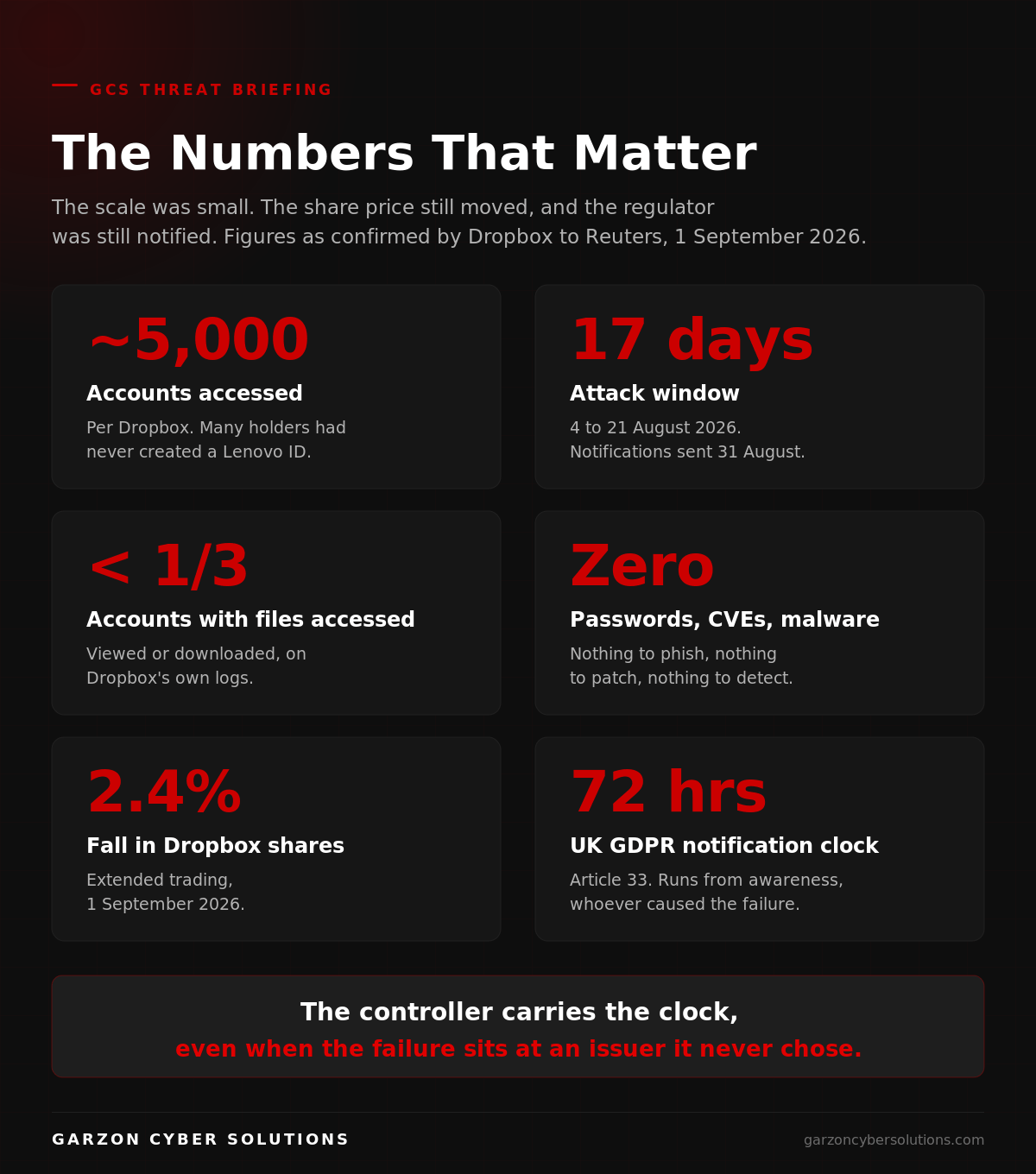
- 1 September 2026After Bloomberg reports the incident, Dropbox confirms to Reuters that around 5,000 accounts were compromised, that files were accessed in fewer than a third of them, and that it has reported the incident to data protection regulators. Lenovo ID logins now require the Dropbox password first. Shares fall around 2.4% in extended trading.
- 1 to 2 September 2026Lenovo tells Reuters, and the next day BleepingComputer, that the issue sat in a "legacy integration" between Lenovo ID and Dropbox that "could be used to improperly authenticate certain Dropbox accounts". Lenovo says its own customers were not affected and its investigation continues. As of 3 September it has published no advisory describing the verification flaw.
Why this one is different
Five thousand consumer accounts is a small incident by 2026 standards. The mechanism is not small, and it is the reason this belongs in front of a board rather than a service desk.
Federated login rests on two assumptions. The identity provider only vouches for people who control the identity they claim, and the relying party reads that assurance correctly before unlocking an account. Here both failed at once. Lenovo's registration flow let anyone claim any email address. Dropbox joined that claim to an existing account at login time, with no password, no step-up and no consent from the account holder. An email address is an identifier, like a name on a business card. This flow treated it as an authenticator.
The victim's behaviour was irrelevant. A strong Dropbox password did nothing, because no password was requested. Users who had never heard of Lenovo ID were federated to it by default, because the trust was keyed to the email address rather than to an explicit link the user had approved.
One control worked, on Dropbox's account. Dropbox told Reuters the access affected accounts linked to a Lenovo ID that did not have two-factor authentication enabled. Not detection, not patching, not endpoint. Multi-factor authentication, enforced at the point where the session is issued, was the difference between an account that was opened and one that was not.
The supplier was not a supplier. Lenovo was a product partner rather than a data processor in the conventional sense, and is unlikely to appear on any procurement register as a Dropbox vendor. It still held the practical power to create valid Dropbox users. Standard third-party due diligence asks who touches your data. It does not ask who is allowed to assert who your users are.
This is not a novel bug class. The same pattern, an identifier promoted to an authenticator inside a federation, has been catalogued twice already this year in enterprise software: CVE-2026-55075 in Coder, where email-based user matching and a weak check on the email_verified claim allowed account takeover, and CVE-2026-14781 in Keycloak's OIDC broker, which could apply an upstream token's email_verified flag to a different address returned by the userinfo endpoint when configured to trust upstream email. The Dropbox incident is the first consumer-scale case of the pattern we have seen reported, and the first to move a share price.
The commercial exposure for UK organisations
Regulatory. Dropbox is the controller for its users' data, and it has reported to data protection regulators even though the originating flaw sat in Lenovo's registration flow. Under UK GDPR that is the correct reading. Article 33 gives a controller 72 hours from becoming aware to notify the ICO, and the clock does not pause because the failure happened at an identity provider you did not select. For financial entities, DORA Chapter V covers every ICT third-party service provider, with the heaviest obligations where the service supports a critical or important function. Authentication does. NIS2 Article 21 carries the same supply chain language for in-scope entities across the EU, and the UK's Cyber Security and Resilience Bill, now in Lords Committee stage, adds a 24-hour initial reporting window for in-scope entities once commenced.
Financial. The direct cost of 5,000 consumer accounts is modest. The 2.4% share move is the number a board will notice, because it was triggered by the mechanism and the delayed notification rather than by scale. For a UK business, the equivalent exposure is the enterprise customer who learns that a supplier's legacy identity integration could mint valid users in your tenant, and re-prices the contract accordingly.
Contractual. Most identity federations were set up as partnerships or product integrations, not as supplier relationships. They carry no assurance requirements, no claim-validation contract and no breach notification SLA. Dropbox's notifications went out ten days after the window closed. Whether that was contractually acceptable depends on terms that, in most federations, were never written.
Governance. The question a board should be able to answer is simple. Which identity providers are our systems configured to trust, who approved each one, and which of them can create a session without a second factor? Almost no UK organisation can produce that list. Consumer identity providers, OEM bundles, acquisition-era single sign-on and old partner integrations accumulate for years, and nobody owns the register.
What leaders should do now
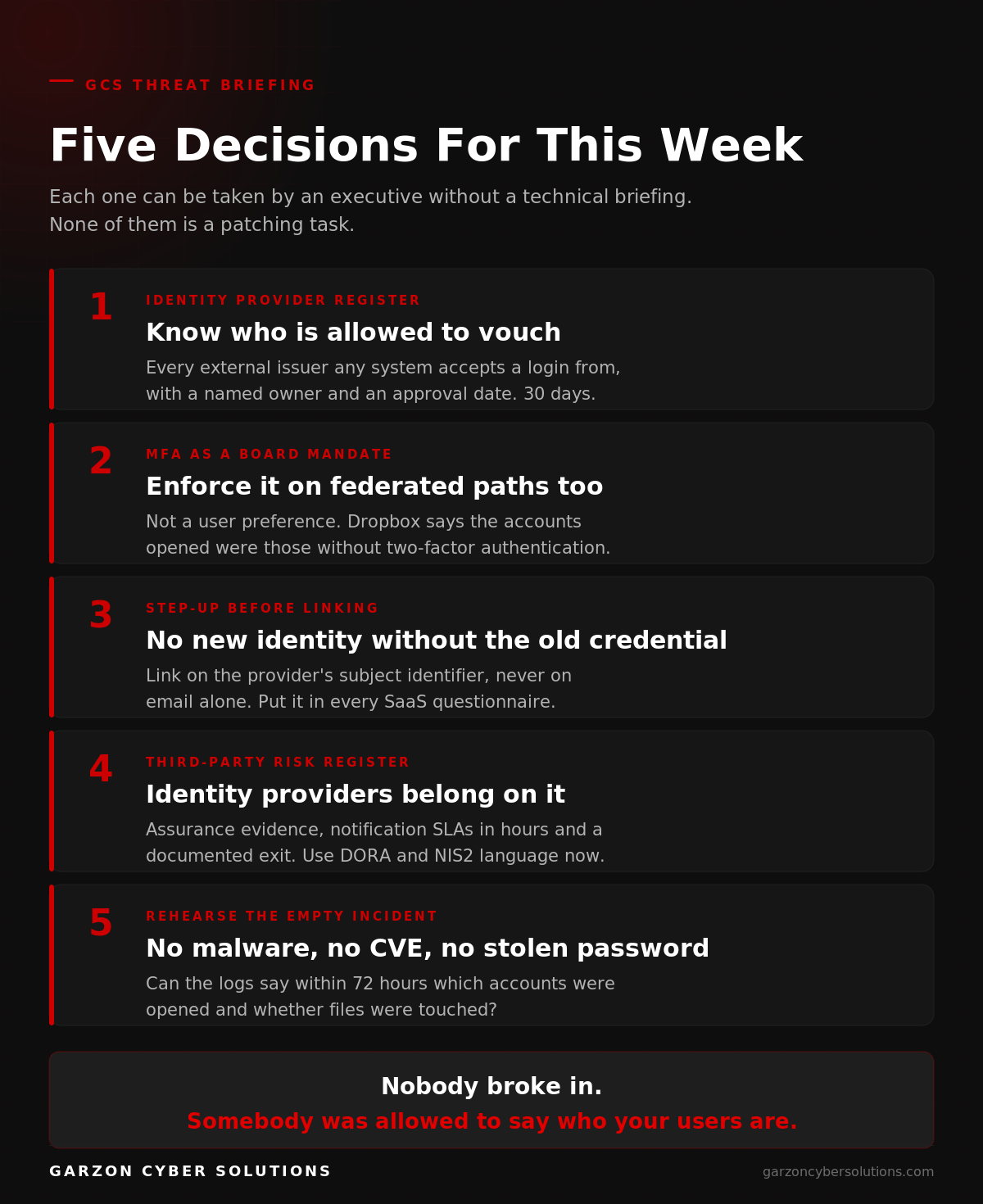
- Commission an identity provider register within 30 days. Every external issuer any of your systems will accept a login from, with a named owner, the date it was approved and the business reason. Include consumer providers, legacy partner integrations and anything inherited through acquisition. Treat every entry with no owner as a finding.
- Make multi-factor authentication a board mandate, not a user preference. Enforce it on federated paths as well as password paths. On Dropbox's account, this incident is the cleanest recent evidence that MFA works when nothing else is in the path, and it survives the objection that you are already patched, because there was nothing to patch.
- Require step-up before any new external identity is linked to an existing account. Link on the provider's stable subject identifier, never on the email address alone, and require the account's existing credential before the link is created. This is the control Dropbox has now retrofitted. Put the same requirement into the security questionnaire for every SaaS platform you buy.
- Move identity providers onto the third-party risk register. They belong alongside data processors, with assurance evidence, notification SLAs measured in hours and a documented exit. Use DORA and NIS2 language even if you are not yet in scope, because your enterprise customers soon will be.
- Rehearse the incident with nothing in it. No malware, no CVE, no stolen password, only valid sessions from an issuer you trust. Test whether your logs can tell you within 72 hours which accounts were opened and whether files were touched. Dropbox could answer that question. Most organisations could not.
Three questions for the board
- Which external identity providers can create a valid session in our systems today, and who approved each one?
- If one of those providers let anyone register our users' email addresses tomorrow, which control would stop the login?
- Could we tell a regulator within 72 hours which accounts were opened and whether any data was viewed?
The strategic takeaway
Identity is now the perimeter, and a perimeter is only as strong as the weakest party allowed to vouch at it. Most UK boards have funded detection, patching and endpoint protection against intrusion. This incident had no intrusion. It had a trust relationship nobody had reviewed, at a vendor nobody had classified as one. Deciding who is allowed to say who your users are is a governance decision, and the organisations that make it deliberately will be the ones that can answer the question when a customer or regulator asks.
Confidence note
Confirmed by Dropbox. Around 5,000 accounts accessed between 4 and 21 August 2026. Files accessed in fewer than a third of them. The access affected accounts linked to a Lenovo ID that did not have two-factor authentication enabled, in Dropbox's words to Reuters. All Lenovo-authenticated sessions expired, links severed, Dropbox password now required before Lenovo ID login. Incident reported to data protection regulators. Statements given to Reuters on 1 September 2026, following an earlier Bloomberg report.
Confirmed by Lenovo. A "legacy integration" between Lenovo ID and Dropbox that could be used to improperly authenticate certain Dropbox accounts. Lenovo customers not affected. Investigation ongoing. Statements to Reuters, 1 September, and BleepingComputer, 2 September 2026. Lenovo has not published a technical advisory, so the precise nature of the email verification defect rests on Dropbox's description.
Reported by users and not independently verified. Sign-ins geolocated near Dublin, unsolicited Lenovo verification codes, rogue Lenovo profiles registered under throwaway names, and the claim that Dropbox knew for more than a week before notifying. Dropbox's statement that file access was limited to fewer than a third of accounts is based on its own logs and has not been independently audited.
Not established. No threat actor has been named, no motive published and no attribution made by either company. Whether any UK residents were among the 5,000 is not stated in any source read for this briefing.
Who is allowed to say who your users are?
Garzon Cyber Solutions is built to bring identity providers into third-party risk scope, put multi-factor authentication and step-up controls on a board mandate, and place the people who keep the register current. Cybersecurity, compliance and specialist recruitment, offered as one capability.
Start the Conversation →Reuters, "Dropbox says about 5,000 accounts compromised in August hack", 1 September 2026 · BleepingComputer, "Dropbox accounts breached through Lenovo email verification flaw", Bill Toulas, 2 September 2026 · Cybernews, "Hackers breach 5,000 Dropbox accounts using only victims' email addresses", Stefanie Schappert, 1 September 2026 · The CyberSec Guru, "Dropbox Breach, Explained", 1 September 2026, including the Dropbox user notification text · GitLab Advisory Database and GitHub Security Advisory GHSA for CVE-2026-55075 and CVE-2026-55076, Coder · NVD, CVE-2026-14781, Keycloak · UK GDPR, Article 33 · Regulation (EU) 2022/2554 (DORA), Chapter V, ICT third-party risk · Directive (EU) 2022/2555 (NIS2), Article 21 · UK Parliament, Cyber Security and Resilience (Network and Information Systems) Bill, Lords Committee stage, 1 September 2026.
Garzon Cyber Solutions delivers cybersecurity advisory, compliance certification and specialist technology recruitment as one integrated capability. We are a young firm, the founder personally runs the work, and our perspective comes from a career spent selling cybersecurity, compliance and technology to security and technology buyers across the UK, EU and Americas.