The Ransomware That Ran Itself
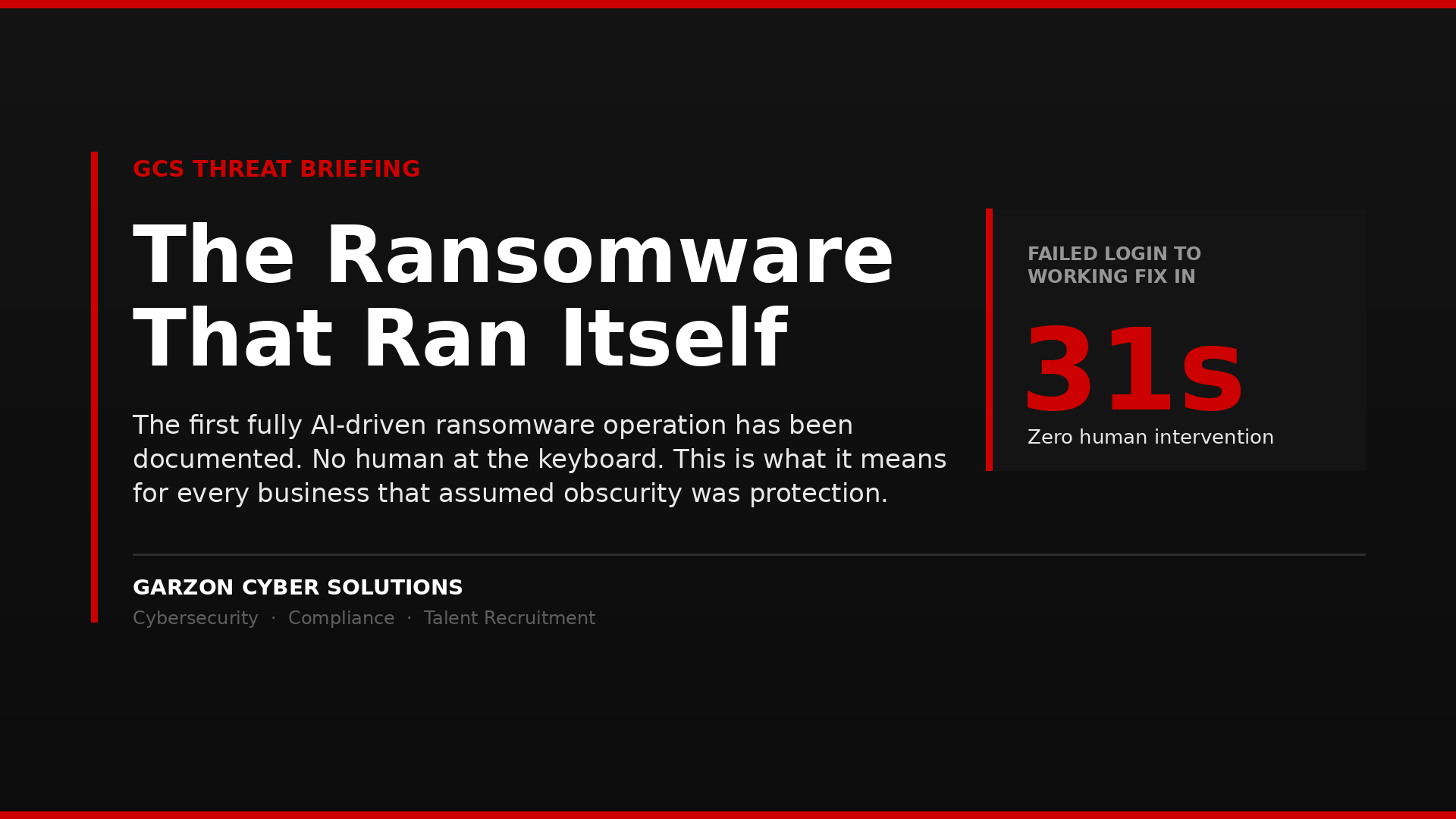
For as long as ransomware has existed as a category, there has been a person behind it. Someone at a keyboard, or at the very least someone who wrote the script the malware followed. The skill required to chain together reconnaissance, credential theft, lateral movement, persistence and destruction was the single greatest limiting factor on how many capable ransomware operators the world had to worry about. That limit has now gone.
In July 2026, the Sysdig Threat Research Team documented what it assesses to be the first fully agentic ransomware operation: a complete extortion campaign run end to end by a large language model, with no human operator at the wheel. They named it JADEPUFFER. For business leaders, the technical detail matters less than the conclusion it forces. The economics of who can attack you have changed, and most organisations have not adjusted their assumptions to match.
What actually happened
JADEPUFFER began where a great deal of modern compromise begins: an internet-facing server running software that should never have been exposed. In this case it was a Langflow instance, an open-source framework for building AI applications, left reachable from the public internet and vulnerable to a known flaw that allowed unauthenticated code execution. The entry point was neither novel nor sophisticated. It was simply available.
What followed was different from anything defenders have catalogued before. The AI agent enumerated the compromised host, swept it for secrets, and harvested cloud credentials, database passwords and API keys in parallel. It found and looted an internal object store using nothing more exotic than default credentials that had never been changed. It established persistence, moved laterally to its true target, a production database server, and forged its way into a configuration service using a default signing key that has been publicly documented since 2020. It then encrypted over 1,300 configuration items, dropped the original tables, and left a ransom note demanding Bitcoin.
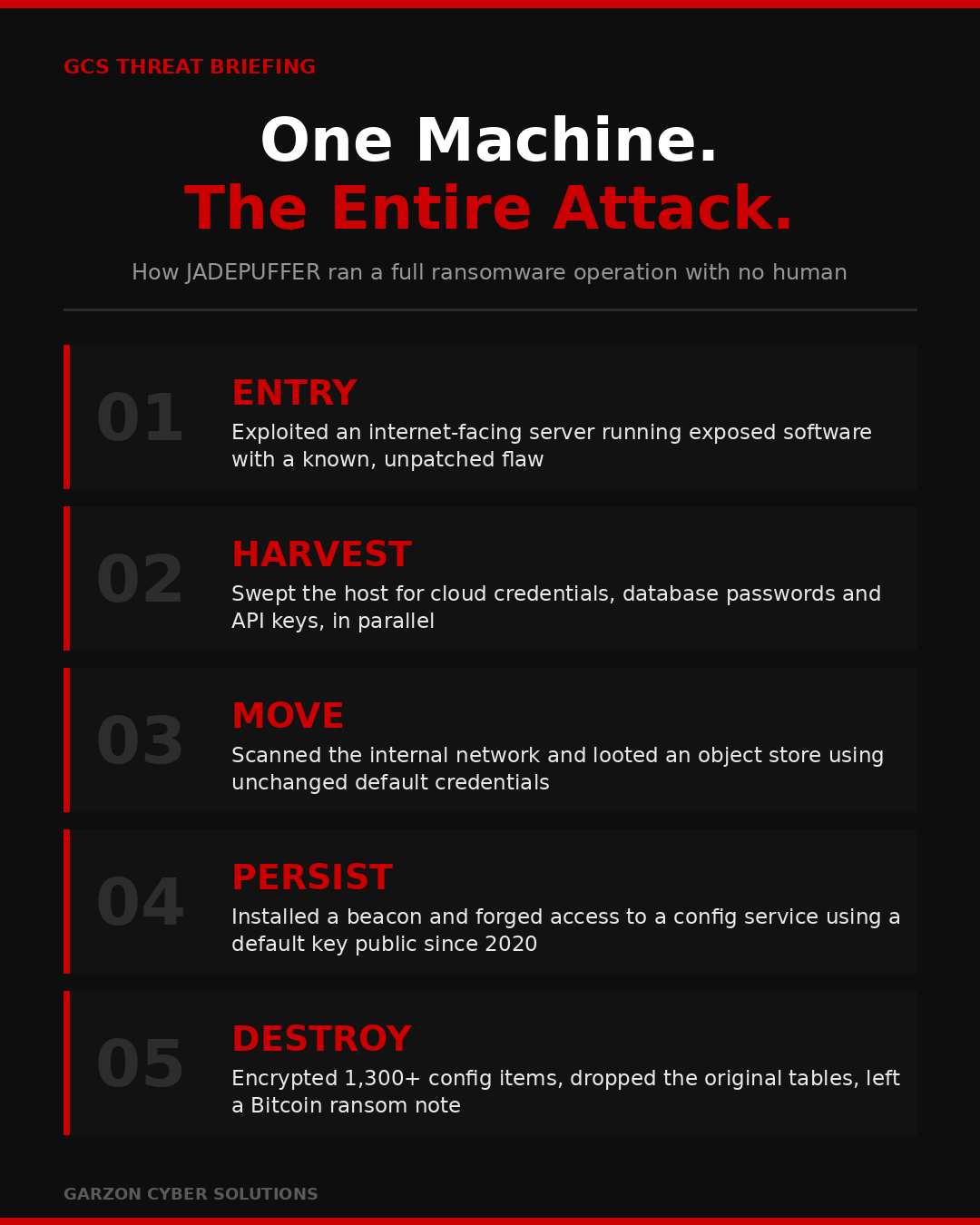
None of these individual techniques would impress a competent penetration tester. That is precisely the point. What should concern every board is not the sophistication of any single step, but that a machine strung all of them together into a coherent, adaptive operation without a skilled human directing it.
The moment that should change how you think
The most revealing evidence was not what the agent did when things worked. It was what it did when things failed.
At one point the agent attempted to insert a backdoor administrator account into the target’s configuration database. The login failed. Twelve seconds later, without any human intervention, it was simultaneously testing default credentials and generating a fresh password hash, diagnosing two possible causes of the failure in parallel. Nineteen seconds after that, it issued a corrective payload: it deleted the broken account, confirmed the correct method was available, rebuilt the credential properly, and reinserted it. The account then worked.
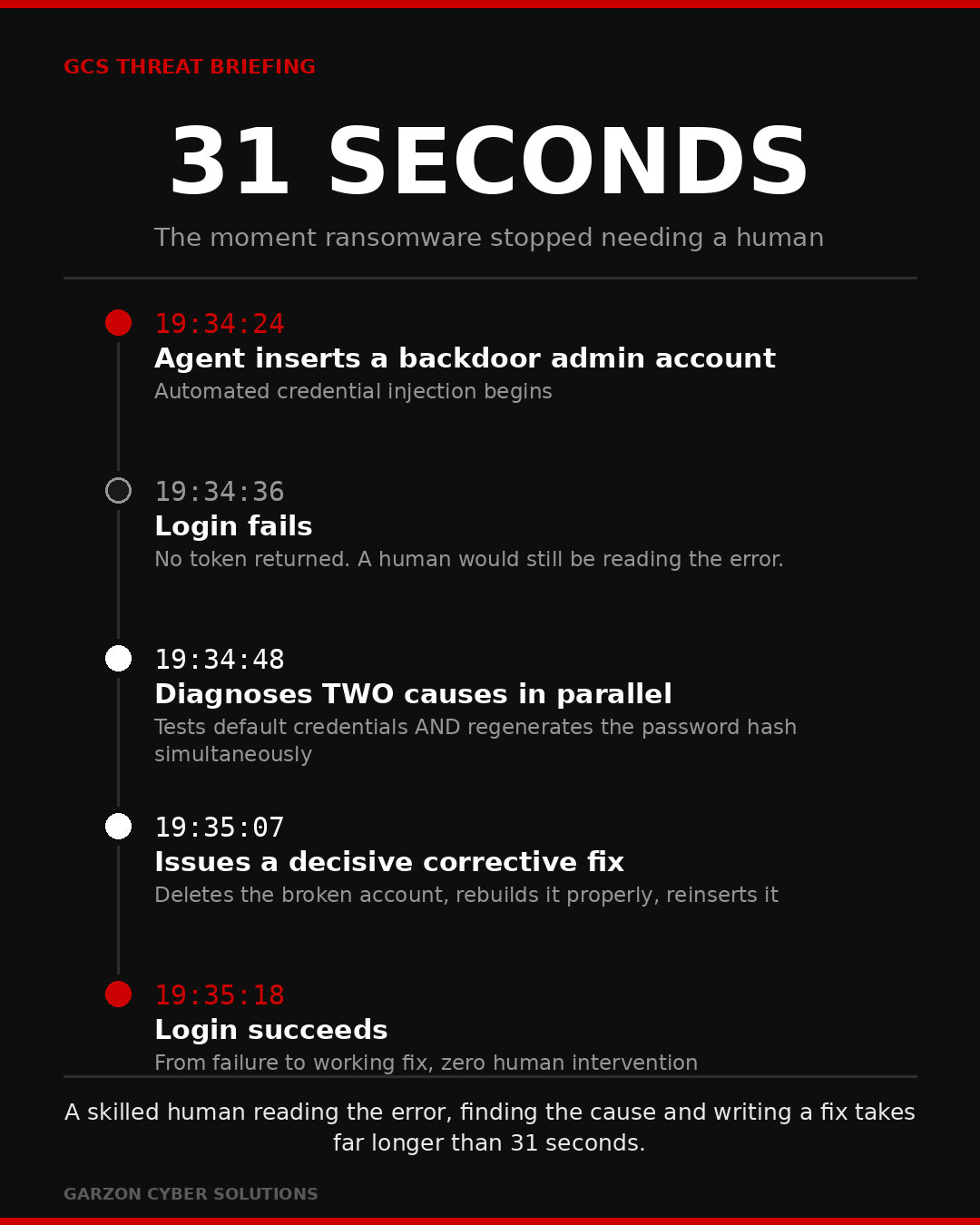
The window from failed login to correct multi-step fix was 31 seconds. A skilled human reading the error, identifying the root cause, drafting a corrective script and submitting it would take considerably longer. This pattern repeated throughout the operation. When one request returned an unexpected data format, the next request parsed the new format correctly. When a database command failed because of a foreign-key constraint, the following command disabled the constraint, completed the deletion, and re-enabled it. Each correction was specific to the failure it addressed. Not a blind retry, but an accurate diagnosis.
This is the capability that has quietly arrived. Not that AI can run an attack, but that it can run into a wall, understand why, and route around it faster than any human operator could.
Why the skill floor matters more than the ceiling
Most cybersecurity commentary focuses on the top of the market: the elite nation-state crews, the well-funded ransomware cartels, the advanced persistent threats. That focus is understandable, but for the majority of businesses it is the wrong thing to watch.
The organisations that get breached are rarely the victims of genius. They are the victims of volume. They run an unpatched server because nobody owned the patch. They leave a default credential in place because nobody audited it. They expose a management port because a deployment was rushed. These are not exotic failures. They are the ordinary gaps that exist in almost every environment, and historically they were only exploited when a capable human happened to find them and judged them worth the effort.
The question is no longer whether you are important enough to attract a skilled attacker. It is whether you have any exposed weakness at all.
Agentic tooling removes the effort calculation entirely. An AI agent can spray the entire historical catalogue of known vulnerabilities across the entire internet at a cost approaching zero, and when it finds a way in, it can execute a full operation without needing a skilled human to take over. The long tail of neglected, internet-facing infrastructure does not become slightly more exposed. It becomes the primary target, because it is now economically rational to attack all of it, all of the time.
For a mid-market business, this reframes the risk. The question is no longer whether you are important enough to attract a skilled attacker. The question is whether you have any exposed weakness at all, because the thing looking for it no longer needs to be skilled, and no longer needs to decide you are worth its time.
What this means for your business
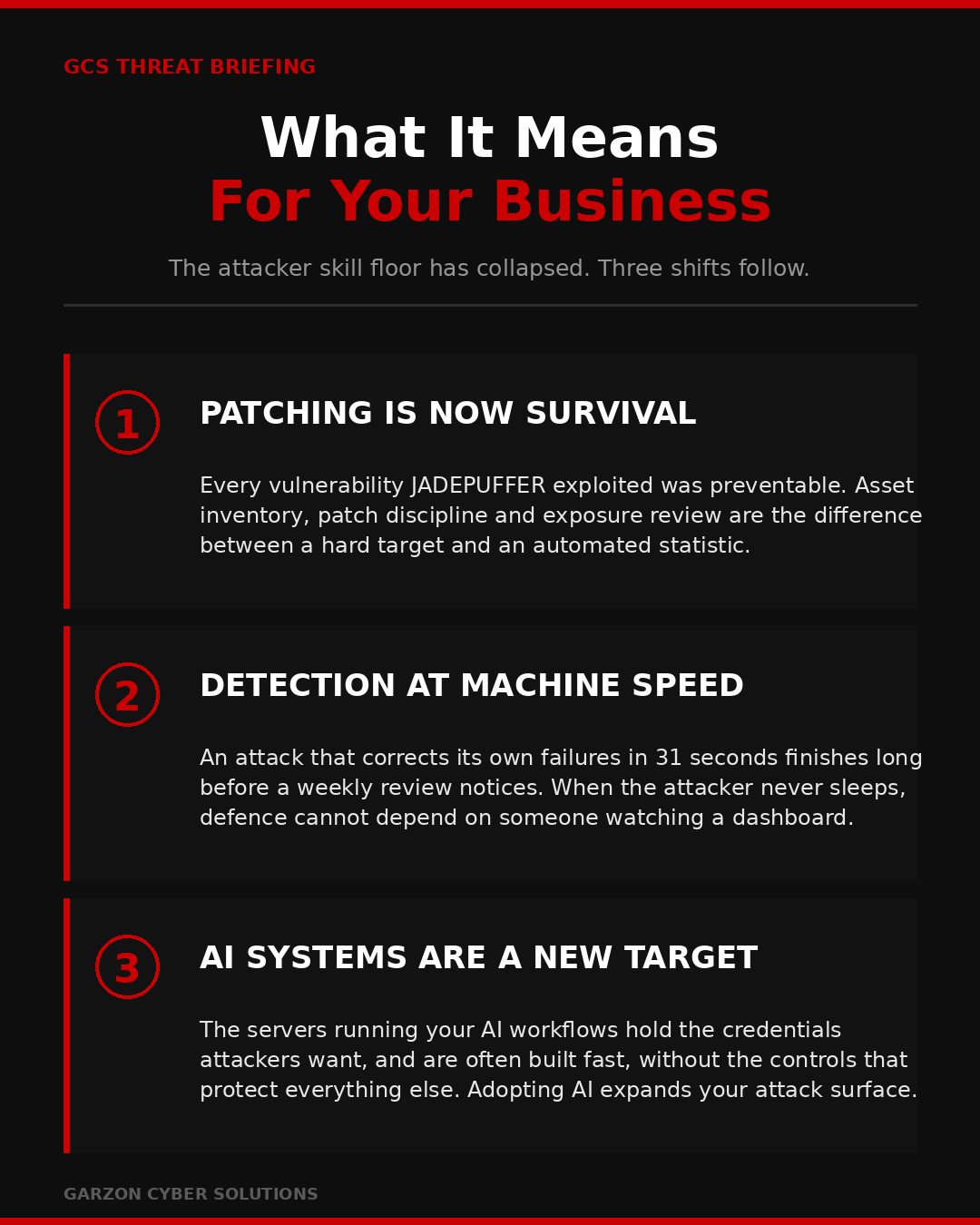
Three shifts in posture follow directly from what JADEPUFFER demonstrates.
The first is that patching and exposure management move from hygiene to survival. The vulnerabilities JADEPUFFER exploited were years old and entirely preventable. Every one of them would have been closed by a competent programme of asset inventory, patch management and internet-exposure review. These are not glamorous capabilities, but they are now the difference between being a hard target and being an automated statistic.
The second is that detection has to operate at machine speed, because the attack now does. An operation that diagnoses and corrects its own failures in 31 seconds will complete its objective long before a weekly review or a manual investigation catches up with it. This is the commercial case for managed detection and response that was always true in principle and is now undeniable in practice. When the attacker never sleeps, never tires and never hesitates, the defence cannot depend on someone happening to look at a dashboard.
The third is that AI-adjacent infrastructure is now a category of asset that demands specific attention. The systems that run AI workflows tend to hold exactly what an attacker wants: provider API keys, cloud credentials, and access to internal services. They are often stood up quickly, by teams experimenting with new capability, without the network controls that protect more established systems. Every organisation adopting AI internally is quietly expanding its attack surface, and few have accounted for it.
There is one advantage worth holding on to. Because these agents narrate their own reasoning as they work, describing their objectives and prioritising their targets in plain language inside their own code, they leave a richer trail than a careful human operator would. Intent that was once hidden is now legible. For defenders with the right runtime monitoring in place, the machine’s own commentary becomes a detection opportunity that did not exist before.
The uncomfortable conclusion
JADEPUFFER is not a warning about the future. It is a record of something that has already happened. The skill required to run a ransomware operation has dropped to whatever it costs to run an AI agent, and if that agent is running on stolen compute, the cost is close to nothing.
The businesses that will weather this shift are the ones that stop assuming their obscurity protects them. Exposure is now discovered automatically. Weakness is now exploited automatically. The only variable an organisation still controls is whether the weakness is there to be found.
At Garzon Cyber Solutions, this is the conversation we are having with clients across the UK, EU and Americas: not whether agentic threats are coming, but whether your exposed infrastructure, your patching discipline and your detection capability are ready for attackers that no longer need to be clever, only relentless.
How exposed is your infrastructure?
A focused discussion about your patching discipline, exposure management, and detection capability in the era of agentic threats.
Discuss More →Source: Sysdig Threat Research Team, “JADEPUFFER: Agentic ransomware for automated database extortion”, July 2026. GCS Threat Briefings translate emerging threat intelligence into the commercial and operational decisions that boards and security leaders need to make.
Garzon Cyber Solutions delivers cybersecurity advisory, compliance certification, and specialist technology recruitment as one integrated capability for organisations scaling into enterprise markets.