The Breached System Came In With An Acquisition. Maersk Said So Itself.
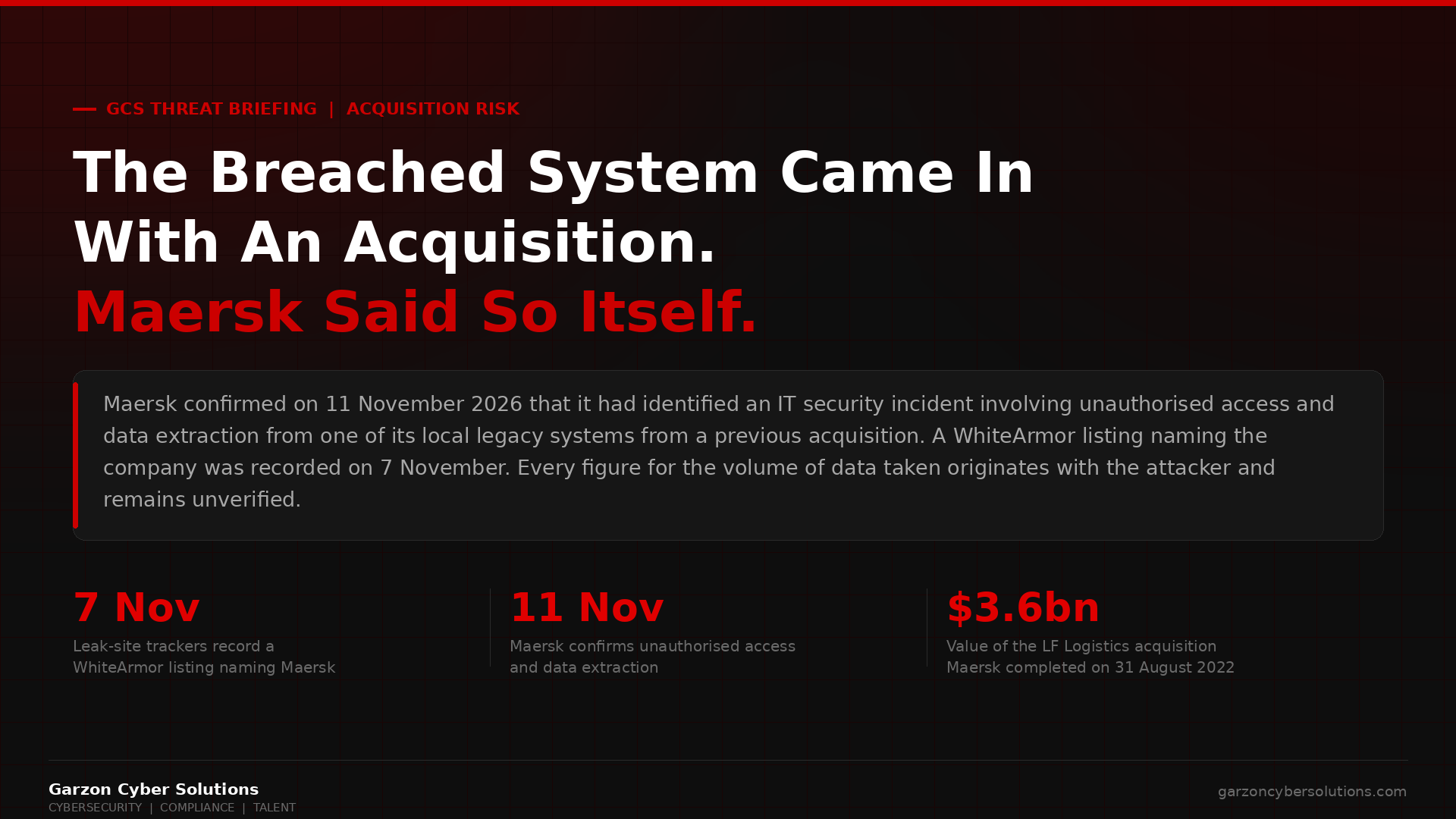
A.P. Moller Maersk confirmed on 11 November 2026 that it had identified an IT security incident involving unauthorised access and data extraction, and that its investigation remains ongoing. Those are the company's own words, published in its own newsroom. The Register, reporting the same statement, described the theft as potential, which is the more cautious reading of a statement that is not itself cautious on the point. The reassuring half of what Maersk said has been quoted everywhere and the commercially important half has barely been noticed. Maersk said the affected system was legacy, that it was isolated, and that it came from a previous acquisition. That last clause is the briefing.
What happened
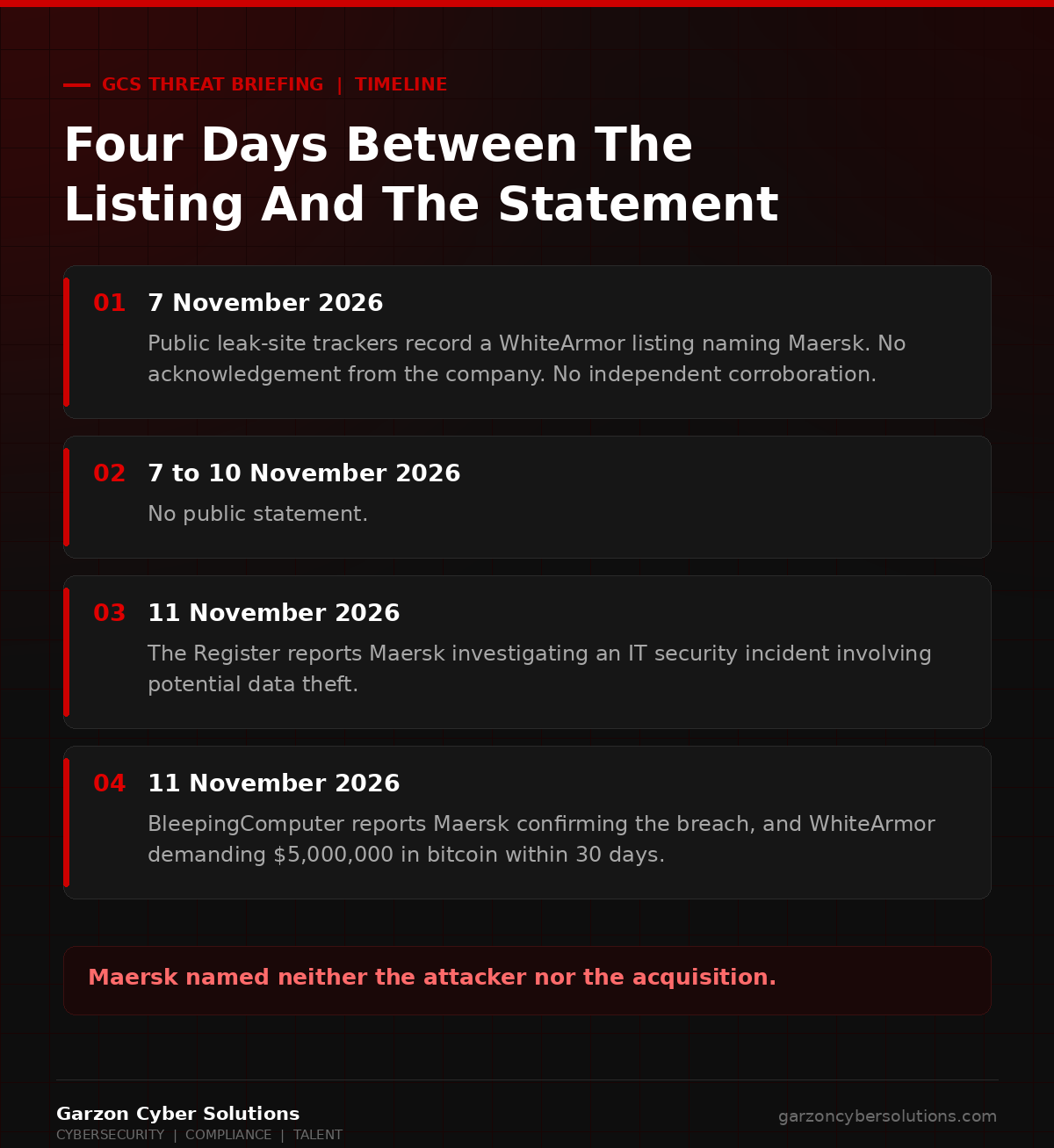
On 7 November 2026 public leak-site trackers recorded a listing by the extortion group WhiteArmor naming Maersk. For four days there was nothing else. Maersk published no acknowledgement, and no independent party corroborated the claim. The UK bulletin service Cypro logged the listing that day and treated it as an unverified intelligence alert, which was the correct handling of it.
On 11 November The Register reported that Maersk was investigating an "IT security incident" involving potential data theft. Later the same day BleepingComputer reported that Maersk had confirmed a breach, and that WhiteArmor was demanding $5,000,000 in bitcoin inside 30 days.
Maersk's own words, as quoted by The Register, are narrow and carefully built. "Our findings so far strongly suggest no sensitive data has been disclosed." "The incident is isolated to a local system." The company said it had "found no indication that there has been any impact on other Maersk systems or customer and partner systems that connect to Maersk through integrations such as APIs and EDI". It described the affected system as being "from a previous acquisition", said it did not expect operational impact, and asked customers to "treat any unexpected communications claiming to relate to this matter with caution and verify them through your usual Maersk contact".
Maersk did not name the attacker. It did not name the acquisition.
What is claimed, and by whom
Everything beyond Maersk's statement comes from the people who say they did it, and that distinction is doing a great deal of work here.
WhiteArmor claims roughly 100GB taken from a logistics platform. BleepingComputer reports the group listing nearly 30,000 driver records, plaintext passwords, 33 accounts holding super-administrator privileges, signed delivery receipts, purchase order and shipping notice rows, and 27,842 mobile device logs carrying phone numbers, email addresses and IMEI numbers. Cypro's bulletin on the same listing records 29,297 driver records, of which 16,093 are said to contain plaintext passwords. The two accounts are consistent with one another. That consistency is worth less than it looks, because both are reporting the same leak-site post rather than corroborating it independently.
No sample files or screenshots have been published. No independent party has validated any of it. Extortion operators overstate access as a matter of routine, recycle older datasets, and occasionally attribute data to a victim who never held it.
WhiteArmor names the affected platform as the former LF Logistics business, and BleepingComputer reports that claim. Maersk has not confirmed it, and the "previous acquisition" wording in its own statement names nothing. For context, and this part is a matter of public record rather than reporting: Maersk completed its $3.6bn acquisition of LF Logistics from the Li & Fung Group on 31 August 2022.
So the position as it stands is a confirmed intrusion into an inherited system, an unverified claim about what left it, and a ransom figure that originates with the attacker's own leak-site post. That is a thinner evidence base than most coverage of this story implies, and it is still enough to act on, because the part Maersk has confirmed is the part that generalises.
Why this one is different
Most breach reporting this year has been about a vulnerability: a product, an identifier, a patch cycle, a window between disclosure and exploitation. This one is about a boundary.
A company that buys another company buys its systems. The diligence that priced the transaction is almost never the same exercise as one that would have inventoried those systems against the acquirer's own security baseline. Commercial diligence asks what the business earns and what it owes. Technical diligence, where it happens at all, tends to ask whether the platforms can be integrated and what that will cost. Neither question is "which of these would we refuse to run if we had built it ourselves".
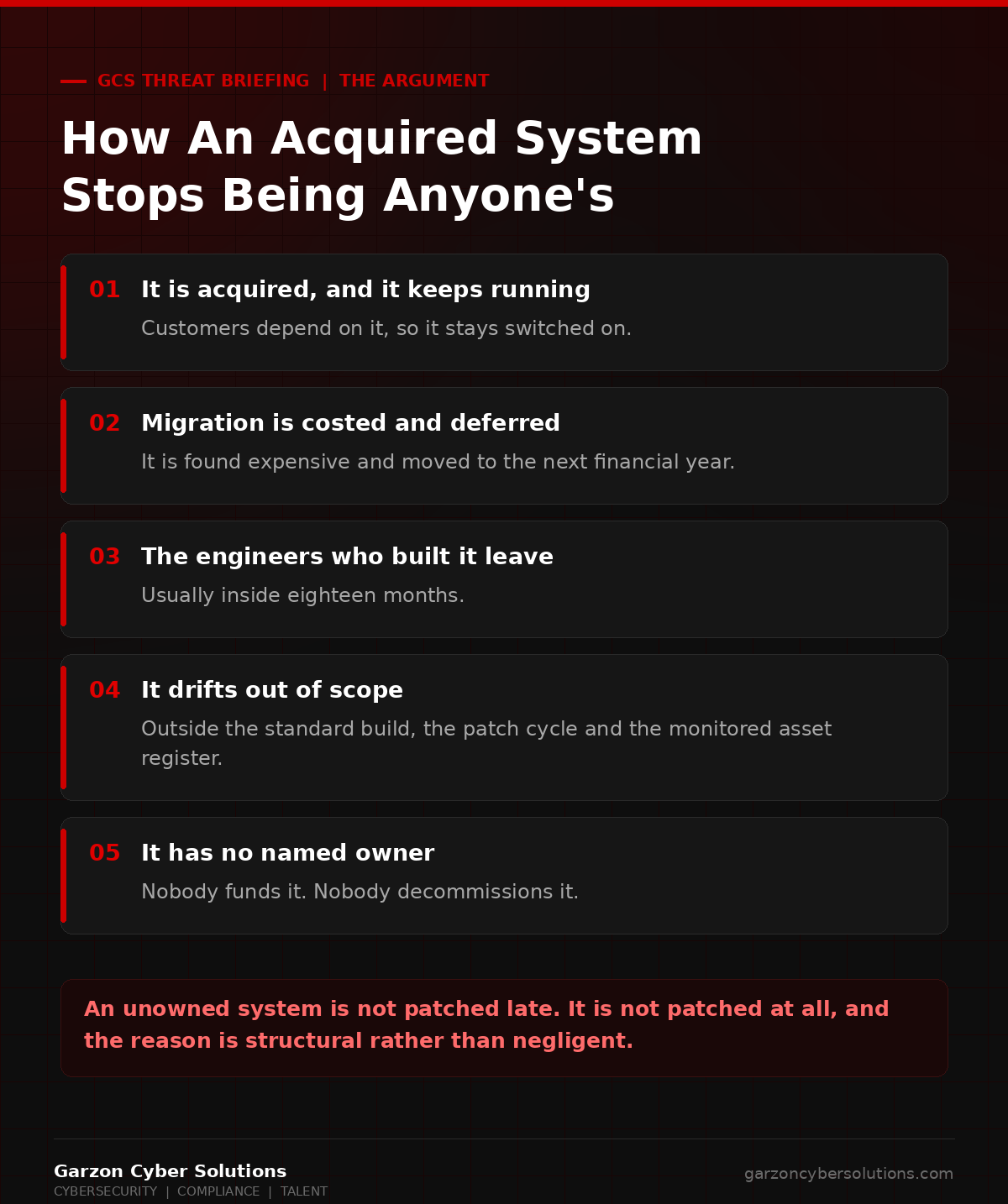
What follows is familiar to anyone who has worked inside a group that grew by acquisition. The acquired platform keeps running because it works and because customers depend on it. Migration is costed, found expensive, and deferred to the next financial year. The engineers who built it leave within eighteen months. It sits outside the standard build, outside the patch cycle, and frequently outside the asset register that the security function actually monitors. It has no owner.
An unowned system is a particular kind of problem. Nobody argues for decommissioning it, because that costs money and breaks something. Nobody argues for funding it properly, because it is not anyone's platform. It persists in the gap, and the gap is where this class of incident happens.
That is not a technology failure with a governance footnote. It is a governance failure that presents as a technology incident, and the two call for different responses at board level.
The precedent UK boards already have
There is a well documented version of this story and it carries a UK regulatory outcome, which makes it more useful to a board than the Maersk incident on its own.
Marriott International acquired Starwood Hotels in 2016. Attackers had been inside Starwood's systems since 2014. The intrusion was not identified until September 2018, two years after the acquisition closed. Hundreds of millions of guest records were exfiltrated worldwide, of which more than 30 million related to data subjects in the EEA, including the UK.
The Information Commissioner issued a notice of intent for £99.2m in July 2019 and imposed a final penalty of £18.4m on 30 October 2020. The gap between those two figures is usually reported as a straight reduction, which understates how the final figure was actually built. On the published commentary the Commissioner settled on £28m after Marriott's representations, applied a 20% discount for mitigating factors to reach £22.4m, and then applied a further reduction attributed to the regulator's approach to penalties at that time rather than to financial hardship. The published decision does not explain how the £28m itself was reached. Marriott indicated that it did not intend to appeal, while denying liability.
The detail worth carrying into your own business is narrower than the headline figure and more uncomfortable. On the published commentary, due diligence was undertaken. It did not surface the problem. An acquirer can run the process properly, sign it off, and still inherit an intrusion that is already two years old, then fail to discover it for another two, because standard transaction diligence is not built to detect an adversary already resident in the target's environment. It is built to value a business.
Ten years separate the Starwood acquisition from the Maersk statement. The mechanism has not changed.
The commercial exposure for UK organisations
Regulatory. Where personal data of UK or EU data subjects is affected, the UK GDPR and the EU GDPR require notification to the relevant supervisory authority without undue delay and, where feasible, within 72 hours of becoming aware of the breach, unless the breach is unlikely to result in a risk to the rights and freedoms of those individuals. Maersk's present position is that its findings so far strongly suggest no sensitive data has been disclosed. That is a statement about disclosure. It is not a determination that no personal data was affected, and the two are not interchangeable. The clock in Article 33 attaches to awareness of a personal data breach, not to confirmation that data has been published somewhere.
Separately, water transport sits in Annex I of the EU NIS2 Directive, among the sectors of high criticality. Whether a given operator in that sector is an essential entity or an important one is a separate question, turning on the criteria in Article 3, principally size, and on national implementation. We are not asserting how any of that applies to a particular Maersk entity, and we have not seen that determination.
Financial. No cost figure has been confirmed and we will not invent one. The reported $5m is the attacker's demand, which is a negotiating position rather than a loss. The costs that reliably land on a business in this position are forensic investigation, external counsel, notification where it is required, and the quieter cost of answering every enterprise customer that now has a question.
Contractual. This is the exposure UK firms consistently underweight. Read Maersk's statement again and notice how much work one sentence is doing: no impact on "customer and partner systems that connect to Maersk through integrations such as APIs and EDI". That sentence is there because large logistics customers carry contractual security obligations of their own and will be asking within the day. Any organisation whose supplier has made an acquisition in the last five years has that same question sitting in front of it, unasked.
Governance. The board question is not whether this particular breach was serious. On the evidence available it may well not be. The question is whether anyone in your business could produce, this week, a list of the systems that arrived through acquisition and have never been assessed against your own security baseline. In most organisations that list does not exist, and the absence of it is the finding.
What leaders should do now
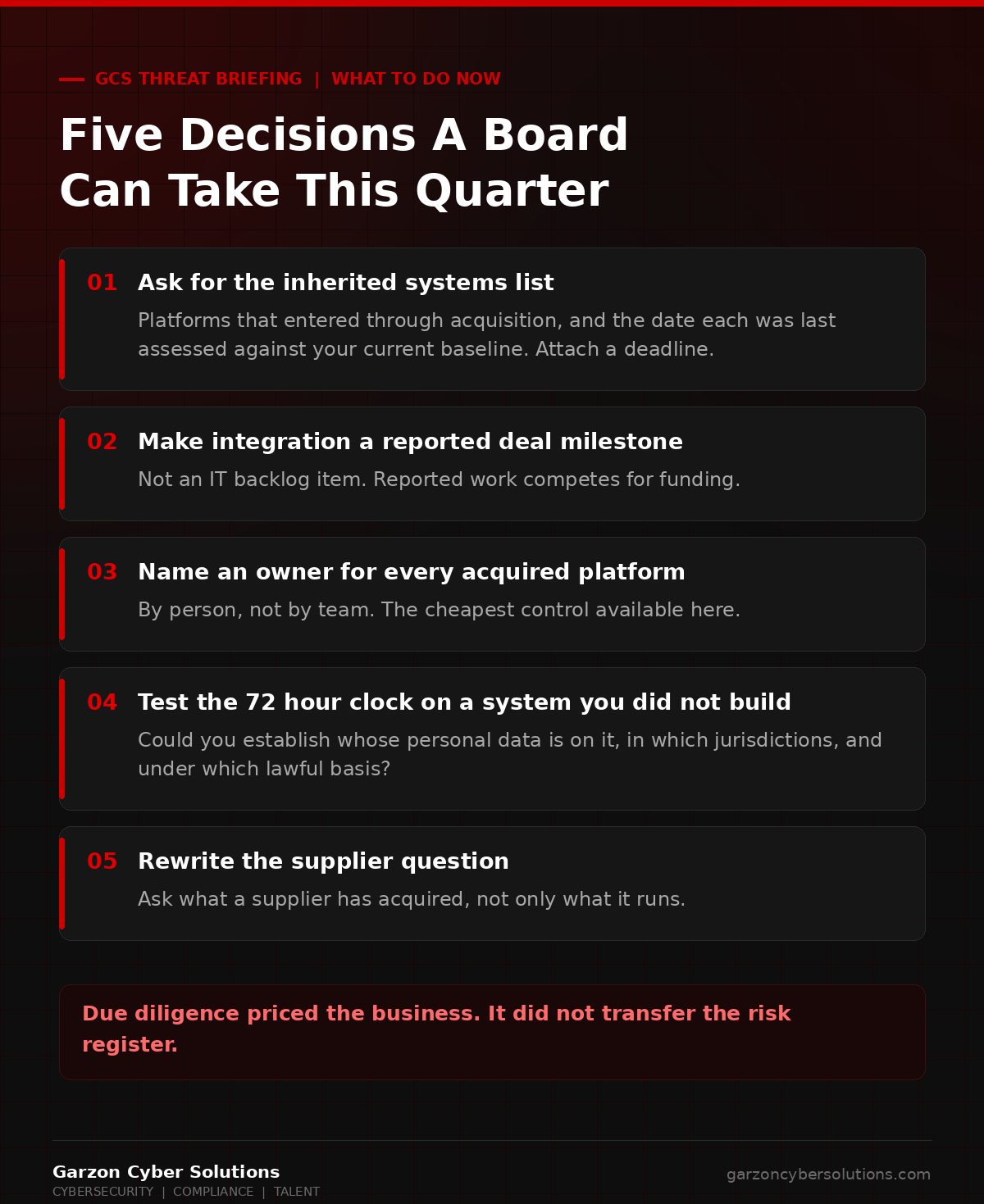
1. Ask for the inherited systems list and put a date on it. Not an asset inventory, which you probably have and which probably flatters you. A specific list of platforms that entered the business through acquisition, with the date each one was last assessed against your current baseline. Ask for it with a deadline attached, because the value is in what the exercise surfaces rather than in the document.
2. Make integration a reported deal milestone rather than an IT backlog item. Deal completion is reported to the board. Integration completion usually is not, which is why it drifts. If the security integration of an acquired platform has a reported status and a named date, it competes for funding. If it lives in a technology backlog it will lose every time to work with a revenue case attached.
3. Name an owner for every acquired platform, by person and not by team. Unowned systems are not patched late, they are patched never, and the reason is structural rather than negligent. An owner with a name is the cheapest control available here and it costs nothing to implement this quarter.
4. Test the notification clock against a system you did not build. Take one inherited platform and ask the practical question: if we were told today that data had been taken from it, could we establish within 72 hours whose personal data was on it, in which jurisdictions, and under which lawful basis. If the answer is no, that is a regulatory exposure that exists right now, with no attacker required.
5. Rewrite the supplier question. Almost every third-party security questionnaire asks a supplier what it runs. Very few ask what it has acquired, when, and whether the acquired environment has been brought onto the same controls. One additional question changes what you learn, and it costs you nothing to add it to the next renewal.
Three questions for leadership
Which systems in our business arrived through an acquisition and have never been assessed against our own security baseline?
If an attacker named one of them publicly tomorrow morning, who here owns the answer, by name?
Could we identify within 72 hours whose personal data sits on a platform we did not build?
The strategic takeaway
Due diligence priced the business. It did not transfer the risk register.
Maersk may well turn out to have handled this competently. Its statement is measured, it is specific about scope, it hedges where it should hedge, and it does not overclaim containment. Several much larger organisations have done considerably worse this year with considerably less cause.
The useful part of the story is not the incident. It is that one of the most operationally mature companies in global logistics was still carrying a legacy system from an earlier acquisition that an attacker could reach, and that the company itself describes in those terms. If that is the position at Maersk, the question for a mid-market group that has bought three businesses since 2022 is not whether the same gap exists. It is who has looked.
Confidence note
Confirmed. Maersk publicly confirmed on 11 November 2026, in a statement published on its own newsroom, that it had identified an IT security incident involving unauthorised access and data extraction from one of its local legacy systems from a previous acquisition, and that the investigation remains ongoing. The company describes the incident as isolated to a local system. The direct quotations in this briefing are taken from that statement and from The Register's reporting of it, which describes the theft as potential. A WhiteArmor listing naming Maersk was recorded by public leak-site trackers on 7 November 2026. Maersk completed its $3.6bn acquisition of LF Logistics from the Li & Fung Group on 31 August 2022. The Marriott penalty figures, dates and record counts are as published.
Assessed. That the affected platform is the former LF Logistics business is the attacker's own claim, reported by BleepingComputer, and is not confirmed by Maersk. We assess the governance pattern described in this briefing as general rather than specific to Maersk, because the company has disclosed nothing about how the system was managed after acquisition.
Not known. Whether personal data was affected. Whether any supervisory authority has been notified. The true volume of data taken, if any. Every figure originates with the attacker's own leak-site post. Whether WhiteArmor holds what it claims, as no samples have been published. Which acquisition Maersk is referring to. Whether any ransom negotiation has taken place.
Which of your systems arrived through an acquisition, and who owns each of them by name?
Garzon Cyber Solutions was built around the argument that security, compliance and the people who sustain them are one capability rather than three cost lines. Building the inherited systems list, putting a named owner against each platform, and testing whether a breach notification clock could actually be met on a system you did not build is a short piece of work with a long shelf life. If you would like a view on what your business acquired along with its last deal, start a conversation.
Start the Conversation →Maersk's statement is quoted as reported by The Register. The ransom figure and the attacker's claimed inventory are reported by BleepingComputer and originate with the group, not with Maersk. The listing date and the conflicting record count are from Cypro's bulletin. The acquisition figure is from Maersk's own announcement. The Marriott penalty detail is from published legal commentary on the ICO decision. Claims are attributed to their source and are not stated as fact.
The Register, Shipping giant Maersk probes IT security incident and data theft, 11 November 2026.
BleepingComputer, Maersk confirms data breach as WhiteArmor ransomware demands $5 million, Bill Toulas, 11 November 2026.
Cypro, WhiteArmor Maersk claim remains unverified, 7 November 2026, updated 11 November 2026.
A.P. Moller Maersk, Maersk completes acquisition of LF Logistics, 31 August 2022.
Mishcon de Reya, The ICO's £18.4m fine against Marriott, November 2020.
Regulation (EU) 2016/679, Article 33. Directive (EU) 2022/2555, Annex I.
Garzon Cyber Solutions delivers cybersecurity advisory, compliance certification and specialist technology recruitment as one integrated capability for organisations in the UK, EU and Americas.