The Notification Was Authentic. The Sender Was Not.
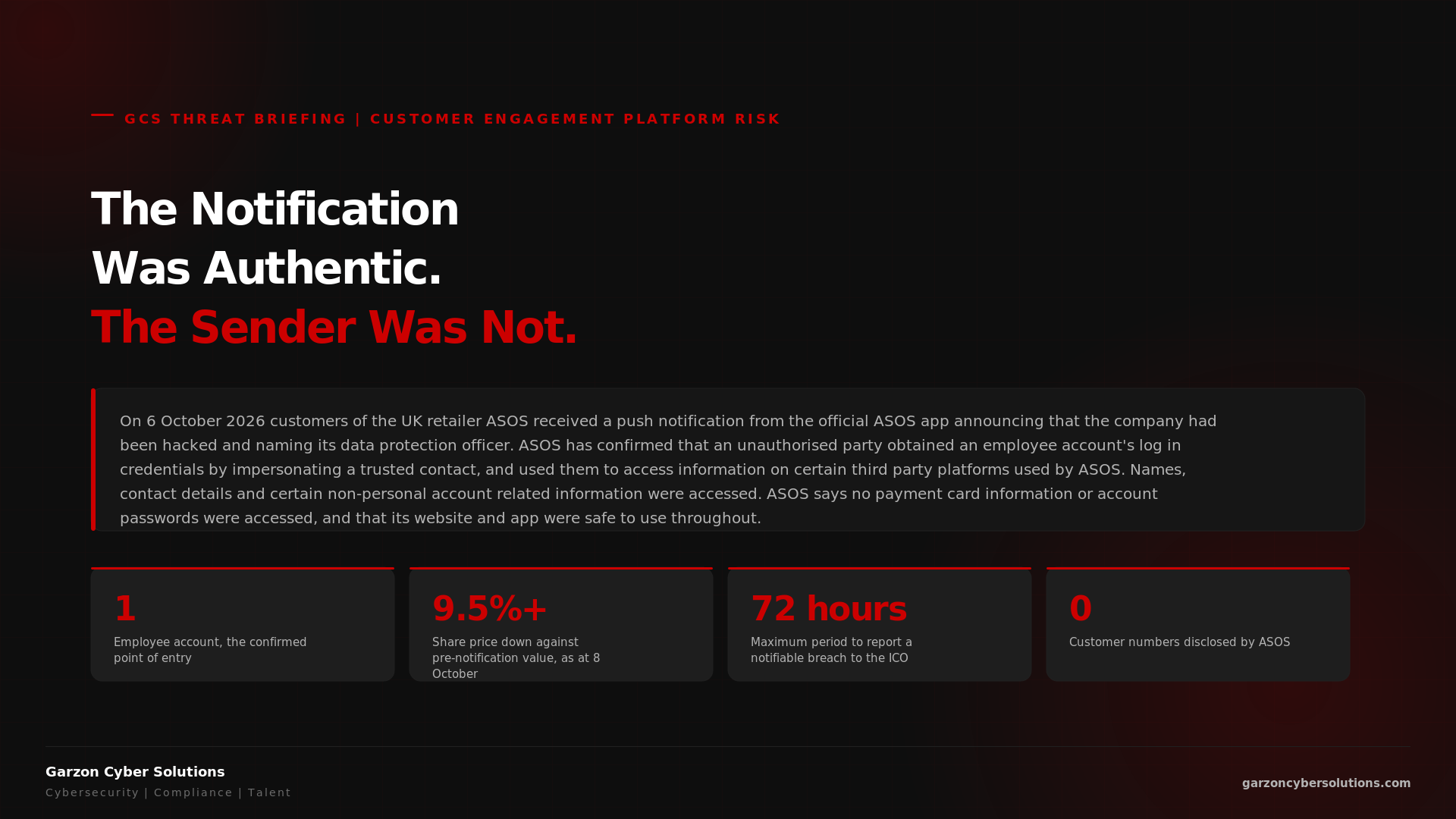
On 6 October 2026, at around ten in the morning, customers of the UK fashion retailer ASOS received a push notification from the official ASOS app. It read "ASOS HACKED". It was addressed to the company's own data protection officer and IT team, it claimed a fully compromised Snowflake instance, and it said: engage with us, or we will leak it. ASOS has since confirmed that an unauthorised party gained access to an employee account "by impersonating a trusted contact to obtain log in credentials", and that "those credentials were then used to access information on certain third-party platforms used by ASOS". The app was not broken into. The notification was delivered exactly as the system was built to deliver it.
Most breach stories hand a board a technical problem to fund. This one hands it a governance problem to own. The attacker did not need to reach the storefront, the payment estate or anything a penetration test would have been pointed at. They needed one set of employee credentials with access to those platforms, and with them they acquired something no data set on its own confers: the authenticated right to speak to every customer, under the retailer's name, on the retailer's own channel, before the retailer had said anything at all.
What happened
The sequence is short and it is unusually well documented, because the first public signal was not a research blog or a leak site. It was a message that reached many, if not all, of the retailer's mobile app users.
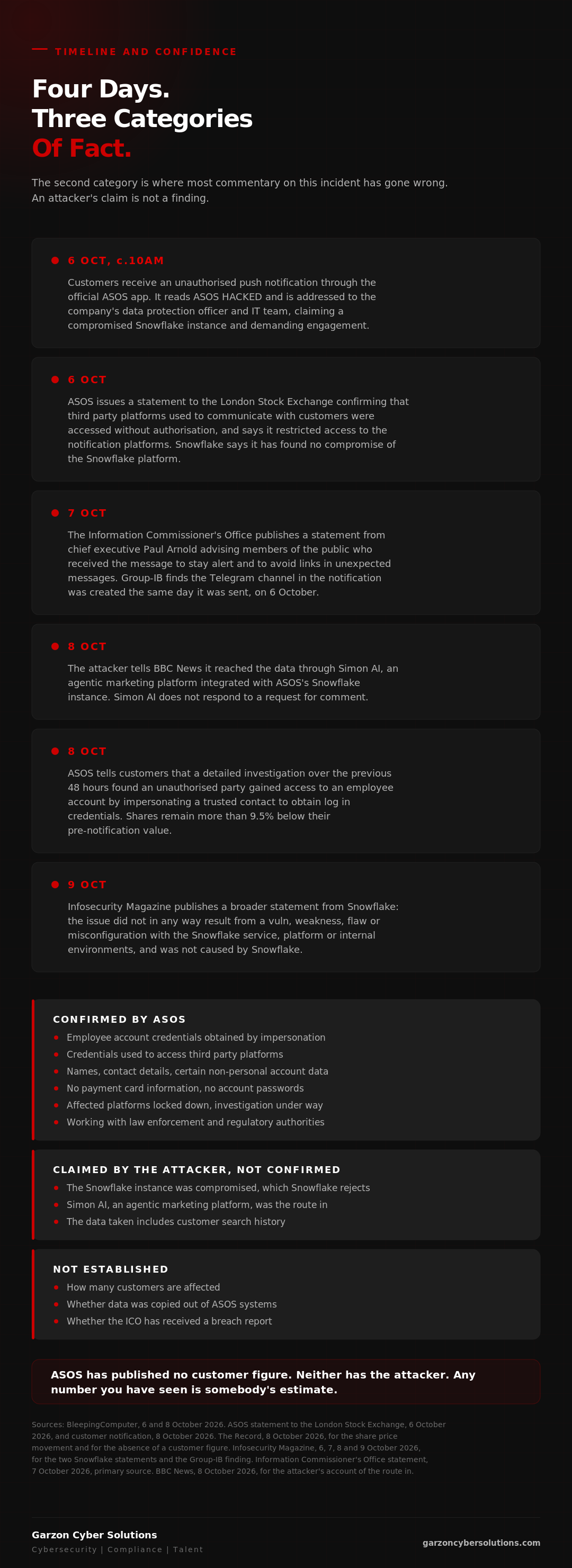
- 6 October 2026, approximately 10:00 UK timeCustomers begin receiving an unauthorised push notification through the official ASOS app. BleepingComputer, which saw the message, reports the text as "ASOS HACKED" followed by "Dear Asos DPO and IT, we have fully compromised the Snowflake instance. Engage with us, or we will leak it." The notification links to a Telegram channel run by an entity calling itself the Xuanye Group.
- 6 October 2026ASOS issues a statement to the London Stock Exchange confirming that third party platforms used to communicate with customers were accessed without authorisation, and that basic personal information including names and contact details may have been exposed. The company says it took immediate action to restrict access to the notification platforms, and displays an in-app notice telling customers to disregard the unauthorised alert and not to engage with the link it carried. Snowflake tells Infosecurity Magazine: "At this time, we can report that we have found no compromise of the Snowflake platform."
- 7 October 2026The Information Commissioner's Office publishes a statement from its chief executive, Paul Arnold. It is addressed to the public rather than to the company: stay alert, be cautious of any links or attachments, monitor bank accounts and online services for unusual activity, and, if you do want to change a password, log in to the account directly through the official website or app rather than following a link. Group-IB finds that the Telegram channel named in the notification was created the same day it was sent, on 6 October, and that the account behind it previously traded under names associated with gaming items.
- 8 October 2026The attacker tells BBC News that it reached the data through Simon AI, an agentic marketing platform integrated with ASOS's Snowflake instance. Simon AI does not respond to a request for comment.
- 8 October 2026ASOS writes to customers. A detailed investigation "over the last 48 hours", supported by external experts, has established the phished employee account as the route in. Names, contact details and certain "non-personal" account related information were accessed. No payment card information and no account passwords were accessed. The affected platforms were locked down and the company says it is working with law enforcement and regulatory authorities. Shares remain more than 9.5% below their pre-notification value.
- 9 October 2026Infosecurity Magazine updates its report with a broader statement from Snowflake: "We can confirm this issue did not in any way result from a vuln, weakness, flaw or misconfiguration with the Snowflake service, platform or internal environments, and was not caused by Snowflake. No remediation is required for Snowflake customers."
Why this one is different
Strip out the brand name and the mechanism is almost mundane: someone was approached by a person claiming to be a trusted contact, and handed over a login. What makes it a board matter is what that login was attached to.
A modern customer engagement stack is not one system. It is a marketing automation platform, a customer data platform, an email service provider, an SMS gateway, a push notification service, a personalisation engine and, increasingly, an agentic layer that reads from the warehouse and decides what to send. Most of these were bought by marketing, on a marketing budget, against a marketing business case. Many of them are never risk assessed as security critical, because on paper they are a campaign tool.
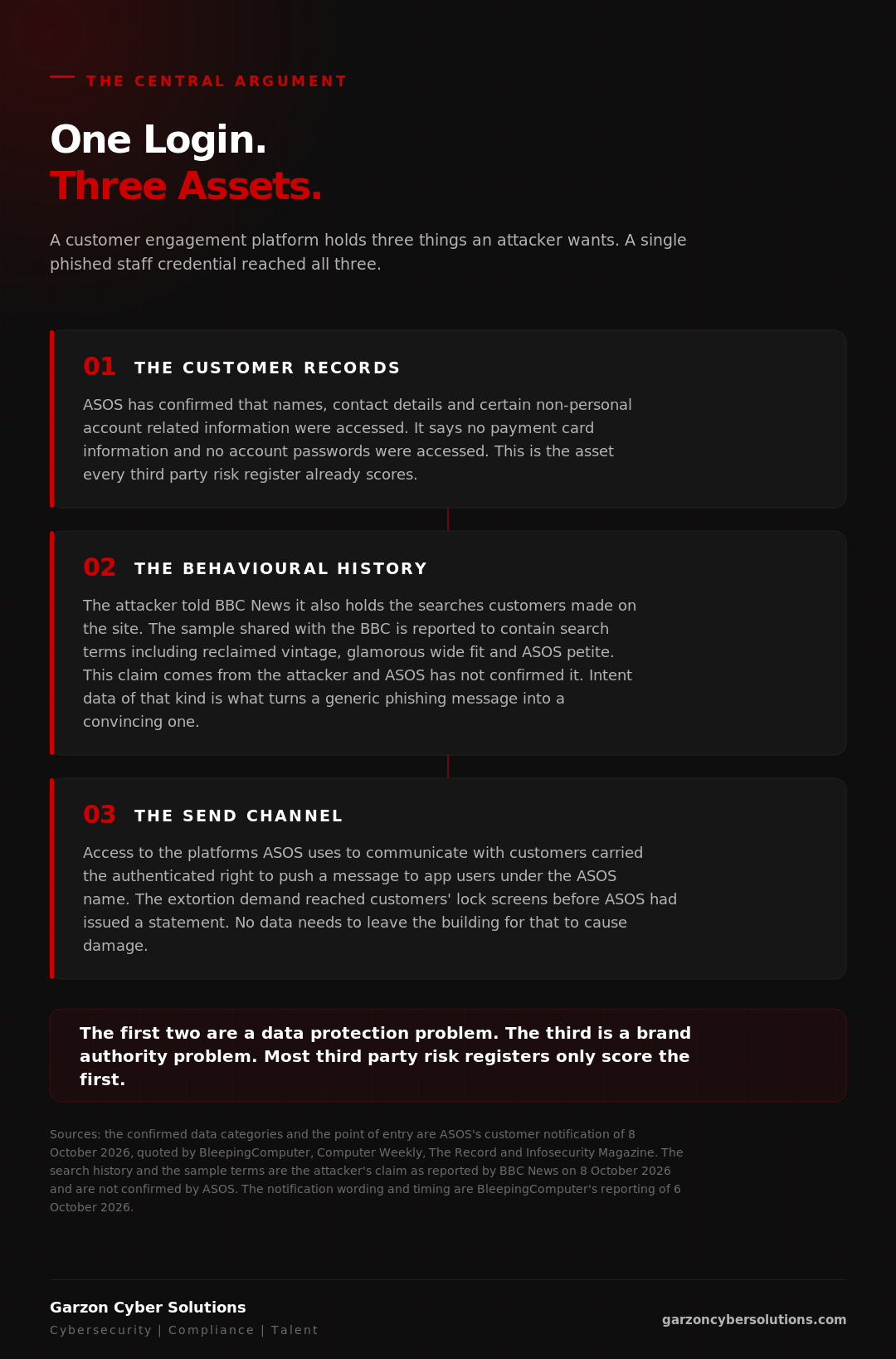
In practice they hold three distinct assets, and an attacker who reaches them collects all three at once.
The customer records. This is the one every third party risk register already scores. ASOS has confirmed names, contact details and certain non-personal account related information were accessed.
The behavioural history. The attacker told the BBC the data also includes what customers searched for on the site. BBC News reports search terms such as "reclaimed vintage", "glamorous wide fit" and "ASOS petite" appearing in a sample it was sent. That claim comes from the attacker and ASOS has not confirmed it. If it holds, it matters more than the contact details, because intent data is what converts a generic phishing message into a plausible one. A message referencing something you were actually shopping for last week does not read like a scam.
The send channel. This is the asset almost nobody governs. Access to the platforms ASOS uses to talk to customers carried the authenticated right to publish to app users under the ASOS name. Camellia Chan, co-founder and chief executive of the data protection firm X-Phy, put the commercial consequence precisely in comments to Computer Weekly: "It didn't sit in an inbox waiting to be read; it lit up the lock screens of app users, under the Asos name, before the company itself had a statement out." Her conclusion is the one to take to a board: "The retailer has, in effect, assembled and qualified the victim pool, and the attackers only needed to borrow the keys."
Notice what that means for incident response. The conventional model assumes the organisation controls disclosure timing: detect, contain, assess, notify the regulator, then tell customers in your own words. Here the attacker published first, through the organisation's own trusted channel, at a moment of their choosing. Every subsequent statement ASOS made was a correction to somebody else's announcement.
What is actually established
This incident has produced a great deal of confident commentary built on an attacker's Telegram posts. It is worth being explicit about which category each claim sits in, because the commercial advice changes depending on the answer.
Confirmed by ASOS. The phished employee account. The use of those credentials against third party platforms. The categories of data accessed. The absence of payment card data and passwords. The lockdown of the affected platforms and the engagement of law enforcement and regulators. These come from the company's own statement to the market and its notification to customers, and they are the only facts in this story sourced to the organisation that was breached.
Claimed by the attacker and not confirmed. That the Snowflake instance was compromised. Snowflake has rejected this on the record, first saying on 6 October that it had found no compromise of the Snowflake platform, and then, in a statement published on 9 October, that the issue "did not in any way result from a vuln, weakness, flaw or misconfiguration with the Snowflake service, platform or internal environments, and was not caused by Snowflake". That Simon AI was the route in. That the stolen data includes search history. A researcher at Malwarebytes has noted that Simon AI is built on Snowflake Cortex AI, which would make any link indirect rather than a platform compromise, but that is an assessment offered to explain a claim, not a confirmation of it.
Not established at all. How many customers are affected. ASOS has not said, and neither has the attacker. Whether data was actually copied out of any system, as distinct from accessed. And whether the ICO has received a breach report, which neither ASOS nor the regulator has stated publicly. ASOS says it is working with regulatory authorities, so no inference should be drawn in either direction.
The group itself is new. The Record notes that Xuanye Group was not previously known to researchers who track extortion gangs, and that it has published no public samples to substantiate its claims, although it reportedly supplied data to the BBC. A brand new Telegram channel, an unfamiliar name and a theatrical "final statement" are not, on their own, evidence of a large data theft. They are also not evidence against one.
The commercial exposure for UK organisations
Regulatory. The ICO's position is not ambiguous. "You must report a notifiable breach to the ICO without undue delay, but not later than 72 hours after becoming aware of it. If you take longer than this, you must give reasons for the delay." Where a breach is likely to result in a high risk to people's rights and freedoms, affected individuals must be told directly and without undue delay. Failure to notify when required carries a penalty ceiling of £8.7 million or 2% of global turnover, and that sits alongside the regulator's other corrective powers rather than in place of them. For most organisations the exposure is not the headline fine. It is that the clock starts from awareness, and that awareness can be created by an attacker posting to your customers rather than by your own detection.
Contractual, and this is the part that gets missed. When the data sits on a supplier's platform, you remain the controller. The ICO quotes Article 33(2): a processor "must inform you without undue delay as soon as it becomes aware" of a breach. It adds that, as required under Article 28, the requirements on breach reporting should be detailed in the contract between you and your processor. Your 72 hour clock is therefore running on somebody else's disclosure discipline. If your marketing platform contracts were negotiated by a marketing team against a standard supplier paper, there is a reasonable chance nobody has read the incident notification clause since signature. That is a one-afternoon piece of work and it is overdue in most organisations.
Financial. The share price reaction is the number to put in front of a board, because it is the only one that is unambiguous and public. More than 10% after the notification, still more than 9.5% down as at 8 October, on an incident with no operational disruption, no payment data loss and no confirmed victim count. The market did not price the data. It priced the loss of control of the customer relationship.
Downstream fraud. Names and contact details alone are low grade. Names, contact details and a record of what someone was shopping for are not. If the attacker's claim about search history holds, the phishing that follows will be substantially more convincing than the usual retail fraud wave, and the organisation carries the customer service cost and the reputational consequence of it regardless of whether the data came out of its own tenancy or a supplier's.
Governance. For organisations in scope of NIS2 in the EU, or of the UK's Cyber Security and Resilience Bill as it progresses, and for financial entities maintaining a register of information under DORA, the question is whether the customer engagement stack appears in the supplier population at all. A platform with standing access to the customer data set and the authority to publish under your brand is not a marketing tool in risk terms, whatever cost centre it was bought from.
What leaders should do now
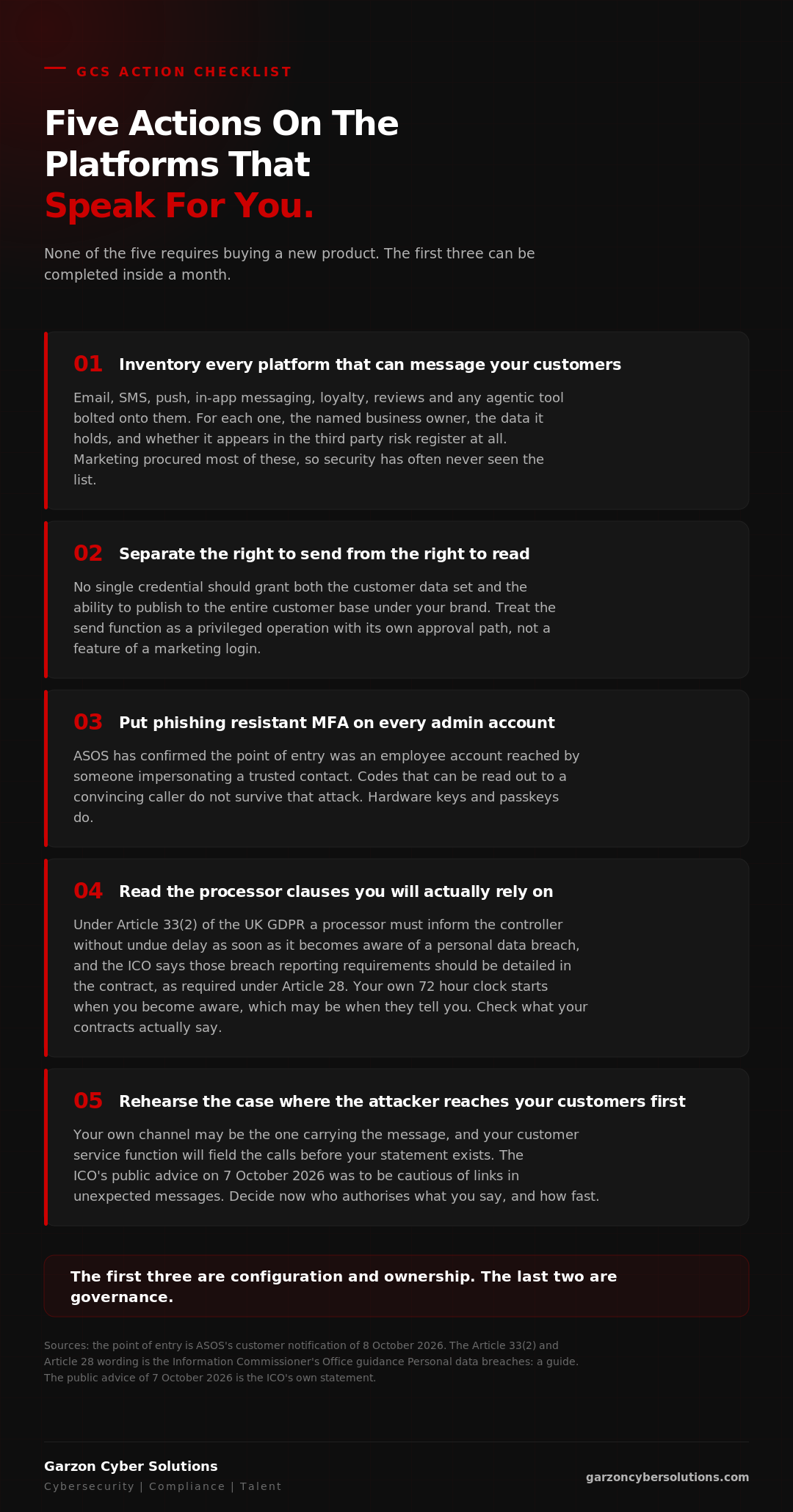
1. Inventory every platform that can message your customers. Email, SMS, push, in-app messaging, loyalty, reviews, and any agentic tooling bolted onto them. For each one: the named business owner, the data it holds, the administrative accounts that exist, and whether it appears in the third party risk register. If that list cannot be produced inside a week, the absence of the list is the finding.
2. Separate the right to send from the right to read. No single credential should grant both the customer data set and the ability to publish to the whole customer base under your brand. Treat an unscheduled broadcast as a privileged operation with its own approval path, not as a routine feature of a marketing login.
3. Put phishing resistant multi-factor authentication on every administrative account across those platforms. ASOS has confirmed the entry point was an employee account reached by someone impersonating a trusted contact. One-time codes that a person can read out to a convincing caller do not survive that attack. Hardware keys and passkeys do.
4. Read the processor clauses you will actually rely on. Specifically: how quickly the supplier must tell you, what they must tell you, and who in your organisation receives it out of hours. Then test it. A notification obligation nobody has exercised is a clause, not a control.
5. Rehearse the case where the attacker reaches your customers before you do. Who authorises a customer-facing statement at 10am on a Tuesday with no facts in hand. What the contact centre says in the first hour. How you tell customers to distinguish your genuine communications from the attacker's, when the attacker has just demonstrated they can use your channel. The ICO's advice to the public on 7 October was to be cautious of links in unexpected messages, which is sensible, and which also makes your own legitimate breach notification harder to land.
Three questions for the board
1. Which third parties can publish to our customers under our name, and who signed that off? Not which hold our data. Which can speak as us.
2. If a supplier to our marketing function were breached tonight, how would we find out, how quickly, and does the contract actually say so? The answer determines whether our 72 hour regulatory clock is within our control or somebody else's.
3. If an attacker announced a breach to our customers before we did, what would we say in the first hour? Not the first day. The first hour, which ASOS spent without a public statement while the message was already on the screens.
Strategic takeaway
The useful lesson here is not about phishing training, and it is not about Snowflake. It is that the customer engagement layer has quietly become one of the highest value targets in a consumer business, and almost nobody governs it that way. It aggregates the customer record, the behavioural signal that makes fraud work, and the brand authority to deliver it. Three assets, usually behind one login, usually owned by a function that does not sit in security governance.
Organisations that treat this as a retail story will patch nothing and change nothing. Organisations that treat it as a third party authority problem will spend a fortnight producing an inventory, tightening a handful of administrative accounts and reading four contracts, and will come out of it with a materially smaller blast radius for a cost that does not need a business case. That is a good trade, and it is available this quarter.
Confidence note
Confirmed, and sourced to the company. The compromise of an ASOS employee account via impersonation of a trusted contact, the onward access to third party platforms, the categories of data accessed, the absence of payment card data and passwords, the lockdown of the affected platforms, and the engagement of law enforcement and regulators. All from ASOS's statement to the London Stock Exchange of 6 October 2026 and its customer notification of 8 October 2026.
Confirmed, and sourced elsewhere. The wording and timing of the push notification, from BleepingComputer's reporting of 6 October 2026. The share price movement, from The Record of 8 October 2026. Snowflake's two statements to Infosecurity Magazine, of 6 October and of 9 October. The ICO's public statement of 7 October 2026, from the regulator's own media centre. The Group-IB finding on the age of the Telegram channel, from Infosecurity Magazine. The regulatory wording is quoted from the ICO's published guidance, not paraphrased.
Reported, and attributed to the attacker. The compromise of a Snowflake instance, first claimed in the notification itself on 6 October and reported by BleepingComputer. The role of Simon AI as the route in, and the presence of customer search history in the stolen data, both relayed by BBC News on 8 October. Snowflake has rejected the claim against it, in terms that broadened between 6 and 9 October. ASOS has confirmed none of these claims.
Assessed, and labelled as ours. That the controlling exposure is the customer engagement layer rather than any one supplier. The read-across to Article 33(2), Article 28, NIS2, DORA and the Cyber Security and Resilience Bill. The five actions and the three board questions. The view that the market reaction priced loss of control of the customer channel rather than the data itself. None of this is stated by ASOS or by any regulator and it should not be read as their position.
Not known. How many customers are affected. Whether data was copied out of any system. Whether the ICO has received a breach report; ASOS says it is working with regulatory authorities and neither party has said more, so no inference should be drawn in either direction. Who the Xuanye Group are. Whether Simon AI or its owner Monetate was involved at all; neither has published a response we could find. We expect material facts to change: The Record reports the investigation is expected to run for several weeks.
Which of your suppliers can send a message to all of your customers, under your name, tonight?
Garzon Cyber Solutions was built around the argument that security, compliance and the people who sustain them are one capability rather than three cost lines. Producing the inventory of platforms that can speak for your brand, separating the right to send from the right to read, and reading the processor clauses you are actually relying on is a short piece of work with a long shelf life. If you would like a view on where your organisation carries unmonitored authority in its customer engagement layer, start a conversation.
Start the Conversation →ASOS's own statements are the primary source for everything attributed to the company. The regulatory wording is quoted from the ICO's published guidance. Claims attributed to the attacker are reported, not confirmed.
BleepingComputer, "ASOS confirms data breach after “HACKED” in-app notifications", 6 October 2026, for the notification wording and timing · BleepingComputer, "ASOS links data breach to social engineering attack, credential theft", 8 October 2026, carrying the customer notification · Computer Weekly, "Scope of Asos data breach wider than first reported", 8 October 2026, carrying the full ASOS customer statement · The Record, "ASOS: Hackers tricked way into employee account before sending rogue push notification", 8 October 2026, for the share price movement · Infosecurity Magazine, "ASOS Customers Receive Bizarre “Hacked” Message Amid Suspected Snowflake Compromise", 6 October 2026, carrying Snowflake's first statement · Infosecurity Magazine, "ASOS Confirms Data Breach Linked to Stolen Employee Credentials", 8 October 2026, updated 9 October with Snowflake's broader statement · Infosecurity Magazine, "Telegram Account Behind ASOS Rogue Notification Tied to Gaming Trading", 7 October 2026, for the Group-IB finding · BBC News, 8 October 2026, for the attacker's account of the route in and the data sample · Information Commissioner's Office, "ASOS statement", 7 October 2026, primary source · ICO, "Personal data breaches: a guide", on the 72 hour deadline, Article 33(2), Article 28 and the penalty ceiling · ICO, "A guide to data security", on Article 32 and security appropriate to the risk · NCSC, "Phishing attacks: defending your organisation" · NIS2 Directive (EU) 2022/2555 · DORA, Regulation (EU) 2022/2554, Chapter V on ICT third-party risk and the register of information · UK Parliament, "Cyber Security and Resilience (Network and Information Systems) Bill: Stages"
Garzon Cyber Solutions delivers cybersecurity advisory, compliance certification and specialist technology recruitment as one integrated capability for organisations in the UK, EU and beyond.