The Precondition Was A Signup Form
A critical flaw in a widely used self-hosted Git server reads like it needs an insider. The product’s default configuration hands that access to anyone with a browser. Twenty-nine days passed between the patch and the exploitation warning, and the gap is a governance failure rather than a patching one.
What happened
On 27 July 2026 the Gitea project released version 1.27.1. The release notes list two security fixes. The second, CVE-2026-60004, is described as remote code execution via the diffpatch API through Git hook installation. The security advisory itself followed a day later, on 28 July, crediting the researcher Shai Rod, who publishes as NightRang3r and works at Salesforce.
The mechanics are worth understanding, because the detail is what misleads a triage process. Gitea applies a submitted patch inside a temporary clone. Submitting the same patch twice produces a collision, and a three-way fallback then writes the file to disk despite a flag that should have kept it in the index. Because the temporary clone is bare, its root is the Git directory, so a file written to the hooks path becomes a live Git hook. Git then executes it. The vulnerability carries a CVSS v3.1 base score of 9.8 and is classified as CWE-94, code injection. A working proof of concept was published in the advisory itself.
On 25 August, CISA added the flaw to its Known Exploited Vulnerabilities catalogue and instructed federal civilian agencies to remediate by 28 August, a three-day window under Binding Operational Directive 26-04. The agency published no detail on the attacks and no attribution. SecurityWeek noted that there appeared to be no prior public reports of exploitation, and that who is behind the activity and what they want remains unclear.
The one documented compromise in the public record is a self-published incident write-up by a developer whose organisation ran an outdated instance with open registration, no email confirmation and no CAPTCHA. An automated scanner registered an account, created a repository, triggered the exploit chain, wrote a proof of code execution back into a Git branch, then pulled down a shell loader and a second-stage dropper that behaved like a crypto-miner. The developer did not analyse the payload and has stated they hold no confirmed information on the miner family, pool, wallet or operator, so the mining description should be read as behaviour rather than identification. By the same account, the active portion of the attack took about eleven seconds. The container was not privileged, the payload did not survive a restart, and no persistence was found.
A note for anyone acting on this today. Version 1.27.2 has since shipped and is the current fixed release, carrying further security fixes. Reaching 1.27.1 is no longer sufficient.
Why this one is different
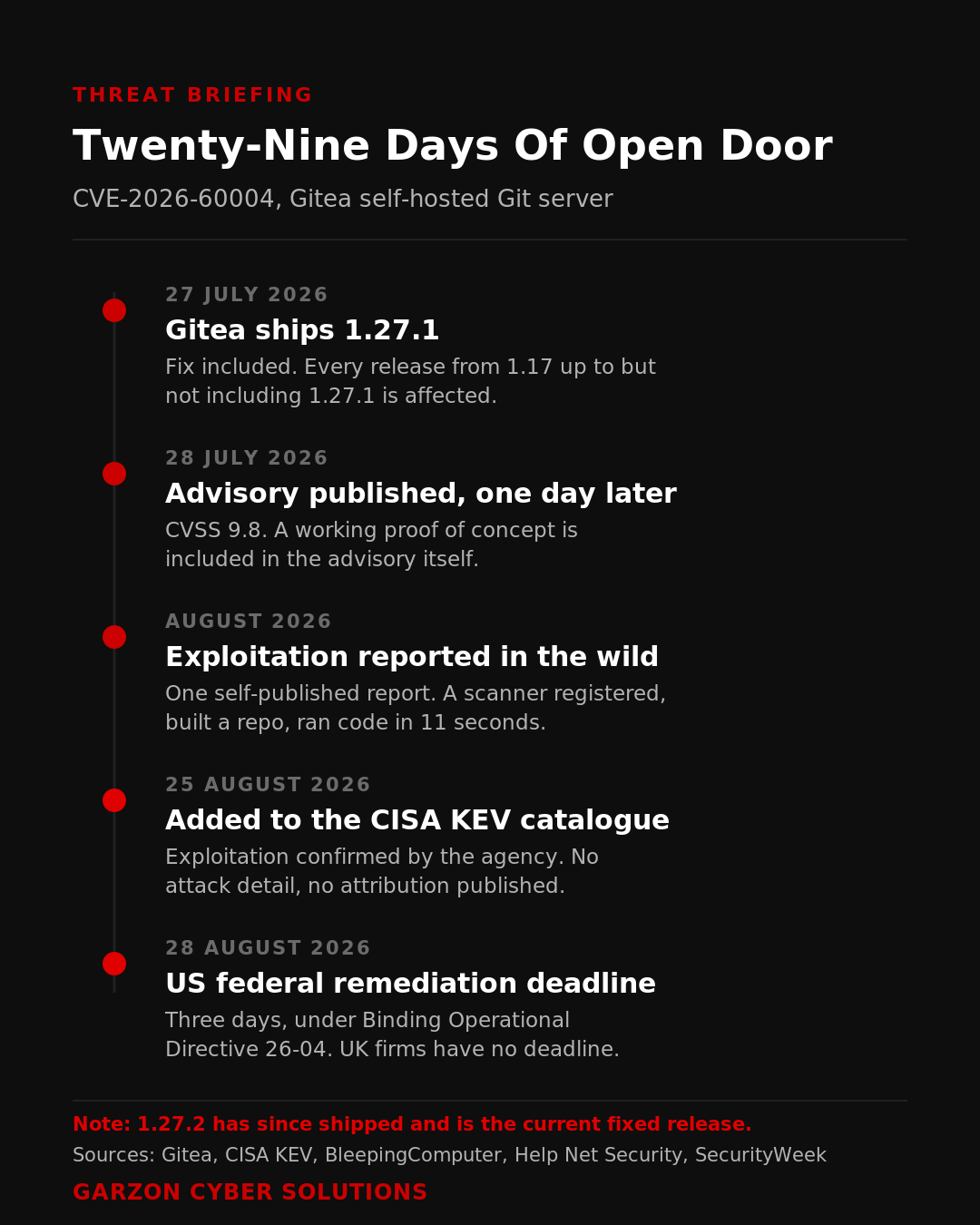
Read the vulnerability description as a security team would on a Monday morning. An attacker with ordinary write access to a repository can execute arbitrary shell commands as the Gitea OS user. That sentence contains a privilege precondition, and every triage process in existence treats a privilege precondition as a reason to lower the priority. Insider risk. Requires credentials. Schedule it.
Now read the product’s shipped configuration. Registration is open. There is no email confirmation. There is no administrator approval step. New accounts are not marked restricted. There is no repository creation limit. The precondition the CVE describes is not a barrier. It is a self-service form, and the attacker fills it in themselves. This is precisely why the CVSS vector records privileges required as none, and why the score is 9.8 rather than something comfortable in the sevens.
Three environmental conditions also have to hold: Git 2.32 or later on the host, the diffpatch route enabled, and a temporary filesystem that is both writable and executable. The assessment published by the external exposure researchers who documented the mechanics is that common default deployments satisfy all three. Which is the point. The chain is built out of defaults from end to end, and defaults are exactly what a busy engineering team leaves alone.
There is a second reason this matters more than the severity number suggests, and it concerns which asset is exposed. Gitea is popular because it is small, fast and simple to stand up. That is also why it tends to live outside central IT: deployed by one engineering team, by a contractor, on a spare cloud instance for a single project, or inside an internal tooling stack that nobody formally inventoried. In the published external asset data, the largest single bucket of exposed Gitea instances was an unclassified group at 42.6%, most of which the researchers could not attribute to a sector at all. Their assessment, which we find persuasive, is that assets resisting industry attribution tend to be the same assets resisting ownership attribution. A server nobody remembers owning does not appear in a patch cycle.
Third, the published proof of concept requires no outbound callback. It stores command output in Git objects and retrieves it over authenticated HTTP. An organisation relying on egress monitoring to catch post-exploitation activity would see nothing unusual. The compromise in the public record was discovered because the hosting provider flagged sustained high CPU, which is to say it was found by accident, by a third party, on the strength of a noisy payload. A quieter attacker collecting credentials would not have raised that flag.
The dated sequence
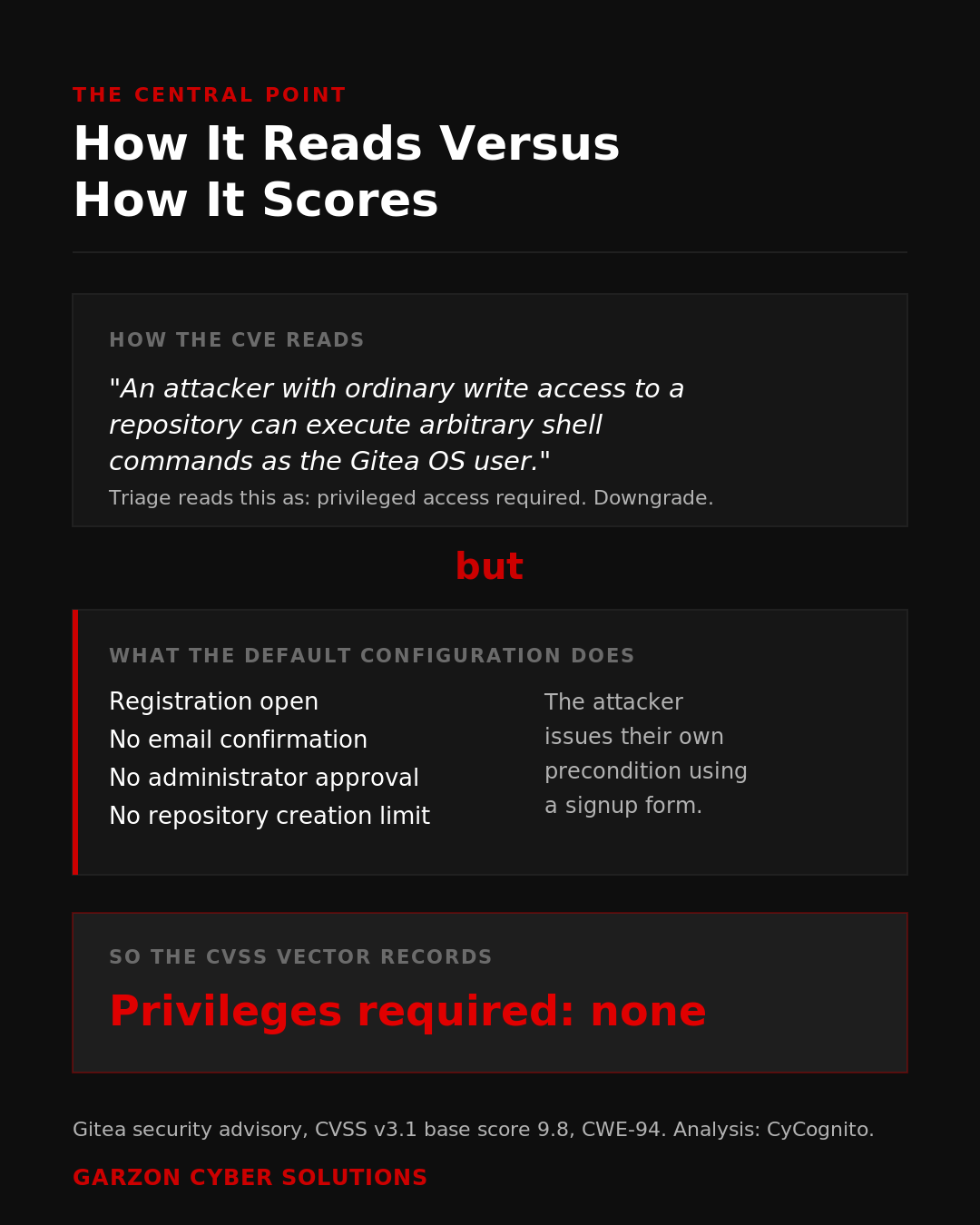
- 27 July 2026Gitea 1.27.1 ships with the fix. Every release from 1.17 up to but not including 1.27.1 is affected, spanning roughly four years of versions.
- 28 July 2026The security advisory publishes a day after the release, carrying a CVSS v3.1 score of 9.8 and a working proof of concept.
- August 2026A developer publishes an account of their own compromised instance. An automated scanner registered an account, created a repository and executed code inside the container. The active portion of the attack took about eleven seconds.
- 25 August 2026CISA adds CVE-2026-60004 to the Known Exploited Vulnerabilities catalogue, confirming exploitation. No attack detail and no attribution are published.
- 28 August 2026The US federal remediation deadline falls, three days after listing, under Binding Operational Directive 26-04. UK organisations carry no equivalent deadline.
The commercial exposure for UK organisations
Regulatory
The Cyber Security and Resilience Bill has completed second reading in the House of Lords, with committee stage due to begin on 1 September 2026. It expands the scope of the NIS Regulations to include managed service providers and, importantly for this story, suppliers that are critical to a regulated organisation’s ability to deliver its essential service. If your firm builds software that a regulated entity depends on, your build chain is moving inside somebody else’s regulatory perimeter. Separately, if a compromised Git server held credentials to systems processing personal data, the reporting question arrives regardless of whether the attacker used them.
Financial
Mining is the cheap outcome and the visible one. The expensive outcome is credential harvest. Code execution as the Gitea service account can expose the application configuration file, process environment variables, database credentials and contents, and OAuth and integration credentials. From there the target is not the Git server. It is everything the Git server is trusted to reach. The cost of that incident is not the forensics bill. It is the period during which you cannot demonstrate that your released software is what you think it is.
Contractual
Enterprise customer agreements and ISO 27001 or SOC 2 attestations make specific claims about access control, secure development and change management. An organisation that cannot produce a list of its source control servers with named owners is making a claim it cannot evidence. That gap surfaces at the worst possible moment, which is during a customer security review or a renewal negotiation rather than during an audit.
Governance
The honest board question is not whether Gitea was patched. It is which production-adjacent systems have no named owner, and how the organisation would know. Every organisation has a version of this asset. The technology changes, the pattern does not: a tool adopted by a capable team for good reasons, running usefully for years, outside the process that would have told anyone to upgrade it.
What leaders should do now
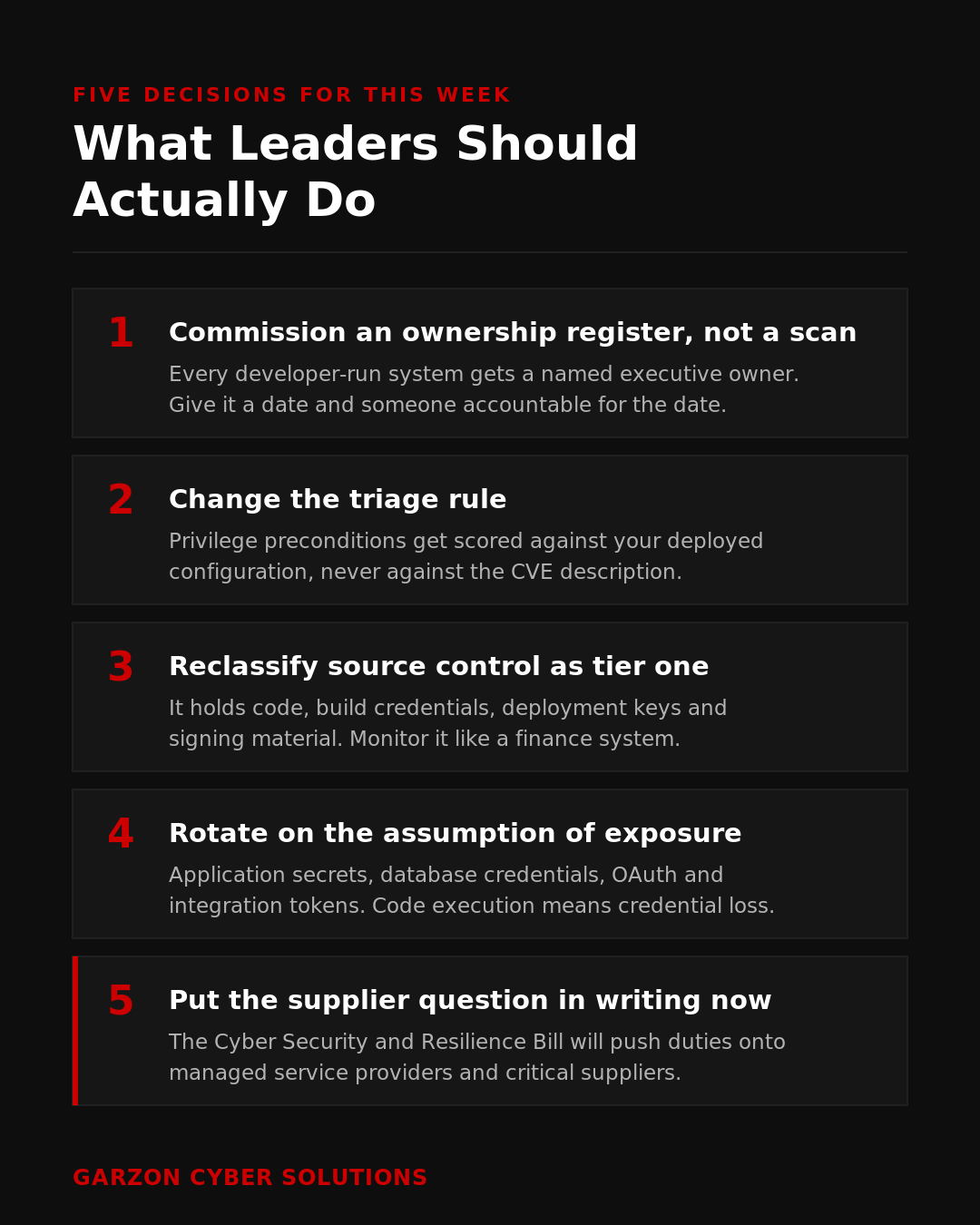
1. Commission an ownership register, not another scan. Scanning tells you what exists. It does not tell you who is accountable when a fix is needed. Require a named executive owner for every developer-run system, with a delivery date and someone answerable for that date.
2. Change the vulnerability triage rule. Make it mandatory to assess privilege preconditions against your deployed configuration rather than the CVE description. Add the question to the workflow as a field that cannot be skipped. This single change would have reprioritised CVE-2026-60004 on 28 July.
3. Reclassify the source control estate as tier one. It holds source code, build credentials, deployment keys, signing material and container images. Give it the monitoring, backup, access review and recovery testing you already apply to finance systems.
4. Rotate on the assumption of exposure, not on proof of it. Where an affected instance ran an unpatched version with open registration, treat application secrets, database credentials, OAuth tokens and deployment keys as exposed and rotate them. Upgrade to 1.27.2 and disable open registration in the interim, noting that disabling registration is a mitigation rather than a fix and does nothing about accounts that already hold write access.
5. Put the supplier question in writing this week. Ask your significant technology suppliers how they inventory and patch developer-run infrastructure. Do it before the Cyber Security and Resilience Bill turns that question into a contractual obligation flowing down to you.
Three questions for leadership
Which systems holding our source code, build credentials and signing keys have a named executive owner, and can we produce that list today?
When our vulnerability process reads requires privileged access, who checks whether our own configuration gives that privilege away for free?
If a build server had been compromised for a month with no outbound callback, which control would have told us?
If the first question cannot be answered with a document, the other two are academic.
The strategic takeaway
Vulnerability management scores the attacker’s starting position. Configuration determines it. Any programme that reads the CVE text and not the deployed configuration is measuring a different threat from the one it actually faces, and the difference is measured in weeks.
The organisations that handled this well were not the ones with better tooling. They were the ones that could answer, on the day the advisory landed, a simple question: do we run this, where, and who owns it.
That is not a security capability. It is an operating discipline, and it is bought with governance rather than licences.
Confidence note
Confirmed. CVE-2026-60004 exists and is rated CVSS v3.1 9.8, CWE-94. Gitea 1.27.1 shipped on 27 July 2026 with the fix and the advisory published on 28 July. Affected versions run from 1.17 up to but not including 1.27.1, and 1.27.2 has since been released as the current fixed version. CISA added the flaw to the KEV catalogue on 25 August 2026 with a federal remediation deadline of 28 August under Binding Operational Directive 26-04. Gitea’s own advisory confirms that default open registration allows an unauthenticated visitor to obtain the required write access. Close to 5,000 internet-exposed Gitea instances are tracked, though how many are honeypots or already patched is not known.
Reported, single source. The only publicly documented compromise is a self-published incident write-up by an individual developer. The eleven-second attack duration, the absence of persistence and the container details all come from that account and have not been independently verified. The second-stage payload was described as mining-like on the basis of CPU consumption; the reporter has stated they did not analyse it. We have not called it a confirmed crypto-miner for that reason.
Assessed, not confirmed. Reporting assessed that the KEV addition was likely prompted by that write-up. CISA itself published no attack detail. The scale of exploitation, the identity of the operators and their objective are not established, and no UK victim has been named. Gitea stated that Cloud instances would be upgraded automatically, which we have not independently verified, so the claim that exposure is concentrated in self-managed installations is an assessment rather than a finding.
Scoped. The exposure proportions referenced here describe one vendor’s observed external asset set. They are not a census of global Gitea deployments, and the size of the unclassified group relative to individual named sectors is not established.
Can you name the owner of every system holding your source code?
Most organisations cannot, and they find out during a customer security review rather than on their own terms. A focused assessment of developer-run infrastructure: where it sits, who owns it, what it can reach, and what evidence you could put in front of a regulator, an insurer or an enterprise client tomorrow.
Start the Conversation →Sources: Gitea, release notes for version 1.27.1, 27 July 2026, and the associated security advisory for CVE-2026-60004, 28 July 2026. Gitea, release notes for version 1.27.2. CISA, “CISA Adds One Known Exploited Vulnerability to Catalog”, 25 August 2026, and the Known Exploited Vulnerabilities catalogue entry. BleepingComputer, “Hackers now exploit critical Gitea flaw in code injection attacks”, 26 August 2026. Help Net Security, “Critical Gitea vulnerability now exploited in the wild”, 26 August 2026. SecurityWeek, “CISA Warns of Exploited Gitea Vulnerability”, 26 August 2026. The Hacker News, “Critical Gitea RCE Actively Exploited as Reported Attack Drops Miner-Like Payload”, August 2026. CyCognito, emerging threat advisory for CVE-2026-60004, 30 July 2026, for the vulnerability mechanics, CVSS vector analysis and external exposure data. Shadowserver, internet-exposed Gitea instance tracking. UK Parliament, Cyber Security and Resilience (Network and Information Systems) Bill, bill stages. House of Commons Library, research briefing CBP-10442. GCS Threat Briefings translate live incidents into the governance and commercial decisions boards and security leaders need to make.
Garzon Cyber Solutions delivers cybersecurity advisory, compliance certification, and specialist technology recruitment as one integrated capability. We are a young firm, the founder personally runs the work, and our perspective comes from a career spent selling cybersecurity, compliance and technology to security and technology buyers, working alongside marketing and technical colleagues.