Your Detection Architecture Is Facing the Wrong Direction
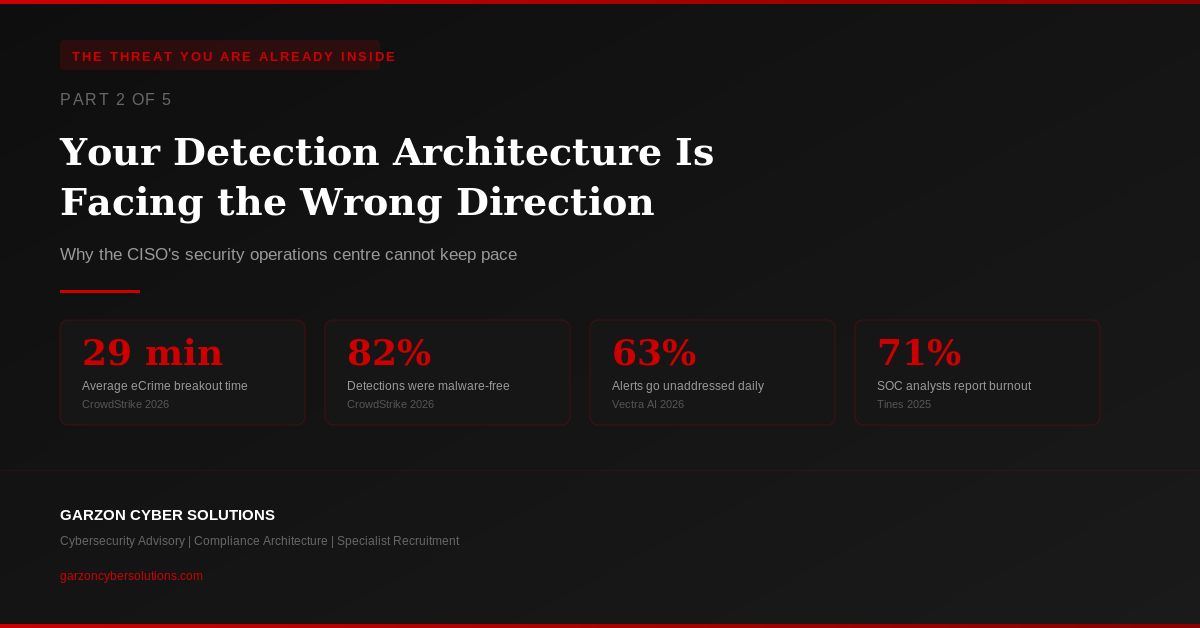
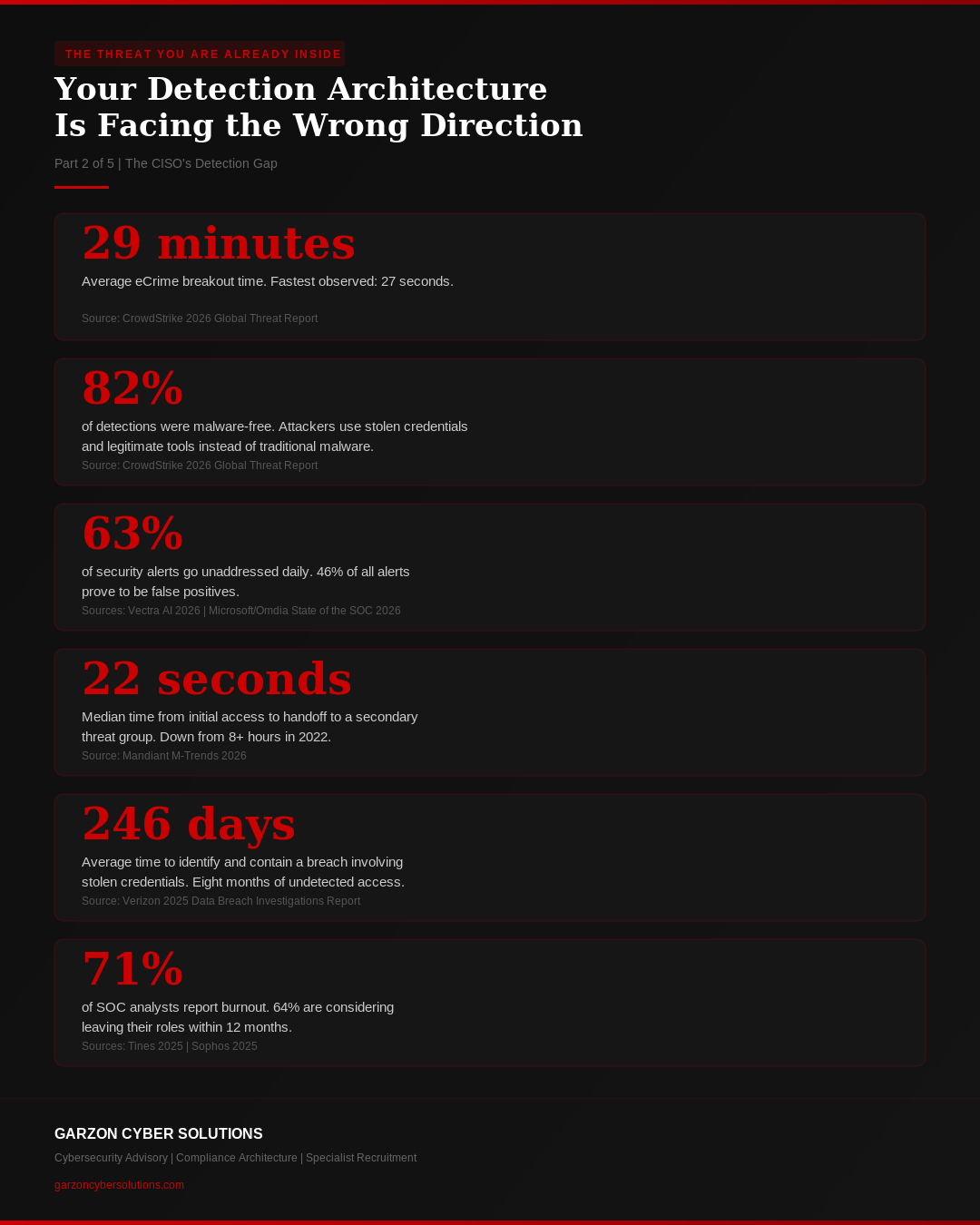
The average eCrime breakout time fell to 29 minutes in 2025. The fastest observed breakout, from initial access to lateral movement, took 27 seconds. CrowdStrike’s 2026 Global Threat Report documents this as a 65% acceleration from the previous year. In one intrusion, data exfiltration began within four minutes of initial access.
Most security operations centres were designed to detect threats that no longer exist in the form they were built to find.
The architecture was built for a different attacker.
CISOs inherited a detection model constructed around a specific assumption: that attackers deploy malware, trigger signatures, and move through networks slowly enough for analysts to investigate, escalate, and respond. That assumption is now operationally obsolete.
CrowdStrike found that 82% of detections in 2025 were malware-free. Attackers are using stolen credentials, legitimate remote access tools, and living-off-the-land techniques that produce no signatures for traditional detection to catch. IBM’s 2026 X-Force Threat Intelligence Index confirmed that vulnerability exploitation was the leading cause of attacks, accounting for 40% of observed incidents. Credential harvesting was the most common impact. The Verizon 2025 Data Breach Investigations Report found that breaches involving stolen credentials took an average of 246 days to identify and contain. Eight months of undetected access.
The detection stack sees the malware. It does not see the attacker who logged in with valid credentials and moved laterally using tools the organisation already trusts.
Alert volume is not a detection capability.
Vectra AI’s 2026 research found that organisations receive an average of 2,992 security alerts daily, yet 63% go unaddressed. The Microsoft and Omdia State of the SOC report, published in February 2026, found that 46% of all alerts are false positives and 42% go entirely uninvestigated.
The mathematics of this warrants examination. If nearly half of all alerts are false positives and more than four in ten are never investigated, the SOC is not a detection function. It is a triage function that is losing.
Splunk’s 2026 CISO Report surveyed 650 CISOs globally and found that 98% cited high alert volumes as a leading stressor, 94% cited false alerts, and 79% cited tool fatigue. The detection architecture is generating noise at a scale beyond human capacity to process. More tools have not solved this. They have compounded it.
The speed gap is structural.
Mandiant’s M-Trends 2026 report, based on 450,000 hours of incident response, found that the median time between an initial access event and the handoff to a secondary threat group collapsed from more than eight hours in 2022 to 22 seconds in 2025. Palo Alto Networks’ Unit 42 found that in the fastest cases investigated, attackers moved from initial access to data exfiltration in 72 minutes, four times faster than the previous year.
The CISO’s detection and response cycle, from alert generation through triage, investigation, escalation, and containment, was designed for a threat that moved in days. The threat now moves in minutes. The gap between the attacker’s speed and the defender’s response time is not closing. It is widening.
Fortinet’s 2026 Global Threat Landscape Report found that the median time to exploit is now measured in hours rather than days and documented a 389% year-over-year surge in ransomware victims, driven by AI-powered attack automation. The organisations that experienced these attacks had security operations centres. They had detection tools. What they lacked was an architecture capable of matching the threat’s operational tempo.
The SOC cannot hold
Tines found that 71% of SOC analysts report burnout. 64% are considering leaving their roles. Sophos’s 2025 data showed 76% of cybersecurity professionals experienced burnout either constantly, frequently, or occasionally over the past year.
The human layer of the detection architecture is degrading. Experienced analysts are leaving. Replacements take months to hire and longer to train to operational effectiveness. Meanwhile, IBM’s X-Force identified 109 distinct extortion groups operating in 2025, up from 73 the previous year. The attack surface is fragmenting. Palo Alto Networks found that 87% of attacks unfolded across multiple surfaces simultaneously, and identity weaknesses played a material role in nearly 90% of the incidents Unit 42 investigated.
The CISO who relies on headcount to close the detection gap is solving a structural problem with a depleting resource.
What needs to change
The detection architecture most CISOs operate was designed for perimeter defence and signature-based threats. The threat environment has shifted to identity-based access, living-off-the-land techniques, and multi-surface attacks that unfold faster than human analysts can process.
Rebuilding detection capability requires three shifts. First, moving from alert volume to signal quality. The organisations that detect threats effectively are not the ones generating the most alerts. They are the ones that have reduced false positives and focused analyst attention on the signals that matter. Second, closing the identity gap. When 82% of attacks are malware-free and credential-based access is the primary vector, detection must centre on identity behaviour rather than endpoint signatures. Third, accepting that the response timeline has compressed permanently. Detection that cannot lead to containment within minutes arrives after the damage is done.
The World Economic Forum’s Global Cybersecurity Outlook 2026 found that only 16% of organisations with industrial environments report OT security issues to their boards. The gap between what the detection architecture sees and what the board understands remains one of the most consequential governance failures in modern enterprise security.
The question for every CISO is not whether the SOC is busy. It is whether the detection architecture can identify the threats that are actually inside the network, moving at the speed they do now, using the techniques they do now.
This is Part 2 of “The Threat You Are Already Inside,” a five-part series examining how cybersecurity risk intersects with every level of the organisation. Part 3 examines what the CTO needs to understand about infrastructure debt as a security liability.
Garzon Cyber Solutions provides cybersecurity advisory, compliance architecture, and specialist recruitment for organisations building integrated security capability.
Where does this sit on your own risk register?
A short, practical conversation about where the exposure actually is, and what a proportionate response looks like. No obligation and no product pitch.
Start the Conversation →