Both Flaws Need Access To Your Admin Interface. CISA Still Gave Three Days, Not The Usual Fortnight.
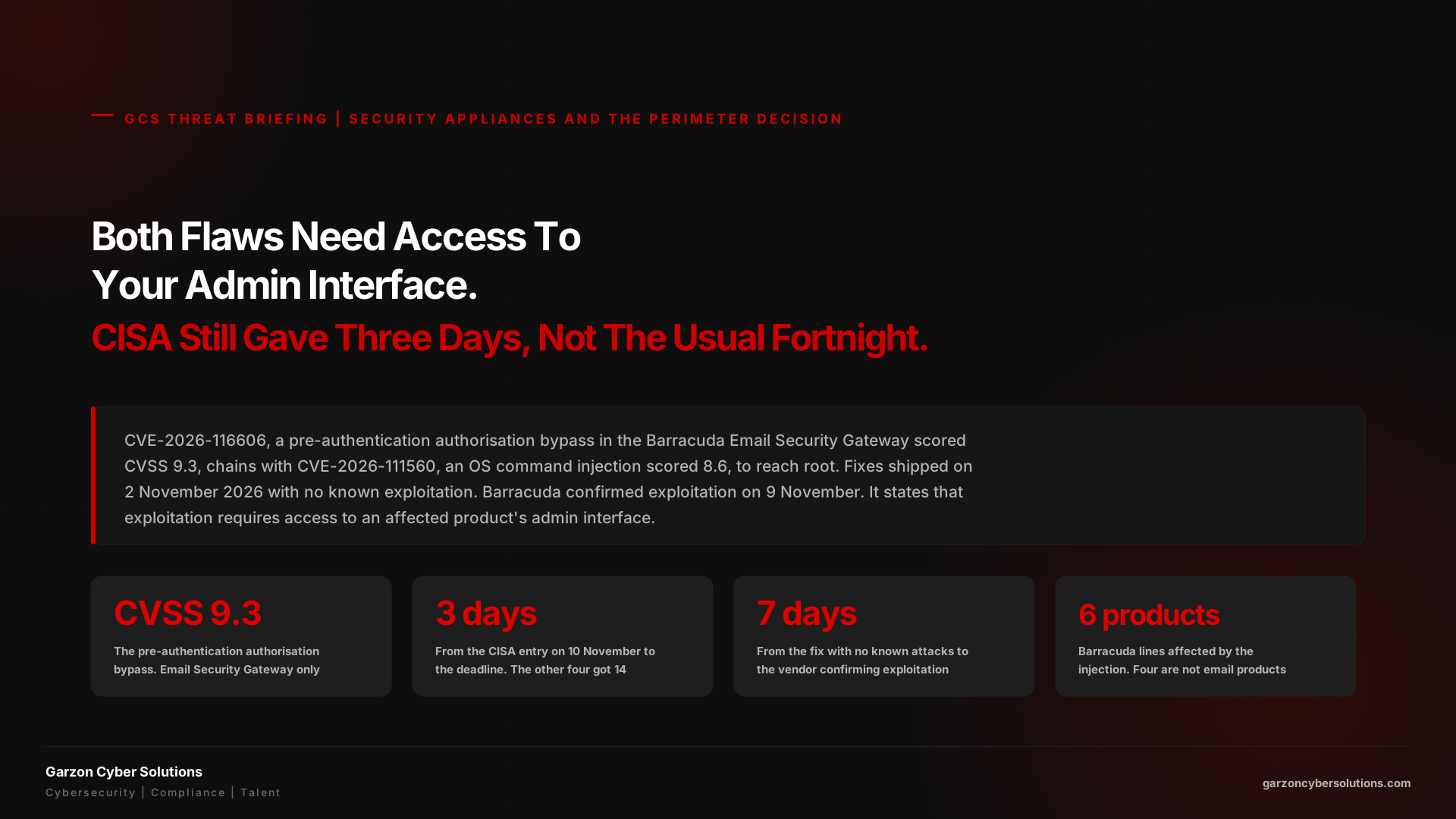
On 2 November 2026 Barracuda published fixes for two vulnerabilities in its appliance range and reported no active exploitation. Seven days later it updated that advisory to say exploitation had been identified, affecting what it called a small number of organisations. On 10 November CISA added both flaws to its Known Exploited Vulnerabilities catalogue and set a remediation date of 13 November, three days rather than the fortnight the other four vulnerabilities in the same release were given. The technical chain is interesting. The governance point is sharper. Barracuda's own condition on both vulnerabilities is that successful exploitation "requires an attacker to have access to the administrative interface of an affected product". In practice that is a question of network reachability, which means your exposure was decided by a firewall rule and a published port rather than by your patch cadence. Most organisations running one of these appliances cannot answer that question this morning. It takes one request from outside the network to answer it.
What happened
Two vulnerabilities, recorded in Mandiant's disclosure timeline with report dates of 15 and 22 October 2026, were fixed and disclosed together on 2 November. Mandiant is the CVE Numbering Authority here rather than the finder, and the public record does not establish who found them. Taken individually neither is remarkable. Chained, they take an attacker from no credentials to root on an appliance that sees every message entering and leaving the organisation.
CVE-2026-116606, scored 9.3 under CVSS v4.0, is an authorisation bypass in the Email Security Gateway's administrative interface. An unauthenticated password-change attempt fails, as it should, but instead of halting the request the code returns the low-privilege role belonging to the login screen and carries on processing. That is enough to reach a configuration-import function. watchTowr Labs, which published the full chain on 5 November, found that the integrity checksum on a Barracuda configuration backup is derived from a hardcoded secret, so an attacker can forge one. The bypass therefore lets an unauthenticated attacker restore a crafted backup and overwrite the appliance's global configuration.
CVE-2026-111560, scored 8.6, is an OS command injection. The value held in the system timezone field reaches a shell command and a root-level script invoked through sudo, so crafted input runs as root. On its own this flaw requires administrator access, and it scores below the bypass at 8.6 against 9.3. The bypass is what supplies that access, and the configuration restore is what writes the malicious timezone value. That ordering matters. On the reading this briefing follows, supported by Barracuda's own classification of the injection and by both Beazley Security and watchTowr, the command injection is not an unauthenticated flaw in its own right. It becomes one on the Email Security Gateway, and only there, because that is the one product in the range that carries the bypass. BleepingComputer reports the injection as unauthenticated on its own; this briefing does not follow that reading.
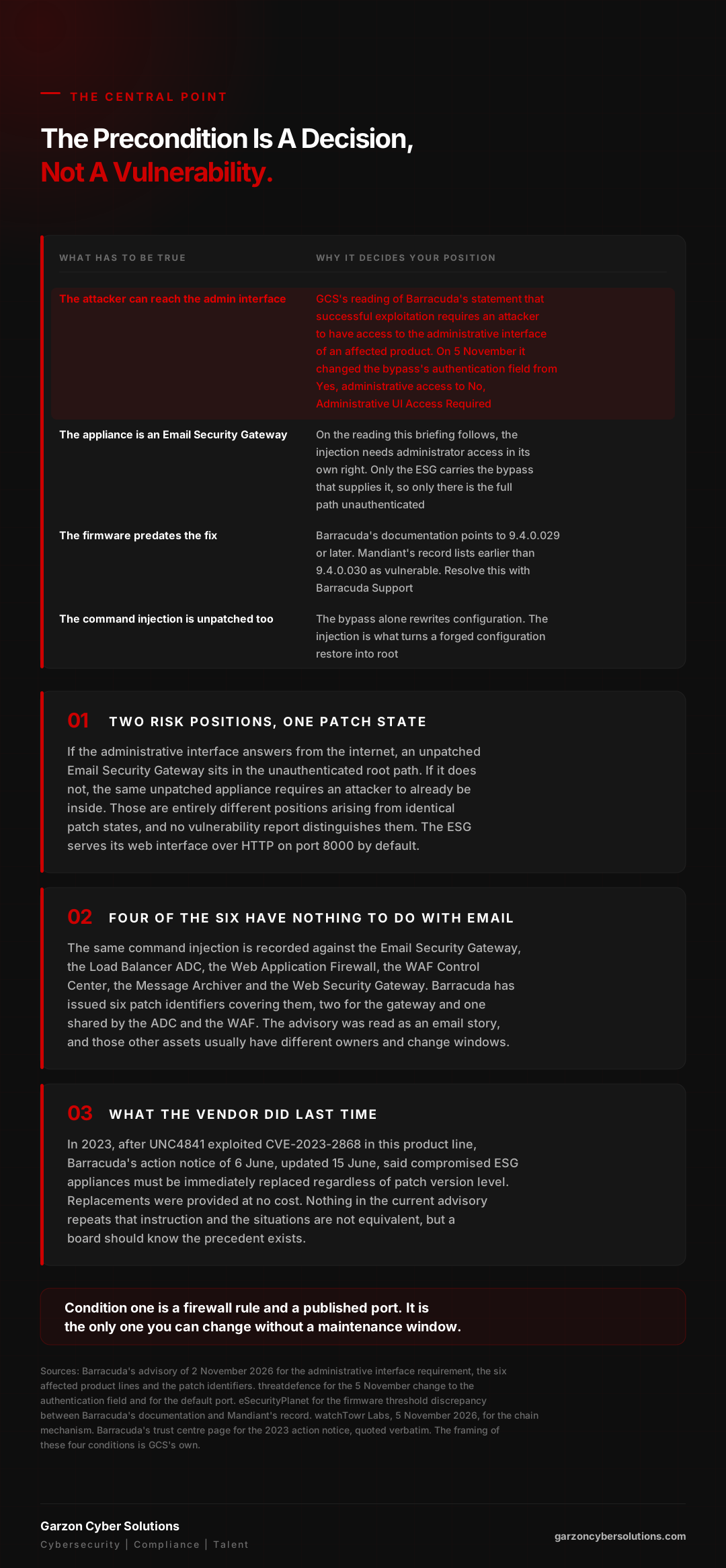
The injection, though, is not confined to the email gateway. The same flaw is recorded against six Barracuda product lines: the Email Security Gateway, the Load Balancer ADC, the Web Application Firewall, the WAF Control Center, the Message Archiver and the Web Security Gateway. Barracuda has published six patch identifiers across those lines, two of them for the Email Security Gateway and one shared by the Load Balancer ADC and the Web Application Firewall. An organisation that read the headline, found its email gateway and patched it has addressed one of six.
Barracuda's advisory on 2 November reported no active exploitation. On 5 November watchTowr published the chain and a public tool, which its README describes as a detection artifact generator and which accepts whatever command an operator supplies. On 6 November a detection template for the bypass was proposed for Nuclei, a widely used open template library for vulnerability scanning, and on 8 November it was merged. Late on Monday 9 November Barracuda updated its advisory to confirm exploitation affecting a small number of organisations. It declined to say how many and said it had worked directly with the affected businesses. On 10 November CISA added both CVEs to its Known Exploited Vulnerabilities catalogue with a remediation date of 13 November.
Why this one is different
Three things set this apart from an ordinary critical-patch cycle, and the severity score is not one of them.
The first is that the determining condition is a configuration decision rather than a software defect. Barracuda states that successful exploitation "requires an attacker to have access to the administrative interface of an affected product". On 5 November it changed the bypass's authentication field from "Yes, administrative access" to "No (Administrative UI Access Required)", dropping the authentication requirement while recording that access to the administrative interface is needed. Reading that condition as a question of network reachability is this briefing's gloss rather than the vendor's wording, but it is the only reading that makes operational sense for an appliance. The Email Security Gateway serves its web interface over HTTP on port 8000 by default. If that interface answers from the internet, an unpatched appliance sits in the unauthenticated root path. If it does not, the same unpatched appliance requires an attacker to already be inside. Those are two entirely different risk positions arising from identical patch states, and the difference between them was settled by whoever configured the perimeter, quite possibly years ago and quite possibly no longer with the organisation. No vulnerability report will tell you which position you are in. A single request from outside your own network will.
The second is where the appliance sits. An email security gateway is placed deliberately in front of everything, because its job is to inspect mail before anything else does. Root on that device is not equivalent to root on a web server. It is a position with sight of message content and attachments in transit, the routing configuration, and whatever credentials the appliance holds to talk to directory and mail infrastructure. The control bought to reduce email risk becomes the most valuable single foothold in the estate. That is the uncomfortable arithmetic of security appliances generally, and it is worth a board hearing it plainly once.
The third is Barracuda's own precedent, and it is the detail most likely to change a budget conversation. In 2023 the group Mandiant tracks as UNC4841 exploited CVE-2023-2868 in the same product as a zero-day, and Barracuda later established that exploitation had been running since at least October 2022. Mandiant found that 27 per cent of the identified affected organisations were government entities. Barracuda's action notice of 6 June 2023, updated on 15 June, said: "Compromised ESG appliances must be immediately replaced regardless of patch version level." It provided replacements at no cost and was still recommending replacement in late August 2023. Nothing in the current advisory repeats that instruction, and this briefing does not suggest the two situations are equivalent. But a leadership team deciding how seriously to treat a potentially compromised Email Security Gateway should know that the vendor's own documented position, the last time one was compromised, was that patching it was not a remedy.
Commercial exposure for UK and European organisations
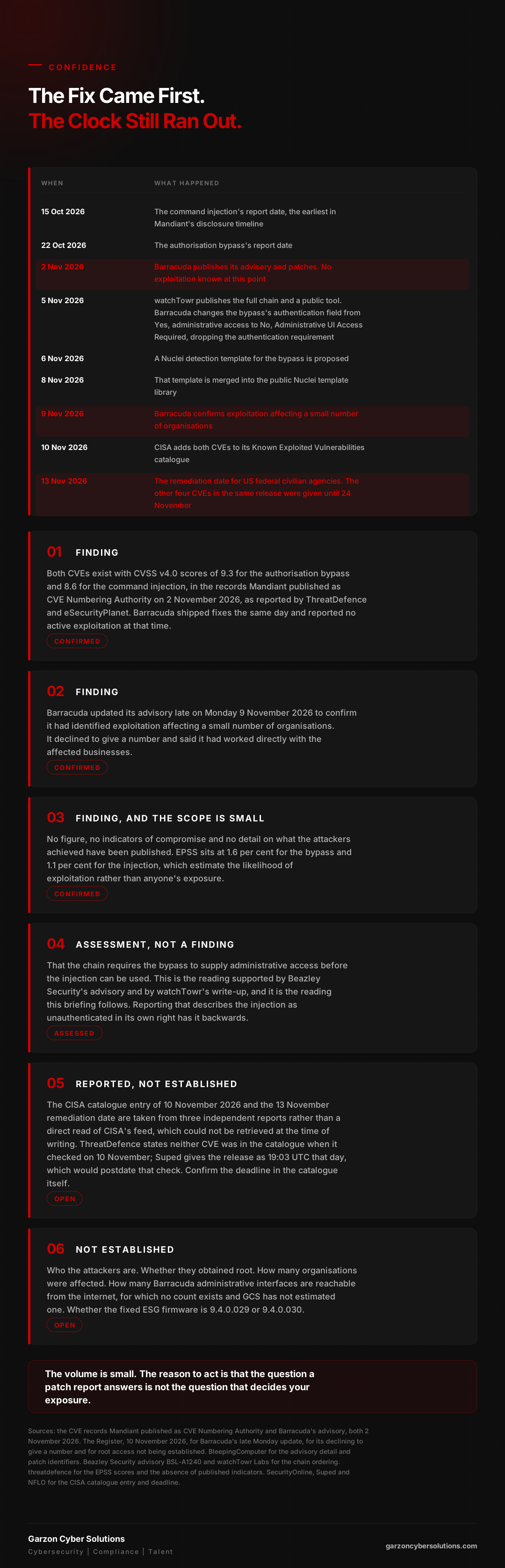
Begin with scope, because it is modest and saying so is worth more than drama. Barracuda's phrase is a small number of organisations. It has published no figure, no indicators of compromise and no detail on what the attackers achieved, and The Register reports that it is not established whether root was obtained. No threat actor has been identified. The EPSS scores sit at 1.6 per cent for the bypass and 1.1 per cent for the injection, and those estimate the likelihood of exploitation rather than anyone's exposure. Nobody has published a credible count of internet-facing Barracuda administrative interfaces, and this briefing has not estimated one.
So this is not a mass-exploitation event. It is a confirmed exploitation event against a security appliance, with a three-day remediation deadline attached for US federal civilian agencies, and it carries four commercial edges for a UK or European organisation.
Regulatory. The clocks here are not started by the patch. They are started by the decision that an appliance may have been compromised. For essential and important entities under NIS2, Article 23(4) requires an early warning "without undue delay and in any event within 24 hours of becoming aware of the significant incident" and an incident notification "without undue delay and in any event within 72 hours of becoming aware of the significant incident", carrying "an initial assessment of the significant incident, including its severity and impact, as well as, where available, the indicators of compromise", with a final report "not later than one month after the submission of the incident notification". For UK controllers, UK GDPR Article 33 requires notification "without undue delay and, where feasible, not later than 72 hours after having become aware of it", unless the breach "is unlikely to result in a risk to the rights and freedoms of natural persons". Note that the Article now reads "notify the personal data breach to the Commission" rather than the Commissioner, following a substitution in force from 30 September 2026. Both clocks run from awareness. Because this appliance handles message content, a credible compromise is more likely than usual to engage the personal-data limb rather than only the operational one. Treating an appliance as possibly compromised is not itself a notifiable incident, and this briefing does not claim it is. It is the point at which the assessment that determines notifiability begins.
Financial. The realistic cost case is not the patch. It is the branch where the appliance has to be treated as untrustworthy: forensic examination of a device for which no indicators of compromise have been published, potential replacement rather than remediation on the 2023 precedent, credential rotation across whatever the appliance could reach, and a mail-flow cutover under time pressure. That is a materially different number from a maintenance window, and it is worth having a rough figure before it is needed.
Contractual. Most enterprise contracts and nearly all regulated-sector contracts now carry notification obligations that trigger earlier than the statutory ones, frequently at 24 hours and frequently on suspicion rather than confirmation. If an organisation runs one of these appliances inside a service it provides to others, the obligation to tell a customer may arrive before any internal conclusion has been reached.
Governance. This vulnerability was filed, reported and read as an email security story. Four of the six affected product lines have nothing to do with email, and the fifth, the Message Archiver, is a different team's problem from the gateway. In most organisations they have different owners, different change windows and in some cases a different budget holder. The governance failure available here is not slow patching. It is a correctly patched email gateway sitting alongside an unpatched load balancer, because the advisory was routed to the person whose name was on the headline.
What leaders should do now
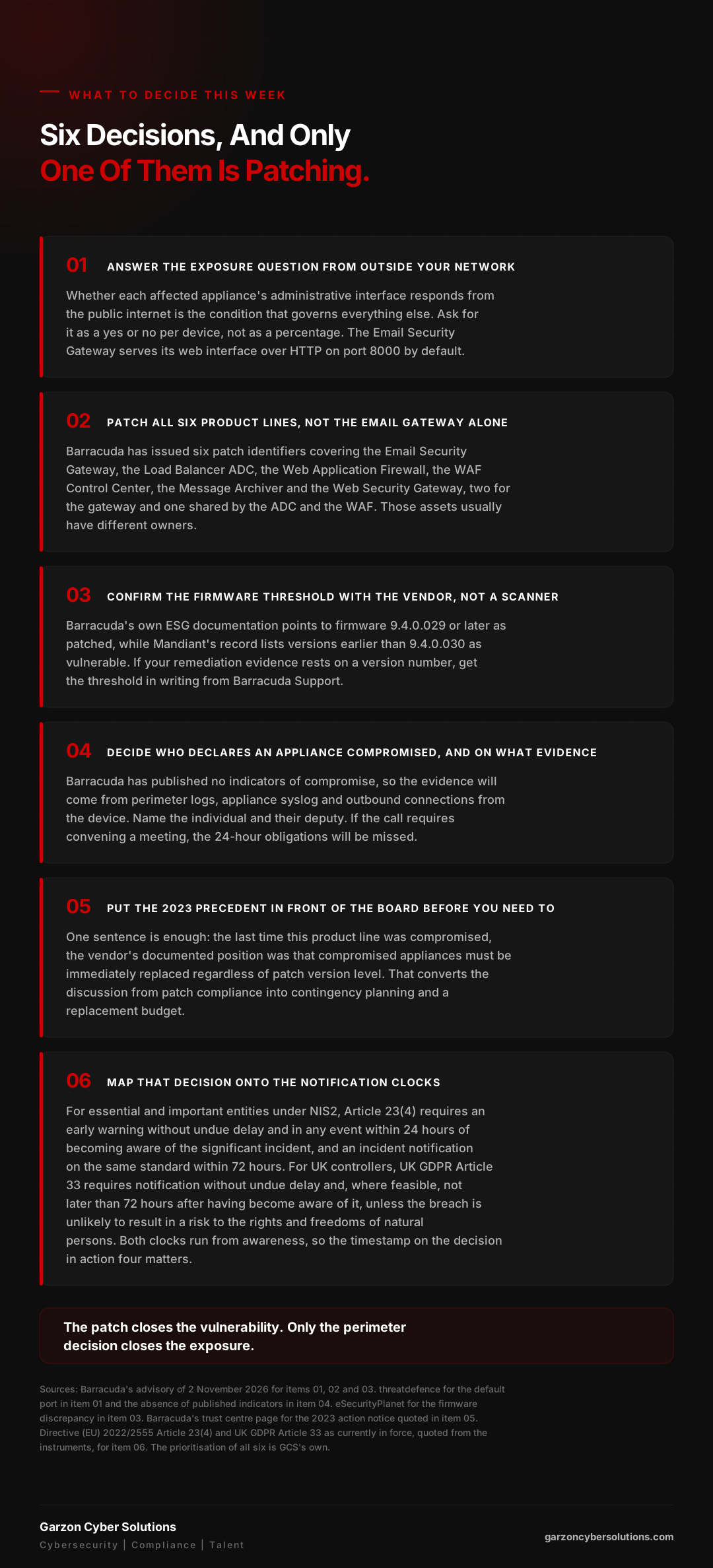
- Answer the exposure question from outside your own network, today. Whether the administrative interface of each affected appliance responds from the public internet is the condition that governs everything else, and it is a five-minute answer. Ask for it as a yes or no per device, not as a percentage.
- Patch all six product lines, not the email gateway alone. Barracuda has issued six patch identifiers covering the Email Security Gateway, the Load Balancer ADC, the Web Application Firewall, the WAF Control Center, the Message Archiver and the Web Security Gateway, two of them for the gateway and one shared by the ADC and the WAF. Confirm who owns each of those assets and that each has seen the advisory.
- Confirm the firmware threshold with Barracuda Support rather than with a scanner. Barracuda's own Email Security Gateway documentation points to firmware 9.4.0.029 or later as patched, while Mandiant's record lists versions earlier than 9.4.0.030 as vulnerable. GCS has not resolved that discrepancy and is not asserting either figure. If your remediation evidence rests on a version number, get the threshold in writing from the vendor.
- Decide now who declares an appliance compromised, and on what evidence. Barracuda has published no indicators of compromise, so the evidence will come from perimeter logs, appliance syslog and outbound connections from the device. Name the individual who makes that call and their deputy. If the answer requires convening a meeting, the 24-hour obligations will be missed.
- Put the 2023 precedent in front of the board before you need to. One sentence is sufficient: the last time this product line was compromised, the vendor's documented position was that compromised appliances had to be replaced regardless of patch version level. That single fact converts the discussion from patch compliance into contingency planning.
- Map the decision in action four onto the notification clocks. The point at which an appliance is treated as possibly compromised should be a logged decision with a timestamp, because that timestamp is what any regulator or customer will ask about first.
Three questions for the board
- Which of our internet-facing security appliances expose a management interface to the public internet, who approved that, and when was it last reviewed?
- When a vulnerability affects several of our product lines at once, how does the advisory reach the owners of the ones not named in the headline?
- If one of our security appliances had to be treated as compromised rather than merely patched, who decides that, how quickly, and what does the replacement path cost?
Strategic takeaway
The defensive side of this story worked. The flaws were reported and fixed before any exploitation was known, Barracuda shipping inside three weeks of the first report date, and the detection ecosystem turned the bypass into something defenders could scan for within six days. None of that is a criticism, and none of it was enough. Exploitation was confirmed on the seventh day, and the US cyber defence agency responded by setting a three-day remediation deadline for federal civilian agencies, where the other four vulnerabilities in the same release were given a fortnight. If an organisation's change process still treats "no known exploitation at disclosure" as licence for a normal maintenance window on an internet-facing security appliance, that assumption has now been tested in public and did not hold. The durable lesson is not about patching faster. For this class of asset the exposure is governed by a perimeter decision rather than a patch state, so the question a board should be asking is not what percentage is remediated, but which of these interfaces was ever reachable in the first place.
Confidence note
Confirmed findings. Both CVEs carry CVSS v4.0 scores of 9.3 and 8.6 in the records Mandiant published as CVE Numbering Authority, as reported by ThreatDefence and eSecurityPlanet; The Register corroborates the figures without naming the version. Barracuda published fixes and an advisory on 2 November 2026 and reported no active exploitation at that time. Barracuda updated that advisory on 9 November 2026 to confirm exploitation affecting a small number of organisations. Barracuda states that successful exploitation "requires an attacker to have access to the administrative interface of an affected product"; reading that as network reachability is this briefing's gloss, not the vendor's wording. Six product lines are affected by the command injection and Barracuda has issued six patch identifiers covering them, two for the Email Security Gateway and one shared by the Load Balancer ADC and the Web Application Firewall. Barracuda's 2023 action notice for CVE-2023-2868 stated that compromised appliances must be immediately replaced regardless of patch version level.
Likely assessments. That the chain requires the bypass to supply administrative access before the injection can be used is the reading supported by Barracuda's own classification, by Beazley Security's advisory and by watchTowr's technical write-up, and it is the reading this briefing follows. That the exploitation Barracuda reported on 9 November used the public chain rather than independent research is plausible on the timing but is not established, and the date of the report is not the date the activity began.
Reported, not established. The CISA Known Exploited Vulnerabilities entry of 10 November 2026 and the 13 November remediation date are taken from three independent reports rather than from a direct read of CISA's catalogue, which could not be retrieved at the time of writing. One of the sources used elsewhere in this briefing, ThreatDefence, states that neither CVE was in the catalogue when it checked on 10 November. Suped gives the catalogue release as 19:03 UTC that day, which would postdate such a check, so the two are not necessarily in conflict, but the point is unresolved from here. Readers relying on that deadline should confirm it in the catalogue itself.
Not established. Who the attackers are. Whether they obtained root. How many organisations were affected beyond the vendor's phrase. How many Barracuda administrative interfaces are reachable from the internet. Whether the fixed Email Security Gateway firmware version is 9.4.0.029 or 9.4.0.030, the vendor's documentation and Mandiant's record disagreeing on the point. No threat actor has been named for the 2026 exploitation and no organisation has been named as a victim, because the public record identifies neither. The only actors named in this briefing, UNC4841 and the PRC-linked attackers of the FBI's 2023 attribution, belong to the 2023 campaign.
Your remediation report gives you a percentage. Can it tell you which of your security appliances has a management interface answering from the public internet?
Garzon Cyber Solutions was built around the argument that security, compliance and the people who sustain them are one capability rather than three cost lines. Establishing which of your appliances expose a management interface and who approved that, making sure a multi-product advisory reaches the owners of the products not named in the headline, naming who declares an appliance compromised and on what evidence, and mapping that decision onto the NIS2 and UK GDPR clocks are short pieces of work with a long shelf life. None of them waits on this CVE, and all of them will still be useful after it. If you would like a view on where your appliance exposure and your notification readiness actually sit, start a conversation.
Start the Conversation →Findings, assessments and unestablished points are separated in the confidence note above. Every interval is computed from event dates, not from the dates on which the story was written up. Regulatory clauses are quoted from the instruments themselves rather than paraphrased. No exposure count has been estimated and no organisation has been named as a victim. No actor is named for the 2026 exploitation; UNC4841 and the PRC-linked attackers of the FBI's attribution belong to the 2023 campaign and are identified as such.
watchTowr Labs, "Barracuda Networks is your new best friend", published 5 November 2026. The primary technical source for the chain: that a failed unauthenticated password-change attempt returns the low-privilege login-screen role instead of halting, that this reaches a configuration-import function, that the integrity checksum on a Barracuda configuration backup derives from a hardcoded secret and can therefore be forged, and that the system timezone value reaches a shell command and a root-level script invoked through sudo. The post labels the accompanying tool a "Detection Artefact Generator"; the README on watchTowr's GitHub repository spells it "Detection Artifact Generator" and documents a --command parameter supplied by the operator. Note that watchTowr places the fix in version 9.4.0.029, which does not match the 9.4.0.030 threshold in Mandiant's record; this briefing asserts neither · Beazley Security advisory BSL-A1240, published 3 November 2026. Independent corroboration that CVE-2026-111560 "on its own" requires administrator access, and that the other five product lines are affected by the injection alone, together with the affected and fixed versions for all six product lines. That only the Email Security Gateway carries the bypass which supplies that access is GCS's inference from the product scope in Barracuda's advisory and Mandiant's records, corroborated by eSecurityPlanet; Beazley Security does not state it. Also the source for the recommendation to restrict administrative interface access to trusted internal networks where patching cannot be immediate. It records that, at the date of its publication, no exploitation had been reported and no public proof of concept was known · The Register, 10 November 2026. The source for Barracuda's 2 November warning having reported no active exploitation, for the late Monday update in which Barracuda said it had identified exploitation affecting "a small number of organisations", for Barracuda declining to say how many and stating that it "worked directly" with affected businesses, and for the points that the attackers and their motives are unknown and that it is not established whether they obtained root. Also the source for the scores of 9.3 and 8.6, though it does not name the CVSS version, for Mandiant's finding that 27 per cent of the identified affected organisations in the 2023 campaign were government entities, and for the 2023 context that the FBI attributed that campaign to PRC-linked attackers · BleepingComputer, 10 November 2026. The source for Barracuda's wording quoted verbatim in this briefing, "Successful exploitation requires an attacker to have access to the administrative interface of an affected product", corroboration of the exploitation confirmation, and the source for the full table of patch identifiers: BNSF-40425 for Email Security Gateway firmware 9.4.017 and later and BNSF-40430 for firmware below it, BNADC-16586 for the Load Balancer ADC and the Web Application Firewall, BNMA-32468 for the Message Archiver, BNWF-60060 for the WAF Control Center and BNYF-24789 for the Web Security Gateway. Also the source for Barracuda's advice to apply patches immediately, restrict administrative access to trusted internal networks and enable automatic patching. Its looser statement that almost a third of systems breached in 2023 belonged to government agencies is not relied on here; The Register's figure of 27 per cent of identified affected organisations is used instead. Note that this article describes CVE-2026-111560 as letting unauthenticated attackers inject commands; Barracuda's own classification, Beazley Security and watchTowr all place the authorisation bypass first, and this briefing follows that reading. Note also that its headline states that attackers obtained root access; The Register reports that this is not established, and this briefing follows The Register · ThreatDefence, "Barracuda ESG CVE-2026-116606: patching and threat hunting", bylined 9 November 2026 with page metadata showing modification on 12 November 2026. The source for the disclosure timeline dates taken from the records Mandiant published as CVE Numbering Authority: the command injection with a report date of 15 October 2026 and reserved 16 October, the authorisation bypass with a report date of 22 October and reserved 26 October, both published with patches on 2 November. Mandiant is the CVE Numbering Authority here rather than the finder, and no source in this list names who found either flaw. Also the source for Barracuda changing the bypass's authentication field on 5 November from "Yes, administrative access" to "No (Administrative UI Access Required)", which dropped the authentication requirement while recording that access to the administrative interface is needed, for the Nuclei detection template being proposed on 6 November and merged into the public template library on 8 November, for the EPSS scores of 1.6 per cent and 1.1 per cent, for the absence of any published indicators of compromise, and for the Email Security Gateway serving its web interface over HTTP on port 8000 by default. Note two things about this page. It records no reported exploitation, where Barracuda's confirmation came late on 9 November, and publication date is not event date. It also states that neither CVE was in CISA's Known Exploited Vulnerabilities catalogue when it checked on 10 November 2026, which conflicts with the three sources this briefing relies on for that entry. Suped gives the catalogue release as 19:03 UTC on 10 November, which would postdate such a check, so the two are not necessarily inconsistent, but the point is unresolved here and is disclosed in the confidence note · eSecurityPlanet, 4 November 2026. The source for the firmware threshold discrepancy stated in this briefing: that Barracuda's own Email Security Gateway documentation identifies firmware 9.4.0.029 or later as patched while Mandiant lists versions earlier than 9.4.0.030 as vulnerable, and that administrators should confirm their status with Barracuda Support. Also the source for the CVSS v4.0 designation of the 9.3 and 8.6 scores, for corroboration of the 2 November patch date, and for the paraphrase that exploitation requires "network access to an affected appliance's administrative interface", which is where the network reading in commentary on these CVEs originates. eSecurityPlanet paraphrases rather than quotes the vendor; the verbatim sentence used in this briefing comes from BleepingComputer · SecurityOnline, published 11 November 2026, on CISA adding six vulnerabilities to the Known Exploited Vulnerabilities catalogue on 10 November including both Barracuda CVEs, with a remediation date of 13 November 2026 for the Barracuda entries against 24 November for the other four, and recording known ransomware campaign use as unknown. The fourteen-day comparison used throughout this briefing is taken from that 24 November date in the same release. Corroborated by Suped, which gives the catalogue release time as 19:03 UTC on 10 November and states that CISA lists 13 November 2026 as the due date for covered US federal civilian agencies, and by NFLO, which records the same due date. CISA's catalogue could not be retrieved directly from the session in which this briefing was written, so the entry and the deadline are cited as reporting rather than as a direct read of the primary feed, and readers relying on the deadline should confirm it in the catalogue · Barracuda trust centre, Email Security Gateway vulnerability page, for the 2023 precedent. The source for the action notice of 6 June 2023, updated 15 June 2023, quoted verbatim in this briefing: "Compromised ESG appliances must be immediately replaced regardless of patch version level." The same page carries replacement guidance on 30 May, 1 June and 15 June 2023, records that Barracuda continued to recommend replacement on 28 July and 29 August 2023, and records that replacements were provided at no cost · Directive (EU) 2022/2555 (NIS2), Article 23(4), quoted rather than paraphrased: the early warning "without undue delay and in any event within 24 hours of becoming aware of the significant incident", the incident notification "without undue delay and in any event within 72 hours of becoming aware of the significant incident" carrying "an initial assessment of the significant incident, including its severity and impact, as well as, where available, the indicators of compromise", and the final report "not later than one month after the submission of the incident notification". Article 23(3) sets out when an incident is significant, and this briefing does not assert that treating an appliance as possibly compromised is itself a significant incident · UK GDPR Article 33 as currently in force, for the controller obligation to notify "without undue delay and, where feasible, not later than 72 hours after having become aware of it" and the exemption where a breach "is unlikely to result in a risk to the rights and freedoms of natural persons". Note that the Article now reads "notify the personal data breach to the Commission"; the word was substituted with effect from 30 September 2026 by S.I. 2026/386 Sch. 3 para. 41, commenced by S.I. 2026/1015 reg. 2(c), so references to the ICO in older commentary no longer track the statutory text
Garzon Cyber Solutions delivers cybersecurity advisory, compliance certification and specialist technology recruitment as one integrated capability for organisations in the UK, EU and beyond.