Engie's Systems Were Not Breached. Its Partners' Sales Tool Was.
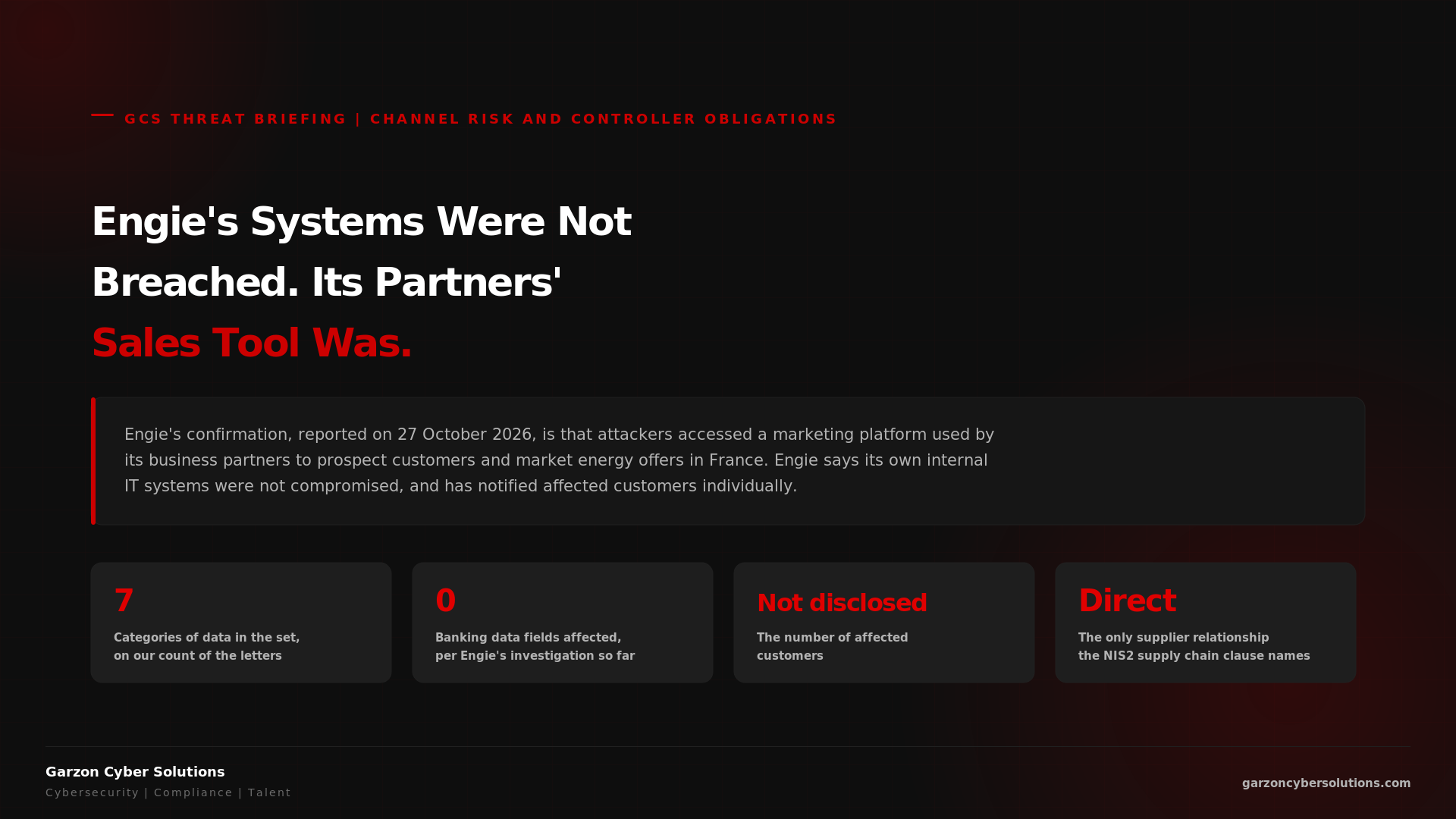
Engie's confirmation that attackers had taken customer data from a marketing platform used by its business partners to prospect customers and market energy offers in France was reported on 27 October 2026. The company says its own internal IT systems were not compromised. Customers had begun receiving notification letters several days earlier. The exposed set is seven categories of personal and contract data, including the meter point identifier that appears on every bill, and no banking data. Engie has not said how many customers are affected. The commercial point is not the data. It is that the system was operated by people who sell on Engie's behalf rather than by a supplier Engie buys from, and Engie is still the party writing the letters.
What happened
Engie operates in around 30 countries, employs more than 90,000 people and reported revenue of €71.9 billion last year. In France it sells electricity and gas to households, and like most large retail energy businesses it does not do all of that selling itself. Independent partners market its offers.
One of the tools those partners use was compromised. Engie's account, as reported on 27 and 28 October 2026, is that it recently identified unusual data access activity in a tool used by partners for prospecting and for marketing energy offers, that it cut off the attackers' access, notified the relevant authorities, and contacted each affected customer individually. A company spokesperson said Engie's internal IT systems were not compromised.
The notification letters list what was taken: first and last name, mailing address, email address, phone number, the PDL electricity delivery point identifier or the PCE gas metering point identifier, the customer ID and the contract number. Engie says investigations so far indicate no banking data was affected, and that the data is limited to contact details and certain information relating to customers' energy contracts.
Be careful with the dates, because the reporting and the event are not the same thing. French customers were receiving notification emails before the story reached the English language security press: the earliest French coverage, published on 24 October 2026, reproduces one already in a customer's hands. No source dates the letters more precisely. Engie has not given a date for the intrusion or for its discovery, saying only that the activity was identified recently. No group has claimed the breach, and Engie has not attributed it.
- Not disclosedThe date of the intrusion and the date of discovery. Engie's wording is that it "recently identified unusual data access activity" in the partner tool. No further detail has been published, which means the dwell time is unknown rather than short.
- By 24 October 2026Notification emails have reached customers in France. The earliest French coverage, published on 24 October, reproduces one of the emails and describes customers being told their personal data had been accessed without authorisation following a cyber incident affecting a tool used by some of Engie's sales partners. The emails are not dated more precisely in any source.
- 27 October 2026Engie's confirmation is reported in the English language security press. The company states that its internal IT systems were not compromised, that attacker access to the platform has been cut off, that the relevant authorities were notified and that the incident is limited to customers in France.
- 28 October 2026Further reporting confirms the same account and the same list of data categories. The number of affected customers remains undisclosed. No group has claimed responsibility.
Why this one is different
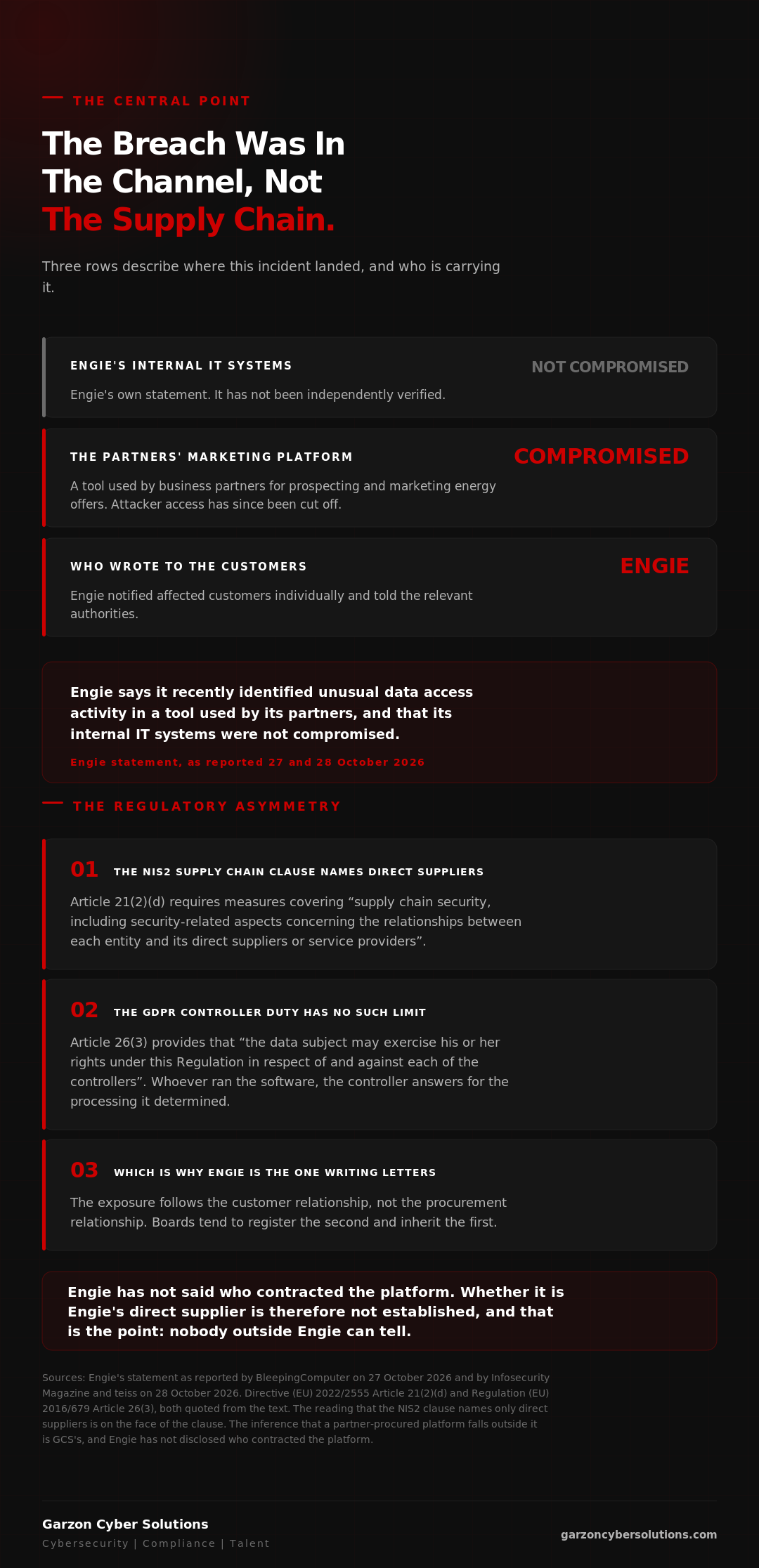
Third-party breaches are no longer novel. What makes this one worth reading is the particular kind of third party involved, because it is the kind most risk registers were never designed to hold. Consider how one is normally built. Someone exports the vendor master file, filters by spend, and works down the list applying due diligence proportionate to contract value. The output is a list of organisations that send the company invoices. That is a reasonable way to find the hosting provider, the payroll bureau and the managed service desk, and a very poor way to find a reseller.
Partners in an indirect sales channel sit on the other side of the money. They do not invoice the company; the company pays them commission, or they buy at a margin and sell on. Nothing in procurement is triggered when they choose a customer relationship platform, because nothing is being procured. They are a revenue relationship that happens to involve customer data, and revenue relationships are governed by commercial agreements, not security questionnaires.
That is the gap this incident sits in. Engie has not said who contracted the compromised platform, and it may well turn out to be a tool Engie provided. But the possibility that it is not, and that nobody outside the company can tell, is the governance problem. An organisation should be able to answer "which systems hold our customers' data" without first establishing who signed the purchase order.
The regulatory treatment makes the gap sharper, because the two regimes most likely to apply do not have the same reach. The NIS2 supply chain obligation, Article 21(2)(d) of Directive (EU) 2022/2555, requires measures covering "supply chain security, including security-related aspects concerning the relationships between each entity and its direct suppliers or service providers". A platform selected and operated by an independent partner is not obviously either of those.
Data protection law has no equivalent boundary. Under Article 26(1) of the GDPR, where two or more controllers "jointly determine the purposes and means of processing, they shall be joint controllers", and Article 26(3) provides that regardless of what they have agreed, "the data subject may exercise his or her rights under this Regulation in respect of and against each of the controllers". Where the arrangement is a processing one, Article 28(1) is blunt: "Where processing is to be carried out on behalf of a controller, the controller shall use only processors" that provide sufficient guarantees. Either way the obligation attaches to whoever determined the processing, not to whoever owned the server.
Which explains why a company that says its own systems were not breached is nonetheless the one writing to affected customers. Exposure follows the customer relationship. Registers follow the procurement relationship. Most boards manage the second and carry the first.
What was actually taken, and what it is worth
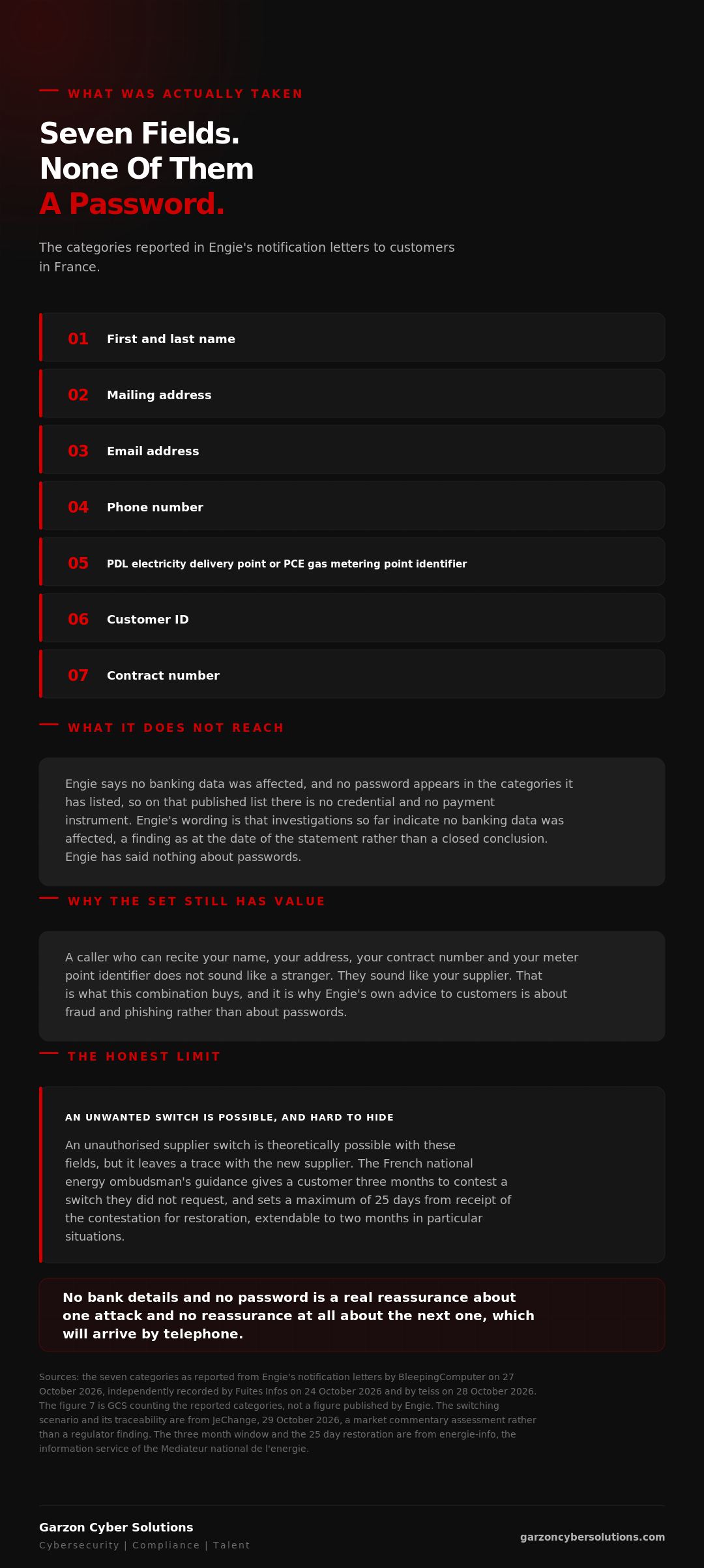
It is worth being accurate about the severity rather than inflating it, because inflation is what destroys credibility on the next briefing. Engie says no banking data was affected, and no password appears in the categories it has listed. On that published list there is no credential and no payment instrument, and French market commentary notes the meter point identifier alone gives no account access and no payment capability. Against a credential dump or a card breach this is a lesser event, and saying so costs nothing.
What it does contain is a contract-level profile of a household, taken from Engie's own records: who they are, where they live, how to reach them by two channels, which account they hold, which contract they are on, and which delivery point serves the property. The PDL is the 14-digit identifier of the point at which electricity enters the property on the distribution network; the PCE is its gas equivalent. Both appear on the customer's bill.
The practical consequence is a quality problem rather than an access problem. A cold caller reading from a purchased list can be identified as a stranger within a sentence. A caller who opens with the customer's contract number and the meter identifier for their address cannot, because everything they say checks out against the bill on the kitchen table. Engie's advice to customers is accordingly about fraud and phishing, not about resetting anything.
The one scenario worth bounding honestly is unauthorised supplier switching, because the meter point identifier is the field a switch is executed against. French market commentary published on 29 October describes this as theoretically possible but very unlikely, on the reasoning that a switch leaves a trace with the gaining supplier and triggers a closing bill from the losing one. The remedy is also established: guidance published by the French national energy ombudsman gives a customer three months to contest a switch they did not request, and sets a maximum of 25 days from receipt of the contestation for restoration to the previous situation, extendable to two months in particular situations. This is a nuisance with a defined process, not a catastrophe, and it should be described that way.
Commercial exposure for UK organisations
Transposed to a UK board, the exposure has four faces.
The regulatory face is the one with the clock on it. If a partner-operated system holding your customers' data is compromised and you determined the purposes of that processing, the notification duty is yours. UK GDPR requires a controller to report a notifiable breach to the ICO "without undue delay, but not later than 72 hours after becoming aware of it". The hard question is the trigger, not the deadline: you become aware when you are told, and a partner under no obligation to tell you promptly can consume most of the window before your clock starts.
The financial face has recent precedent at both ends of the relationship. In March 2025 the ICO fined Advanced Computer Software Group just over £3 million, its first fine of a processor under the UK GDPR, for failing to implement appropriate technical and organisational measures under Article 32. A processor can now be penalised directly. That does not relieve the controller, whose own Article 28 obligation is to have used only processors offering sufficient guarantees in the first place. A channel partner who has never been asked for evidence is an answer the organisation will have to give in its own words.
The contractual face is where the remediation sits, and it is usually thin. Channel agreements are drafted around commission, territory, exclusivity, branding, volumes and conduct. They frequently contain no processor terms, no audit right, no restriction on which systems may hold customer data, no retention limit and no notification window. Not because anyone decided against those clauses, but because the agreement was written by a commercial function solving a commercial problem.
The governance face is the simplest to test and the most uncomfortable. Ask the executive team to name every organisation holding personal data about your customers, then ask how many appear on the third-party register. In most businesses with an indirect channel the second number is materially smaller, and nobody has been asked to reconcile them.
There is a regulatory direction of travel here too, and it does not close the gap. The UK Cyber Security and Resilience Bill had its first reading on 12 November 2025, has since completed its Commons stages and its Lords committee stage, and reached Lords report stage in late October 2026. It has not received Royal Assent. It brings medium and large managed service providers into scope with the Information Commission as their regulator, and gives regulators a power to designate critical suppliers, in the government's words "ensuring the most important suppliers to essential and digital services are subject to the regulatory regime". For more harmful incidents it will require initial notification within 24 hours and a fuller report within 72 hours. Both the designation power and the reporting duties are among the measures the government says take effect through secondary legislation rather than on day one. All of which is sensible, and none of which, on our reading, reaches a reseller's marketing database: a channel partner's prospecting tool is a long way from the most important suppliers to essential services. Which leaves the contract as the only control that applies to it.
What leaders should do now
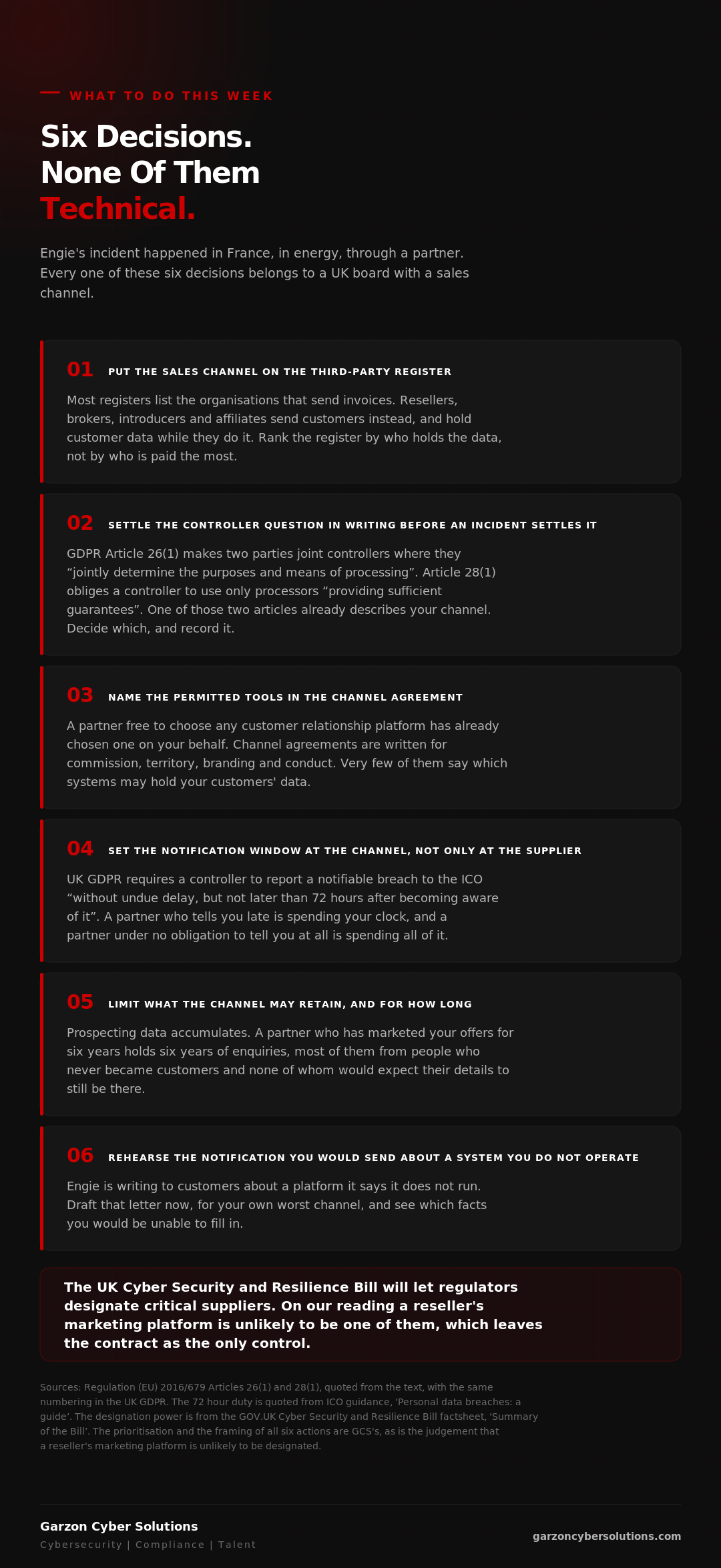
None of the following requires a vendor, a patch or a procurement cycle, and all of it is cheaper this quarter than during a notification decision taken against a 72 hour clock.
- Action 1 · Put the sales channel on the third-party registerRebuild the register from the question "who holds our customer data" rather than from the vendor master file. Resellers, brokers, introducers, affiliates, franchisees and referral partners belong on it. If the register was generated from spend, it currently describes your cost base, not your exposure.
- Action 2 · Settle the controller question in writing before an incident settles itFor each channel relationship, decide whether the partner is a processor acting on your instructions or a joint controller determining purposes with you, and record the decision. Article 26(1) and Article 28(1) describe two different arrangements with two different paper trails. One of them already describes your channel; an incident is an expensive moment to find out which.
- Action 3 · Name the permitted systems in the channel agreementA partner free to choose any platform has already chosen one on your behalf. List the systems that may hold your customers' data, require notification before that list changes, and state who carries the security obligation for each. This is a single clause and it is the one Engie's incident turns on.
- Action 4 · Set the notification window at the channel, not only at the contracted supplierSpecify the trigger, the timescale and the named recipient, and make it an obligation to notify on suspicion rather than on confirmation. Your 72 hour duty to the ICO starts when you become aware; a partner with no duty to tell you controls when that is.
- Action 5 · Limit what the channel may retain, and for how longProspecting data accumulates faster than customer data and is governed less. A partner who has marketed your offers for six years is holding six years of enquiries, most from people who never became customers. Set a retention period, require deletion on termination, and ask for confirmation rather than assuming it.
- Action 6 · Draft the notification letter you would have to send about a system you do not operateTake your largest channel partner and write the customer letter now. The exercise fails quickly and usefully: you will not be able to say what was taken, how many people are affected or when it happened, because those facts live with someone whose contract does not require them to give you any of it.
Three questions for the board
- Question 1How many organisations hold personal data about our customers, and how many of them appear on our third-party register? If those two numbers differ, which function owns closing the gap and by when?
- Question 2For our three largest channel partners, what is the contractual obligation to tell us about a security incident, and what is the timescale? If the answer requires someone to go and read the agreement, that is the answer.
- Question 3If a partner's system holding our customer data were compromised tomorrow, who signs the customer notification, and what could that letter actually say? The company whose name is on the letter is the company carrying the incident, whoever owned the server.
Strategic takeaway
The useful sentence in this story is Engie's own: its internal IT systems were not compromised. That is Engie's account and nothing published contradicts it, and it changes nothing about who is writing to customers, who answers to the regulator and whose brand is attached to the fraud attempts that follow. An organisation's security boundary is drawn by its data, not by its asset inventory, and the indirect sales channel is where those two drawings most often diverge.
For most UK businesses the remediation is not a technology programme. It is a short, unglamorous piece of contractual and registry work: find the partners, find the systems, write the clause, set the window, and test it once against a letter nobody wants to send. In a quiet quarter that costs a few weeks of a commercial lawyer and a security lead. During an incident it costs the quarter.
Confidence note
Confirmed findings. Engie has publicly confirmed a breach of a marketing platform used by its business partners, has stated that its own internal IT systems were not compromised, has said that attacker access was cut off, that the relevant authorities were notified and that affected customers were contacted individually, and has listed the categories of data in its notification letters. These were reported consistently across BleepingComputer on 27 October 2026 and Infosecurity Magazine and teiss on 28 October 2026, with the same items recorded by French coverage on 24 October 2026, set out there in six lines rather than seven. The figure seven is our count of the reported items, not a figure published by Engie.
Stated by Engie but not independently verified. That its internal systems were not compromised; that no banking data was affected, which Engie frames as the position of investigations so far rather than a closed conclusion; and that the incident is limited to France. Each is a company statement reported as such.
Assessment, and clearly labelled as such throughout. That the compromised platform falls outside the NIS2 definition of a direct supplier or service provider is an inference, not an established fact: Engie has not disclosed who contracted the platform, and if Engie provided it to partners the clause may well reach it. The related judgement that a reseller's marketing platform is unlikely to be designated a critical supplier under the UK Cyber Security and Resilience Bill is also ours; the factsheet says only that designation targets the most important suppliers to essential and digital services. The wider argument that indirect sales channels are systematically under-registered is GCS's reading of a recurring pattern, not a finding about Engie. The prioritisation of the six actions is ours.
Not established. The date of the intrusion, the dwell time, the date of discovery, the number of affected customers, the identity of the platform or the partners, the initial access vector and the attacker. Reporting notes that a different Engie entity in North America was named by an extortion group a year earlier; nothing published links the two, and this briefing does not.
Dates. The letter date follows the French coverage that recorded them in circulation; the confirmation date is the date it was reported. Publication dates are not event dates, and the intrusion is undated in every source consulted.
Which organisations outside your company currently hold personal data about your customers, and how many of them appear on your third-party register?
Garzon Cyber Solutions was built around the argument that security, compliance and the people who sustain them are one capability rather than three cost lines. Rebuilding a third-party register around who holds your data rather than who sends you invoices, settling the controller position for each channel relationship, and adding a named-systems and notification clause to the partner agreement are short pieces of work with a long shelf life. All three are considerably cheaper done this quarter than during a notification decision taken against a 72 hour clock. If you would like a view on where your customer data currently sits and what your channel agreements commit your partners to, start a conversation.
Start the Conversation →Engie's account is attributed to Engie throughout rather than stated as independently verified fact, because no regulator or third party has yet confirmed it. Statutory provisions are quoted from the legal text or from the regulator's own guidance rather than paraphrased from memory. Where a figure is this briefing's own count of reported items rather than a published figure, it says so.
BleepingComputer, Sergiu Gatlan, "Energy giant ENGIE discloses data breach affecting customers", 27 October 2026. The primary English language source for Engie's confirmation, for the statement that "ENGIE's internal IT systems were not compromised", for the description of the compromised system as a marketing platform used by business partners for customer prospecting and marketing energy offers, for the seven data categories listed in the notification letters, for the statements that no banking data was affected, that attacker access was cut off, that the relevant authorities were notified and that affected customers were contacted individually, for the company scale figures, and for the record that no group has claimed the breach · Infosecurity Magazine, "Energy Giant Engie Notifies Customers of Supply Chain Breach", 28 October 2026, for independent corroboration of the data categories, of Engie's description of "unusual data access activity within a tool used by partners", of the containment steps and of the advice issued to customers about fraud and phishing · teiss, "ENGIE says attackers stole French customers' data from marketing platform used by partners", 28 October 2026, for corroboration of the same account, for Engie's statement that the incident is "limited to customers in France", and for the wording that the data is limited to contact details and certain information relating to customers' energy contracts · Fuites Infos, Christophe Boutry, "ENGIE : fuite de donnees via un outil de ses partenaires commerciaux", 24 October 2026, for the earliest dated record of the notification emails reaching customers in France and for the same list of data categories, independently of the English language reporting. Used here to establish that the letters were in circulation before the security press reported the confirmation · JeChange, "Fuite de donnees chez Engie : ce qu'un hacker peut faire avec un PDL", 29 October 2026, for the explanation that the PDL is the 14 digit identifier of the electricity delivery point and that it grants no account access or payment capability on its own, and for the assessment that an unauthorised supplier switch is theoretically possible but very unlikely because it leaves a trace with the new supplier. This is market commentary, not a regulator finding, and is presented as such · energie-info, the information service of the Mediateur national de l'energie, "J'ai change de fournisseur sans le souhaiter", for the three month window in which a customer may contest a supplier change they did not request, for the expectation of restoration to the previous situation within 25 days of the complaint reaching the supplier, and for the record that the PDL and PCE identifiers appear on the customer's bill · Regulation (EU) 2016/679, Article 26, quoted for the joint controller test at Article 26(1), "jointly determine the purposes and means of processing, they shall be joint controllers", and for Article 26(3), "the data subject may exercise his or her rights under this Regulation in respect of and against each of the controllers". The UK GDPR carries the same numbering · Regulation (EU) 2016/679, Article 28(1), quoted for "Where processing is to be carried out on behalf of a controller, the controller shall use only processors" providing sufficient guarantees · Directive (EU) 2022/2555 (NIS2), Article 21(2)(d), quoted for "supply chain security, including security-related aspects concerning the relationships between each entity and its direct suppliers or service providers". The reading that the clause names only direct suppliers is on the face of the provision. The inference that a partner-procured platform falls outside it is this briefing's, and is labelled as an assessment in the confidence note · ICO, "Personal data breaches: a guide", quoted for the controller's duty to "report a notifiable breach to the ICO without undue delay, but not later than 72 hours after becoming aware of it" · GOV.UK, Cyber Security and Resilience Bill factsheet, "Summary of the Bill", for the designation power over critical suppliers "ensuring the most important suppliers to essential and digital services are subject to the regulatory regime", for medium and large managed service providers being brought into scope with the Information Commission as regulator, and for the reporting duties of "initial notification within 24 hours and a fuller report within 72 hours". The factsheet lists both the critical supplier power and the reporting duties among the measures that will take effect through secondary legislation rather than on day one · UK Parliament, Cyber Security and Resilience (Network and Information Systems) Bill, for the Bill's progress: first reading on 12 November 2025, Commons stages completed, House of Lords committee stage concluded on 7 September 2026 and Lords report stage reached in late October 2026, with Royal Assent not yet given. The GOV.UK collection page for the Bill is out of date on its parliamentary stage and should not be used for that. Readers should check the Parliament page for the position on the day they read this · ICO penalty notice against Advanced Computer Software Group Ltd, dated 26 March 2025 and published on 27 March 2025, the regulator's first fine of a processor under the UK GDPR, for the finding of a failure to implement appropriate technical and organisational measures under Article 32(1) and for the penalty of £3,076,320, reduced by 20% from a provisional £6,090,000 under a voluntary settlement
Garzon Cyber Solutions delivers cybersecurity advisory, compliance certification and specialist technology recruitment as one integrated capability for organisations in the UK, EU and beyond.