Nineteen Of The Twenty-One Were Patched. The Setting That Let Attackers In Was Not In The Patch Report.
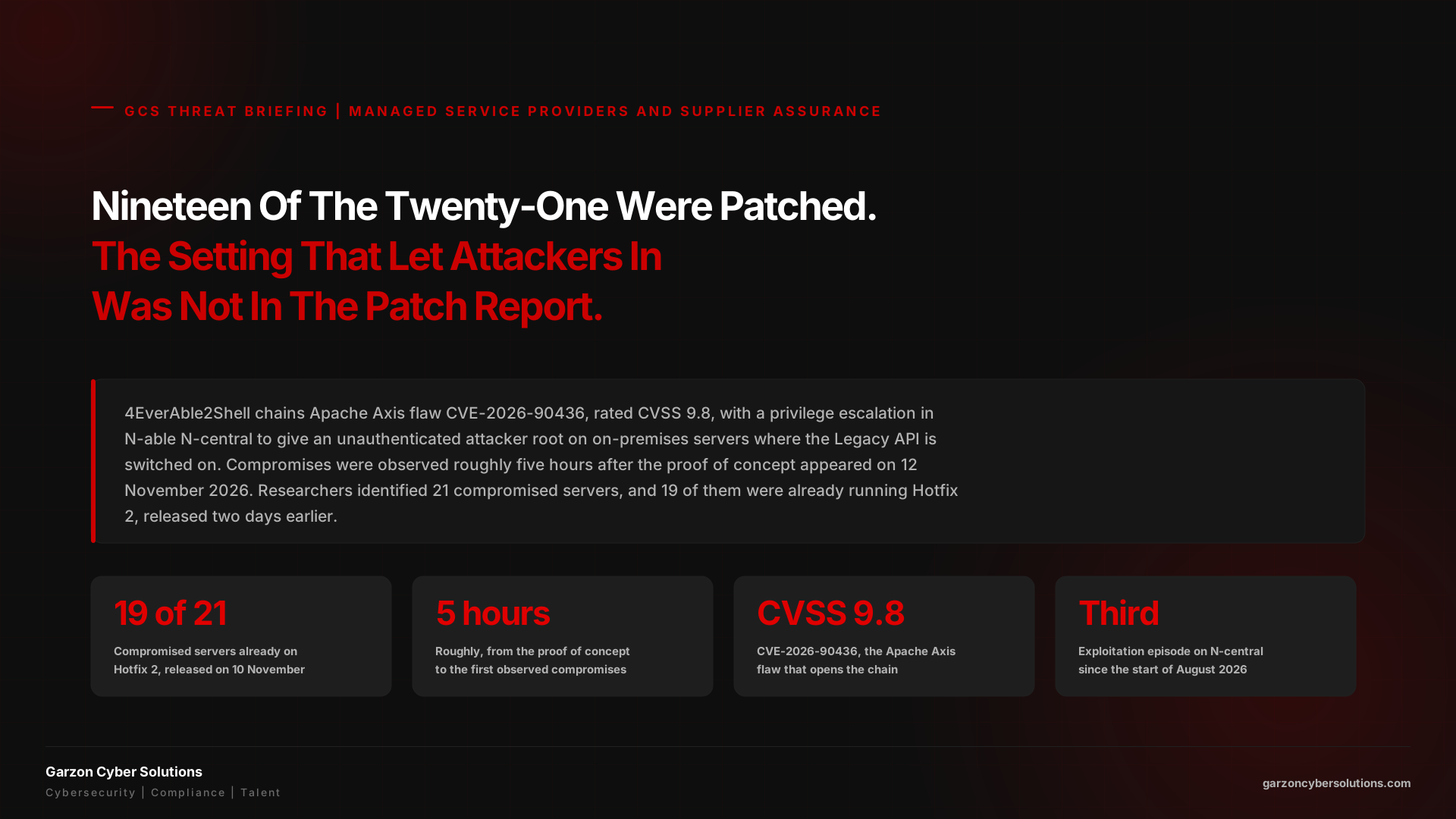
On 12 November 2026 (UTC) a researcher published a new exploit chain for N-able N-central, the remote monitoring and management platform that many managed service providers use to run their clients' IT. Attackers were using it within roughly five hours. Researchers then identified 21 compromised servers, and 19 of them had already installed the hotfix N-able had shipped two days earlier. The tempting reading is that patching failed. That is half right. Patching was necessary and it was not sufficient: on the published evidence, the chain only works where a setting called the Legacy API has been switched on, which N-able ships switched off and does not recommend. On every one of those 19 servers a vendor patch-level report would have shown green, and the setting that let the attackers in would not have appeared on it. For an organisation whose IT is run by a provider, that is the real exposure: the evidence you receive answers a different question from the one that decides your risk.
What happened
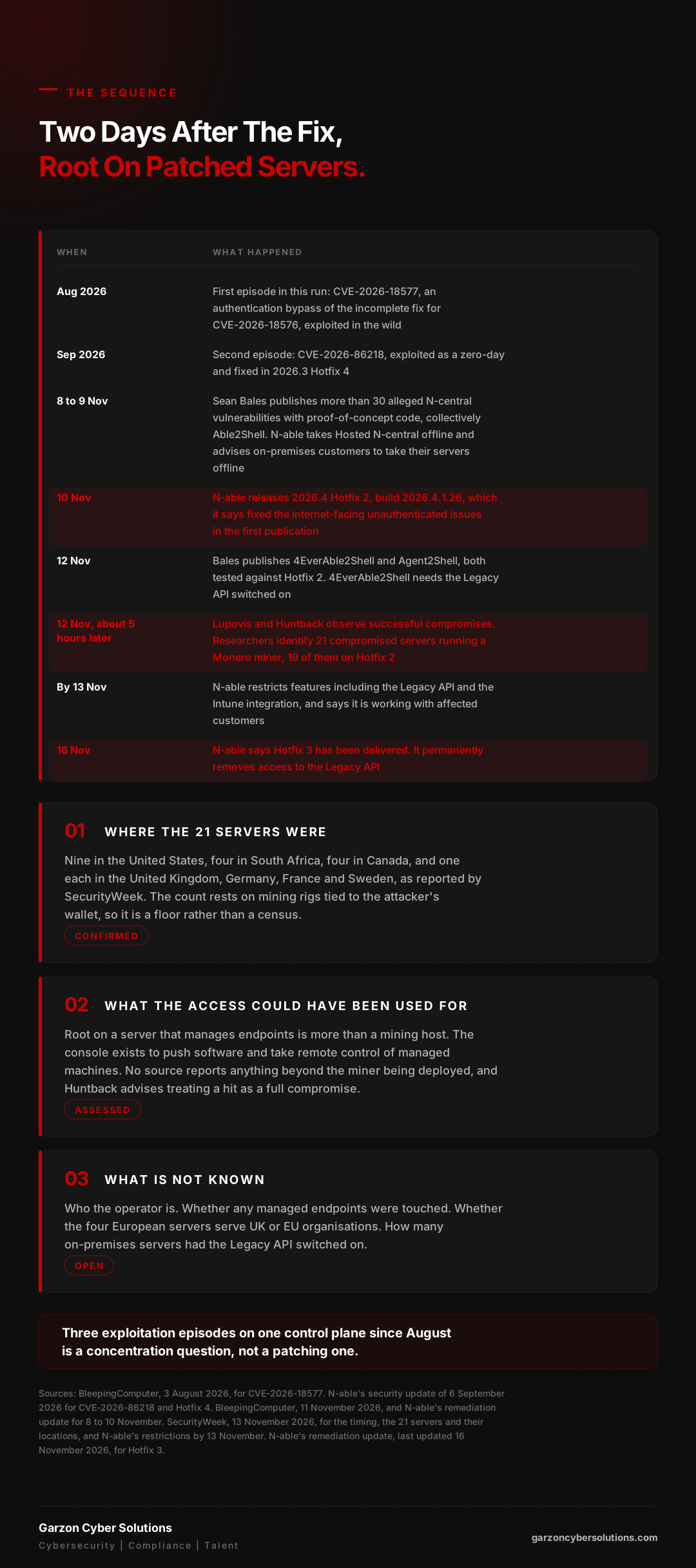
Over the night of 8 to 9 November, independent researcher Sean Bales published more than 30 alleged vulnerabilities in N-central, with proof-of-concept code, under the collective name Able2Shell. He did not disclose them to N-able first. The company took its hosted N-central environment offline as a precaution, advised customers running their own N-central servers to take those offline too, and on 10 November released N-central 2026.4 Hotfix 2, build 2026.4.1.26, which it says resolved all of the internet-facing, unauthenticated issues in that first publication.
On 12 November Bales published two further chains, 4EverAble2Shell and Agent2Shell, and said he had tested both against Hotfix 2. 4EverAble2Shell gives an unauthenticated attacker root on an on-premises N-central server. It starts with CVE-2026-90436, a flaw in the Apache Axis SOAP library bundled inside N-central, rated 9.8 under CVSS v3.1, and then uses a separate N-central privilege escalation to complete the climb. Apache published an upstream fix for CVE-2026-90436 on 6 November but said it does not expect to release a fixed version of Axis 1.x, which is end-of-life. The chain depends on one condition: the server's Legacy API must be switched on and reachable. Agent2Shell, by Bales's description, uses more than ten further flaws to run commands as SYSTEM on managed Windows agents, provided the attacker knows the target appliance ID. N-able says the agent impersonation issues require an attacker to already have a foothold on an endpoint.
Attacks followed quickly. Previdian, an early-warning service, reported exploitation attempts within hours. Lupovis and Huntback observed successful compromises roughly five hours after publication. Researchers identified 21 mining rigs tied to compromised N-central servers through the attacker's wallet, and Huntback reports that 19 of them were running the Hotfix 2 build. The servers were in the United States (nine), South Africa (four), Canada (four), and one each in the United Kingdom, Germany, France and Sweden. The only payload seen was the XMRig cryptocurrency miner, made persistent through systemd or cron.
N-able's position is that the issue depends on a non-default configuration in which the Legacy API is turned on and exposed to the public internet. Its advisory told customers to disable the Legacy API immediately. By 13 November it had restricted several features, including the Legacy API and its Intune integration, and said it was working with affected customers. In its update of 16 November it said Hotfix 3 had been delivered. Hotfix 3 permanently removes access to the Legacy API and hardens how agents, probes and appliances authenticate. N-able lists known issues with that release: remote control other than Take Control is disabled, and the Intune integration is blocked. N-able says hosted N-central servers were not affected by 4EverAble2Shell, although it still advises customers to keep upgrading their agents and probes.
Why this one is different
We wrote about N-central in August, in The Incomplete Patch, when a fix for an authentication bypass was itself bypassed and organisations that had patched in good faith stayed exposed. This is not a repeat of that story. Hotfix 2 did not cover everything: the bundled Axis library it shipped was still exploitable, and Huntback's own conclusion is that applying Hotfix 2 is not enough on its own. But the vulnerable code was reachable only through a door the vendor ships closed and does not recommend opening.
That puts as much of the question on whoever runs the server as on the vendor. N-able says the Legacy API is defaulted to off and not a recommended configuration, kept only for customers who explicitly needed it for legacy operations. According to GovInfoSecurity it has been inactive by default since N-central 2025.4, released in November 2025. A server running it had been left in that state, whether deliberately to keep an older integration working or carried over from an earlier configuration. We cannot see who made that choice on any of the 21 servers, and no published source names the operators. What we can say is where the decision sits. Where a managed service provider runs N-central for its clients, the setting belongs to the provider. The clients do not hold the console, do not see its configuration and may never have been told the setting existed.
Consider what each of those clients would have received if it had asked its provider, on the morning of 12 November, whether its management tools were patched. If any of the 19 operators running Hotfix 2 were providers, they could have answered yes, truthfully, with a report to prove it. That answer would have been accurate and of very little use, because patch status alone did not decide the exposure. Configuration did, and configuration is rarely what supplier assurance asks about.
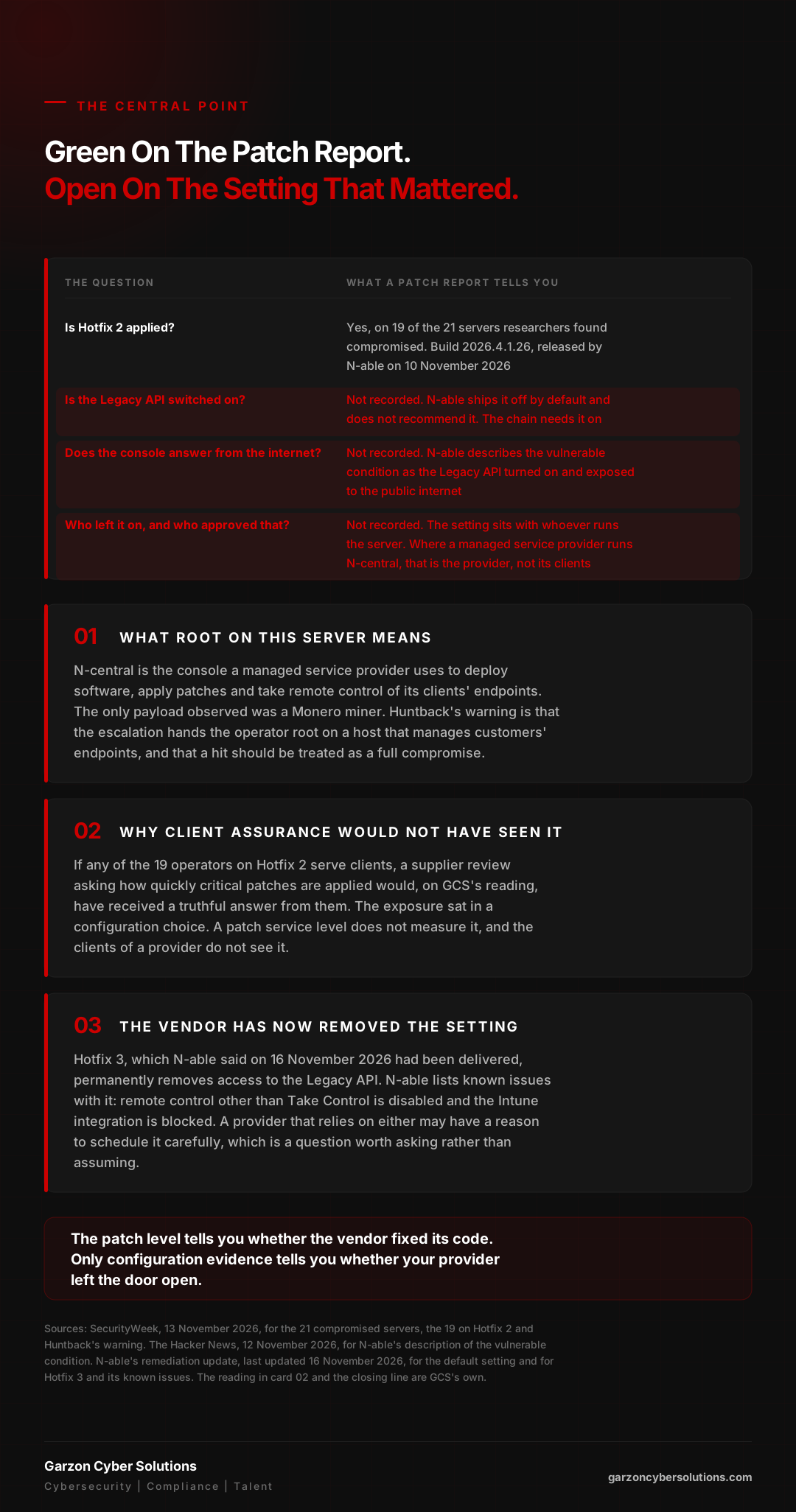
The second difference is what the access was worth. A miner is a cheap use of root. N-central is the console a provider uses to deploy software, apply patches and take remote control of its clients' endpoints, which is why Huntback warns that the escalation gives the operator root on a host that manages customers' endpoints, and advises: "Treat a hit as a full compromise, not a cleanup job." By design, a console with that reach can push software to the machines it manages. No source reports anything beyond the miner being deployed, and we do not suggest that it was. The point is that the operator who installed a miner held a position from which far more was possible, and the clients of an affected provider cannot verify from the outside what was or was not done with it.
The third difference is frequency. This is the third episode of exploitation on N-central since the start of August: CVE-2026-18577 in August, CVE-2026-86218 in September, and now the Able2Shell cycle. Each was handled with a hotfix. Taken together they say something no single advisory does. A remote monitoring and management platform is a concentration point. If it is compromised, every client it manages is exposed at once, and that remains true whoever the vendor is.
Commercial exposure for UK and European organisations
Regulatory. The Cyber Security and Resilience (Network and Information Systems) Bill would bring medium and large managed service providers into the UK regime for the first time, as relevant managed service providers, and the Minister has proposed a mechanism to bring certain high-risk smaller providers into scope too. It completed its Lords stages on 2 November and returns to the Commons for consideration of the Lords amendments. It is not yet law. ISACA reports that amendments made in the Lords strengthened requirements on certain managed service providers to keep affected customers informed during significant incidents. In the EU, NIS2 already brings medium-sized and large managed service providers and managed security service providers into scope under Annex I, and Article 21 requires essential and important entities to address supply chain security, including the security of their relationships with direct suppliers and service providers. An organisation in NIS2 scope that relies on a provider's N-central console has a supply chain question to answer whether or not the provider was affected.
Financial. The direct cost of a miner is compute. The indirect cost is the one Huntback points to. If a provider's management server is treated as fully compromised, the remediation runs across every client it manages: credential rotation, endpoint review and, where warranted, rebuild. Those costs land on the provider and its clients at the same time, and the clients are rarely in a position to set the pace.
Contractual. Most managed service agreements set patching commitments. Fewer, on our reading, set obligations on the configuration of the provider's own management tools, on internet exposure of those tools, or on how quickly the client must be told when one of them is compromised. Where a provider processes personal data, UK GDPR already requires it to notify the controller without undue delay after becoming aware of a personal data breach, under Article 33(2), and Article 28 requires certain assistance terms in the contract. Beyond that, where specific terms are missing, the client's position rests on general provisions rather than on anything written for this risk.
Governance. The question a board will ask after an incident of this kind is who owned the risk. In many organisations the provider relationship sits with procurement or IT operations, the security function sees an annual questionnaire, and nobody has the provider's management plane on the risk register by name. That is a gap in ownership rather than in technology, and it can be closed without waiting for the next advisory.
What leaders should do now
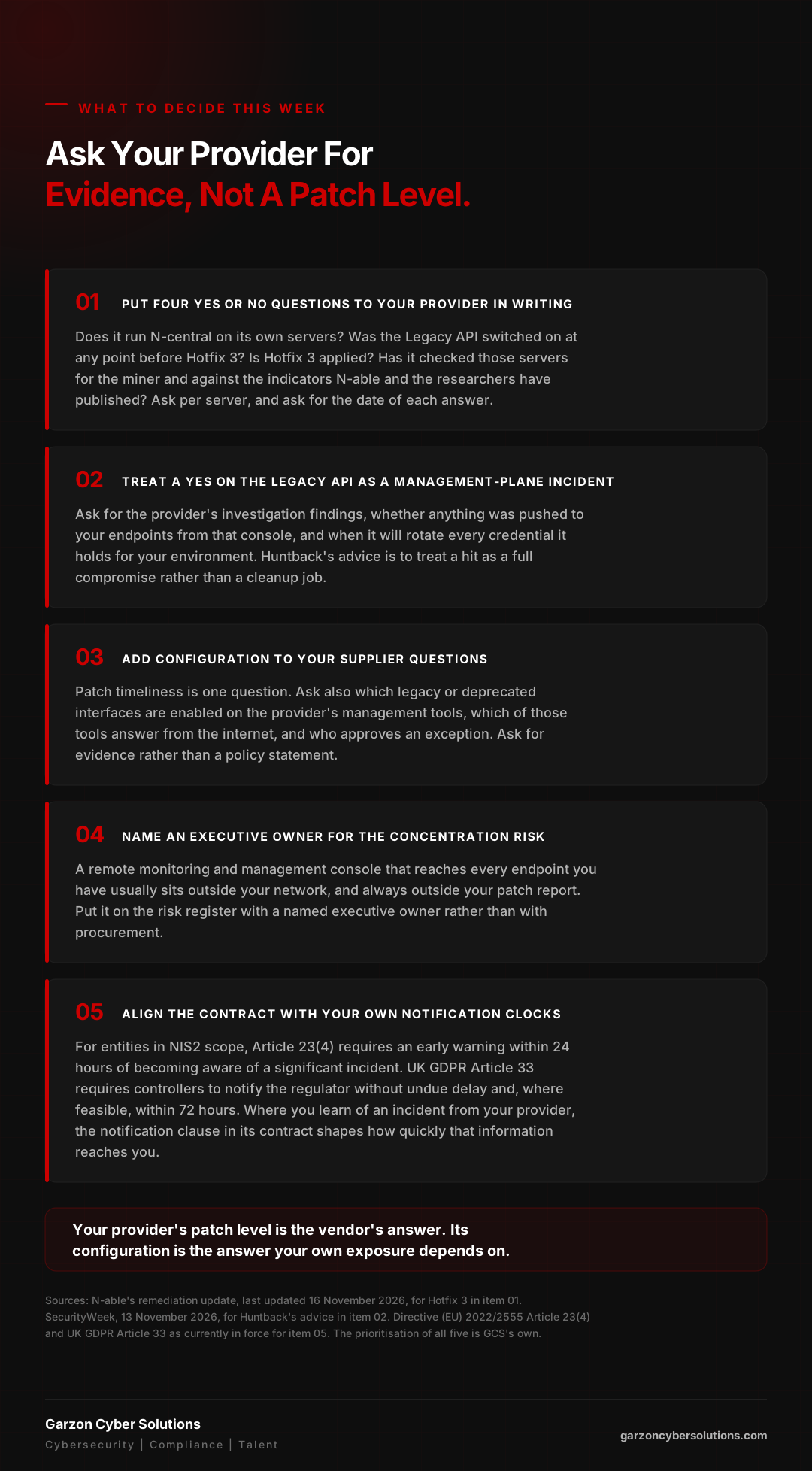
- Put four yes or no questions to your provider in writing. Does it run N-central on its own servers? Is Hotfix 3 applied? Was the Legacy API switched on at any point before it was? Has it checked those servers for the miner and against the indicators N-able and the researchers have published? Ask per server, and ask for the date of each answer.
- Treat a yes on the Legacy API as a management-plane incident. Ask for the provider's investigation findings, whether anything was pushed to your endpoints from that console, and when it will rotate every credential it holds for your environment.
- Add configuration to your supplier questions. Patch timeliness is one question. Ask also which legacy or deprecated interfaces are enabled on the provider's management tools, which of those tools answer from the internet, and who approves an exception. Ask for evidence rather than a policy statement.
- Name an executive owner for the concentration risk. A remote monitoring and management console that reaches every endpoint you have usually sits outside your network, and always outside your patch report. It belongs on the risk register with a named owner.
- Align the contract with your own notification clocks. For entities in NIS2 scope, Article 23(4) requires an early warning "without undue delay and in any event within 24 hours of becoming aware of the significant incident". UK GDPR Article 33 requires a controller to notify the regulator "without undue delay and, where feasible, not later than 72 hours after having become aware of it". Where you learn of an incident from your provider, the notification clause in its contract shapes how quickly that information reaches you.
Three questions for leadership
- Which of our suppliers can run code on our endpoints today, and through which console?
- If one of those consoles were compromised this morning, when would we find out, and would that leave us inside our own notification obligations?
- Does our supplier assurance ask how our providers configure their tools, or only how quickly they patch them?
Strategic takeaway
Patch status is a fact about the vendor's code. Exposure, in this case, turned on how each server was configured. Much supplier assurance is built to collect the first and is not designed to see the second, which is why 19 operators could have produced a clean report on the day their servers were compromised. The organisations best placed for the next cycle are not the ones with the fastest patch window. They are the ones that know which of their suppliers hold a console with reach into their environment, ask those suppliers for configuration evidence, and have a contract that tells them quickly when something goes wrong. None of that depends on N-able, and all of it will matter for the next platform too.
Confidence note
Confirmed. Sean Bales published 4EverAble2Shell and Agent2Shell on 12 November 2026, two days after N-able released 2026.4 Hotfix 2. 4EverAble2Shell chains CVE-2026-90436, rated 9.8 under CVSS v3.1, with a separate N-central privilege escalation and requires the Legacy API to be switched on. Lupovis and Huntback observed compromises roughly five hours after publication. Researchers identified 21 compromised servers, 19 of them on Hotfix 2, located as set out above, and the only payload observed was the XMRig miner. N-able states that the Legacy API is off by default and not recommended, had restricted features by 13 November, and in its 16 November update said Hotfix 3, which removes Legacy API access, had been delivered.
Assessed. That patching was necessary but not sufficient, and that configuration was the decisive precondition, is our reading of Huntback's findings and N-able's statements. That the Legacy API was on through a choice or an omission by whoever ran each server, most plausibly to support older integrations, is our inference from N-able's statement that it is off by default. That the root access could have been used for more than mining rests on Huntback's warning and on what the console does by design, not on any reported use. That standard supplier patch questions would have produced truthful positive answers from 19 of the operators is our reading of the patch figures, not a finding about any particular provider's assurance process.
Not known. Who the attacker is. Whether any of the compromised servers belonged to managed service providers rather than to organisations running N-central for themselves. Whether any managed endpoints were touched. Whether the four European servers serve UK or EU organisations. How many on-premises N-central servers had the Legacy API switched on, and how widely Hotfix 3 has been applied. Whether each compromised server had the Legacy API on is inferred from the chain's requirement, not observed. The exact release date of Hotfix 3: N-able's release notes are dated 14 November, and its update of 16 November says it has been delivered. The count of 21 rests on mining rigs tied to the attacker's wallet and should be read as a floor.
Your provider can show you its patch level. Can it show you how its management tools are configured, and who approved each exception?
Garzon Cyber Solutions was built around the argument that security, compliance and the people who sustain them are one capability rather than three cost lines. Establishing which of your suppliers hold a console with reach into your environment, adding configuration evidence to the questions you ask them, naming an executive owner for that concentration risk and aligning provider contracts with your NIS2 and UK GDPR notification clocks are short pieces of work with a long shelf life. None of them waits on N-able, and all of them will apply to the next platform. If you would like a view on where your supplier assurance and your notification readiness actually sit, start a conversation.
Start the Conversation →Sources: SecurityWeek, "Hackers Exploit New N-central Zero-Day Hours After PoC Publication", 13 November 2026 · The Hacker News, "New N-central Exploits Work Against Patched Servers, Enable Root RCE and Windows SYSTEM Access", 12 November 2026 · BleepingComputer, "New N-able 4EverAble2Shell zero-day exploited hours after PoC released", 12 November 2026 · BleepingComputer, "N-able releases security hotfixes for zero-day vulnerabilities", 11 November 2026 · N-able, "N-able Vulnerability Remediation Update", last updated 16 November 2026 · GovInfoSecurity, "Researcher Drops More Zero-Day Exploits for N-Able Software", 12 November 2026 · Huntback, technical write-up on 4EverAble2Shell miners on live N-central servers, November 2026 · Apache Software Foundation, security advisory for CVE-2026-90436, Apache Axis 1.x, 6 November 2026 · BleepingComputer, "N-able warns of N-central auth bypass flaw exploited in attacks", 3 August 2026 · N-able, "N-central Security Update: Take Action to Apply 2026.3 HF4", 6 September 2026 · ISACA, "The UK's Cyber Security and Resilience (NIS) Bill: five key takeaways from Lords Report Stage", 2026 · VinciWorks, "Cyber Security and Resilience Bill: Government defeated twice as Lords demand stronger protections", 2026 · MLex, "Retain reviews of companies facing cyber duties, UK govt urged as bill advances", 2 November 2026 · techUK, "What are the key areas of focus of government's Cyber Security and Resilience Bill?", 12 November 2025 · Directive (EU) 2022/2555 (NIS2), Articles 21 and 23 and Annex I · UK GDPR Article 33 as currently in force · Garzon Cyber Solutions, "The Incomplete Patch", August 2026
Garzon Cyber Solutions offers cybersecurity advisory, compliance certification readiness and specialist technology recruitment as one integrated capability to organisations in the UK, EU and Americas.