It Was Not An Attack. The Response Plan Ran On The Same Platform.
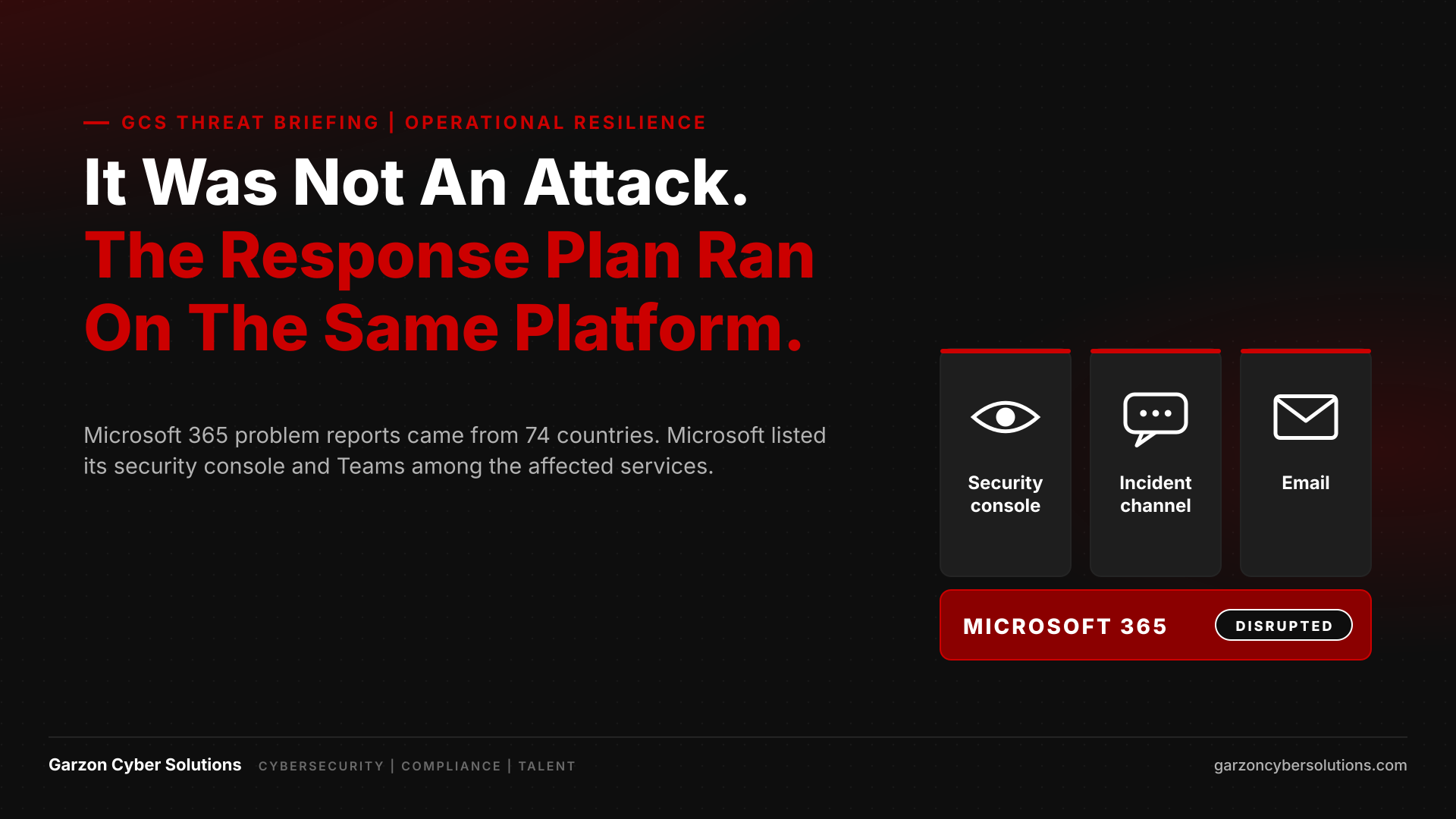
Microsoft says the outage that disrupted Outlook, Teams and much of Microsoft 365 on 12 and 13 November was not a cyber attack. On everything published so far, that is right. It is also the less useful finding. The services Microsoft listed as affected included its own security console, and for many UK organisations the email and Teams channels that would carry an incident response sit on the same platform as the systems that response exists to protect. In the same week, a one-click Outlook flaw was confirmed as exploited, and it received a fraction of the attention.
Executive summary
- From late afternoon UK time on Thursday 12 November, Microsoft 365 users lost access to Exchange Online mailboxes. Microsoft's advisory listed Teams, SharePoint Online, Microsoft 365 Copilot and Defender XDR among the affected services. Downdetector logged problem reports from 74 countries and territories.
- Microsoft attributes the disruption to servers becoming "unexpectedly unavailable" and says the load was not caused by a traffic increase. Its executive vice-president Charles Lamanna said there was "no indication this is the result of malicious or cyber activity". No group has claimed it.
- In the UK, GP practices told patients to phone, several police forces pointed online reports to 101, and the National Pharmacy Association warned of prescription delays. Recovery was still incomplete on Friday morning.
- The attack that did happen this week was CVE-2026-124194, an Outlook flaw Microsoft marked "Exploitation Detected" and patched on 10 November. Its CVSS score of 6.5 understates its priority.
- The board question is not who attacked Microsoft. It is whether the people, tools and channels that would run your response depend on the provider that failed.
What happened
The first signs came on Thursday afternoon UK time. Outlook problem reports climbed on Downdetector and Microsoft acknowledged that users "may be unable to connect to their mailboxes in Exchange Online through multiple connection methods". Within about an hour, reports were coming from 74 countries and territories, according to Downdetector data cited by Al Jazeera and ITV News. Outlook problem reports reached nearly 130,000 to 140,000, depending on the snapshot each outlet used. These are user submissions, not a count of affected accounts.
Microsoft tracked the incident in the Microsoft 365 admin centre as EX1550543, with a wider advisory, MO1550821, that listed Exchange Online, Microsoft Teams, SharePoint Online, Microsoft 365 Copilot and Microsoft Defender XDR, according to BleepingComputer's reporting of the advisory. Euronews reported that Planner and To Do were also reported down. Services that connect other platforms to Microsoft 365 were also hit: OpenAI reported problems with its Microsoft connectors.
Microsoft's explanation developed through the evening. It first described "elevated load across multiple regions". It then said the load was not caused by more traffic, but by "a number of servers being unexpectedly unavailable", which pushed work onto the machines still running. Servers returned to service failed automated health checks or became unresponsive again once traffic reached them. On Friday morning Microsoft was rolling back recent network configuration changes that it said correlated with the onset of the impact, without saying they caused it, and was reporting only limited early success. By late morning it reported "early stabilisation and capacity improvements as recovery actions continue", and it had extended email timeouts to 48 hours so that delayed mail would not be lost.
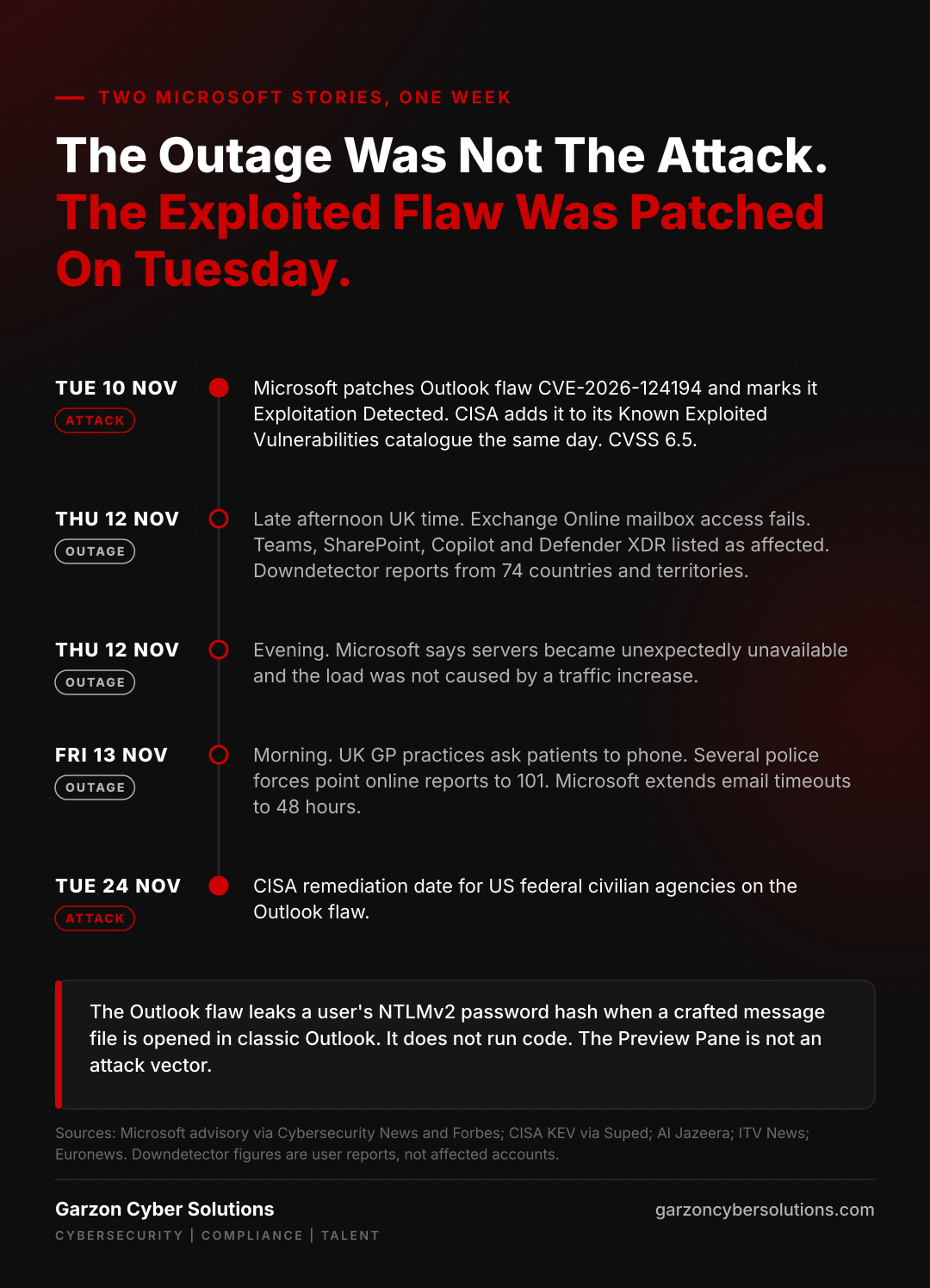
- Tuesday 10 NovemberMicrosoft patches CVE-2026-124194 in classic Outlook and marks it "Exploitation Detected". CISA adds it to the Known Exploited Vulnerabilities catalogue the same day.
- Thursday 12 November, late afternoon UK timeExchange Online mailbox access fails. Reports spread to 74 countries and territories within about an hour.
- Thursday eveningMicrosoft says servers became unexpectedly unavailable and the load was not caused by a traffic increase.
- Friday 13 November, morningUK GP practices, police forces and pharmacies report disruption. Microsoft reports limited early success, then early stabilisation, and extends email timeouts to 48 hours.
- Tuesday 24 NovemberCISA's remediation date for US federal civilian agencies on the Outlook flaw.
In the UK, the effects showed in public services first. GP practices in Hampshire and Shropshire told patients to phone or come in if they needed urgent care, and a Penzance GP said his practice had received no emails that day. The Metropolitan Police, Greater Manchester Police and North Yorkshire Police said online forms might be affected and asked people to call 101 for time-critical non-emergency reports; South Wales Police and Dyfed-Powys Police reported similar problems and asked people to phone. The National Pharmacy Association warned that "waits may be longer than normal and there may be delays to some prescriptions". The government said it had "robust contingency plans" in place. One detail stood out: London Ambulance Service was reported unaffected, because its critical platforms do not use Microsoft.
Was it an attack?
The question that spread fastest on Thursday was whether this was a cyber attack. On the evidence available, it was not. Microsoft said it was "not aware of any malicious activity". Lamanna wrote that there was "no indication this is the result of malicious or cyber activity". No group has claimed responsibility. The shape of the failure also argues against the most obvious attack theory: a denial-of-service attack shows up as a flood of incoming traffic, and Microsoft said explicitly that the load was not caused by more traffic. Australia's Home Affairs Minister, Tony Burke, said Microsoft had told him it did not believe it was dealing with a cyber attack, and he described the cause as "an update that has gone awry". Microsoft has not published a root cause, so that description is his rather than Microsoft's.
The rumours still carried a cost. A GlobalData analyst quoted by Euronews attributed their spread on X to the absence of a confirmed cause or a fix timeline. That gap is useful to fraudsters. As Euronews noted, outages are routinely exploited with fake "support" messages, and staff who have been told something is broken are more inclined to click on a message that promises to fix it.
The attack that did happen
Two days before the outage, Microsoft's November security release fixed CVE-2026-124194, a spoofing flaw in classic Outlook for Windows. A crafted message file, once opened, makes Outlook connect to an attacker-controlled location without the usual warning. In doing so it discloses the user's NTLMv2 password hash, which an attacker can try to crack offline or relay in order to authenticate as that user. Microsoft marked the flaw "Exploitation Detected", meaning it knew of real-world exploitation, and CISA added it to the Known Exploited Vulnerabilities catalogue on 10 November with a remediation date of 24 November for US federal civilian agencies. It affects Microsoft 365 Apps for Enterprise and Office LTSC 2021 and 2024. Microsoft says the Preview Pane is not an attack vector: the user has to open the file. It does not run code.
Its CVSS score is 6.5, rated moderate. That is the number most patching queues sort by, and it is why the flaw deserves its own section. Rapid7's Adam Barnett said the score "does not tell the full story here". A flaw that yields a usable credential from a single opened message, and that someone is already exploiting, belongs higher in the queue than a moderate score suggests. Microsoft also recommends blocking unnecessary outbound SMB traffic on TCP port 445 to the internet, alongside the update rather than instead of it.
Nothing published links the Outlook flaw to the outage, and we draw no such link. The point is about attention. In the week a moderately scored but actively exploited email flaw needed patching, most leadership conversations were about a cloud outage that was not an attack.
Why this one is different
Outages at large providers are not new. Microsoft 365 was down across North America for close to ten hours in January, and a further incident disrupted Outlook and Exchange Online for several days at the end of August. Our briefing of 7 November on Google Cloud's London region made the regulatory case that designating a provider as a critical third party does not move accountability away from its customers. This incident adds something narrower and more practical.
Look at what Microsoft listed as affected. Exchange Online and Outlook are how most organisations tell staff, customers and suppliers what is happening. Teams is where many incident bridges now convene. Defender XDR is, for a large share of Microsoft-centred organisations, the console the security team uses to see what is happening. In a typical UK mid-market estate, all three come from the same provider as the services they would be used to manage. The response function and the thing it responds to share a dependency.
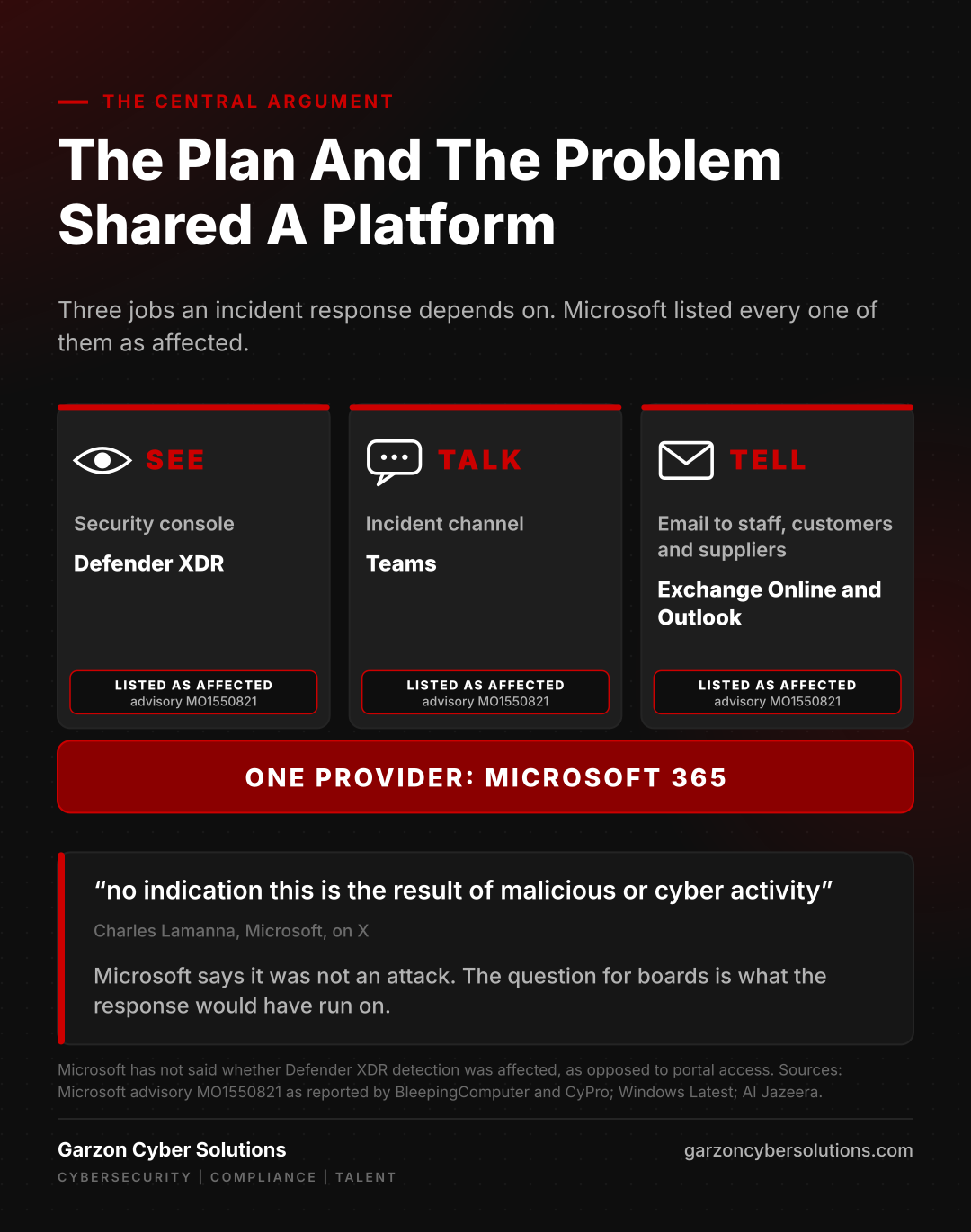
That matters in two scenarios, and only one of them happened this week. In an outage, the cost is slower coordination. People improvise on personal phones and messaging groups, decisions go unrecorded, and customers hear nothing because the channel used to tell them is the one that is down. In an attack that coincides with an outage, or that is designed to cause one, the cost is losing sight and voice at the same moment. The second scenario did not occur. The first was a rehearsal for it.
We should be precise about Defender XDR. Microsoft's advisory listed it among the affected services, but Microsoft has not said whether detection itself was degraded or whether the effect was limited to the portal. As Cybersecurity News observed, portal access problems alone do not establish that endpoint protection stopped working. A sensor that keeps recording while nobody can open the console is better than one that stops. An analyst who cannot see an alert still cannot act on it.
The organisations that came through this cleanly were not necessarily those with the best Microsoft configuration. They were those whose critical paths did not depend on it. That is not an argument for leaving Microsoft, and we are not making one. It is an argument for knowing, service by service, which parts of your response would survive the loss of your primary provider, and for deciding deliberately where they should not depend on it.
The commercial exposure for UK organisations
Regulatory
For firms regulated by the FCA and PRA, the operational resilience rules that took full effect in March 2025 require firms to be able to remain within impact tolerances for their important business services in severe but plausible scenarios. In our view, a loss of email and collaboration at a major provider lasting most of a business day is now a demonstrated scenario rather than a hypothetical one. Microsoft Ireland Operations Limited is one of four providers designated as critical third parties under the UK regime from 13 July 2026, but, as we set out on 7 November, designation changes who supervises the provider, not who answers for the firm's own services.
For entities in scope of NIS2 in the EU, Article 21(2)(c) lists "business continuity, such as backup management and disaster recovery, and crisis management" among the minimum risk-management measures, and Article 21(2)(d) covers "supply chain security, including security-related aspects concerning the relationships between each entity and its direct suppliers or service providers". Crisis management that runs on the platform in crisis sits awkwardly with both. In the UK, the Cyber Security and Resilience Bill completed its Lords stages on 2 November and returns to the Commons. As drafted it would introduce a two-stage incident reporting duty, an initial notification within 24 hours and a full report within 72 hours. It has not received Royal Assent, and its final text may change.
Financial
Nothing Microsoft has said suggests customer data was lost or exposed in this outage, so the direct cost sits in lost time. An adviser quoted by Euronews described many companies as having effectively "lost a business day", and the US electric vehicle maker Workhorse postponed its earnings call. For UK firms the more expensive line is usually downstream: delayed client communications, deadlines that run on email, and the effort of reconstructing a day of correspondence. Provider service level agreements generally remedy downtime with service credits against fees rather than compensation for business loss. It is worth knowing what yours says before the next outage rather than after it.
Contractual
Many UK firms owe their own customers notifications that quietly assume email works: incident reports, service status updates, breach notifications under client contracts. Few contracts say what happens when the notification channel is the thing that failed. If a notification clause names email as the method, it is worth confirming now whether a phone call, a status page or a second channel also satisfies it.
Governance
The board question is about design, not blame. A response plan that names a Teams channel as the incident bridge, keeps the contact list in Outlook and relies on a single console for detection has a single point of failure that rarely appears in the risk register, because it sits inside the response function rather than inside the service. A board that asks for that dependency to be mapped is asking a question its executives can answer within a week.
What leaders should do now
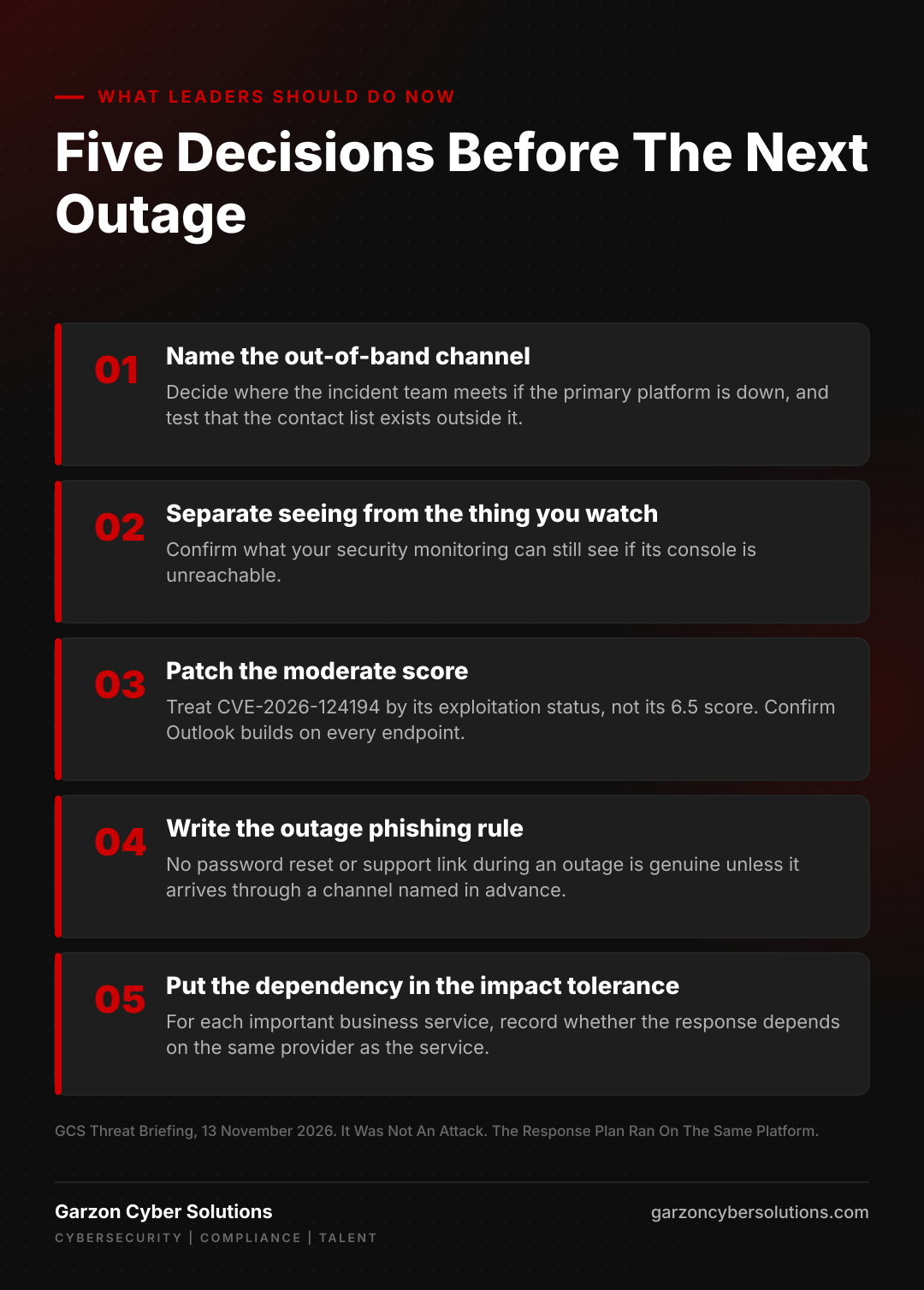
- Name the out-of-band channel. Decide where the incident team meets and messages if the primary collaboration platform is down. Test it, and confirm the contact list exists outside the platform it would replace.
- Separate seeing from the thing you watch. Establish whether your security monitoring and its console share a provider with the services they protect, and what your team or your detection provider can still see if that console is unreachable.
- Patch the moderate score. Prioritise CVE-2026-124194 by its exploitation status, not its 6.5 score. Confirm the installed Outlook build on every endpoint, including offline devices and old desktop images.
- Write the outage phishing rule. Tell staff now that no password reset or "support" link during an outage is genuine unless it arrives through a channel named in advance.
- Put the dependency in the impact tolerance. For each important business service, record whether the people and tools running the response depend on the same provider as the service, and decide whether that is acceptable.
Three questions for the board
- If our primary productivity platform were unavailable for 24 hours, where would our incident team meet, and has that been tested this year?
- Do our security monitoring and its console depend on the same provider as the services they protect, and what would we still see if that console were unreachable?
- Has the exploited Outlook flaw patched on 10 November been deployed to every endpoint, and how do we know?
The strategic takeaway
The lesson of 12 November is not that Microsoft failed. Large platforms fail, and they will fail again. It is that many organisations have consolidated their means of seeing, talking and telling onto the same provider as the services those means exist to protect. That consolidation is usually sensible on cost and integration. It becomes a governance issue only when nobody decided it deliberately.
Deciding it deliberately is cheap. An out-of-band channel, an offline contact list and a clear view of what the security team can still see during a provider outage cost little, and they turn the next outage from an improvisation into a procedure. The next one may not be an accident.
Confidence note
Confirmed. A Microsoft 365 disruption from 12 November affecting Exchange Online and Outlook, with Teams, SharePoint Online, Copilot and Defender XDR listed in Microsoft's advisory. Microsoft's statements that servers became unexpectedly unavailable and that the load was not caused by a traffic increase. Charles Lamanna's statement on X. The UK service impacts as reported by the named organisations. CVE-2026-124194 marked "Exploitation Detected", patched on 10 November and added to CISA's catalogue the same day.
Assessed. That the outage was not a cyber attack rests on Microsoft's statements and the absence of contrary evidence, not on a published root cause. Our argument about the shared dependency of response functions is our assessment of typical Microsoft-centred estates, not a finding about any named organisation.
Not known. Microsoft's root cause. Whether Defender XDR detection, as opposed to portal access, was affected. The exact start time: outlets place the first reports between about 16:00 and 17:40 GMT. The number of affected accounts. Who exploited CVE-2026-124194 and against whom. The time of full recovery, which had not been confirmed at the time of writing, around midday UK time on 13 November.
If your primary platform went dark tomorrow, do you know what your incident response would run on?
Garzon Cyber Solutions was built around the argument that security, compliance and the people who sustain them are one capability rather than three cost lines. Mapping which of your response capabilities share a provider with the services they protect, and deciding where they should not, is work we deliver with specialist technology partners.
Start the Conversation →Findings, assessments and unestablished points are separated in the confidence note above. Downdetector figures are user reports, not affected accounts. Microsoft had not published a root cause at the time of writing.
Al Jazeera, 13 November 2026. The source for the 74 countries and territories figure from Downdetector, the start of reports around 16:00 GMT, Tony Burke's account, and Microsoft's statement that the load was not caused by a traffic increase.
Euronews, 13 November 2026. The source for nearly 140,000 Outlook reports, Planner and To Do, the GlobalData comment on rumours, the fraud warning, Paul Spain's "lost a business day", and that nothing Microsoft said suggests data was exposed.
ITV News, 13 November 2026. The source for nearly 130,000 Outlook reports on Thursday night, "early stabilisation and capacity improvements as recovery actions continue", the 48-hour email timeout and the government's "robust contingency plans".
Yahoo News (PA), 13 November 2026. The source for the named police forces, the GP practices in Hampshire, Shropshire and Penzance, the National Pharmacy Association quote and London Ambulance Service.
Windows Latest, 13 November 2026. The source for Charles Lamanna's statement on X, quoted verbatim.
RansomNews, 12 November 2026, citing BleepingComputer. The source for the services listed in advisory MO1550821 and the incident identifiers.
Cybersecurity News. Corroborates Defender XDR in the reported impact, and the point that portal problems alone do not establish that endpoint protection stopped working.
ABC News, 12 November 2026. Microsoft's wording on servers being unexpectedly unavailable and on returned servers becoming unresponsive.
The National, 13 November 2026. Microsoft's status page wording on Exchange Online connection methods.
SmartScope, 13 November 2026. Microsoft's status text on network configuration changes correlating with the onset of impact, and "not aware of any malicious activity". Not independently verified against Microsoft's page.
Forbes, 11 November 2026. CVE-2026-124194 exploitation, affected products and Adam Barnett's comment.
Cybersecurity News. CVE-2026-124194 CVSS 6.5, Exploitation Detected, 10 November patch, Preview Pane exclusion and the TCP 445 recommendation.
Suped. CISA Known Exploited Vulnerabilities addition on 10 November and the 24 November federal remediation date.
Directive (EU) 2022/2555 (NIS2), Article 21(2)(c) and (d), quoted rather than paraphrased.
Cyber Security and Resilience Bill parliamentary stages, updated 10 November 2026: Lords Third Reading on 2 November, 24-hour and 72-hour reporting as drafted, no Royal Assent.
GCS Threat Briefing, 7 November 2026, Google Cloud Was Designated In July. The Liability Stayed With You. For the UK critical third party designation of Microsoft Ireland Operations Limited from 13 July 2026.
Garzon Cyber Solutions delivers cybersecurity, compliance and specialist technology recruitment as one integrated capability for organisations across the UK, EU and Americas, with technical delivery through specialist technology partners.