Two Zero-Days In Thirty Days. Neither Needed Anyone To Open The Email.
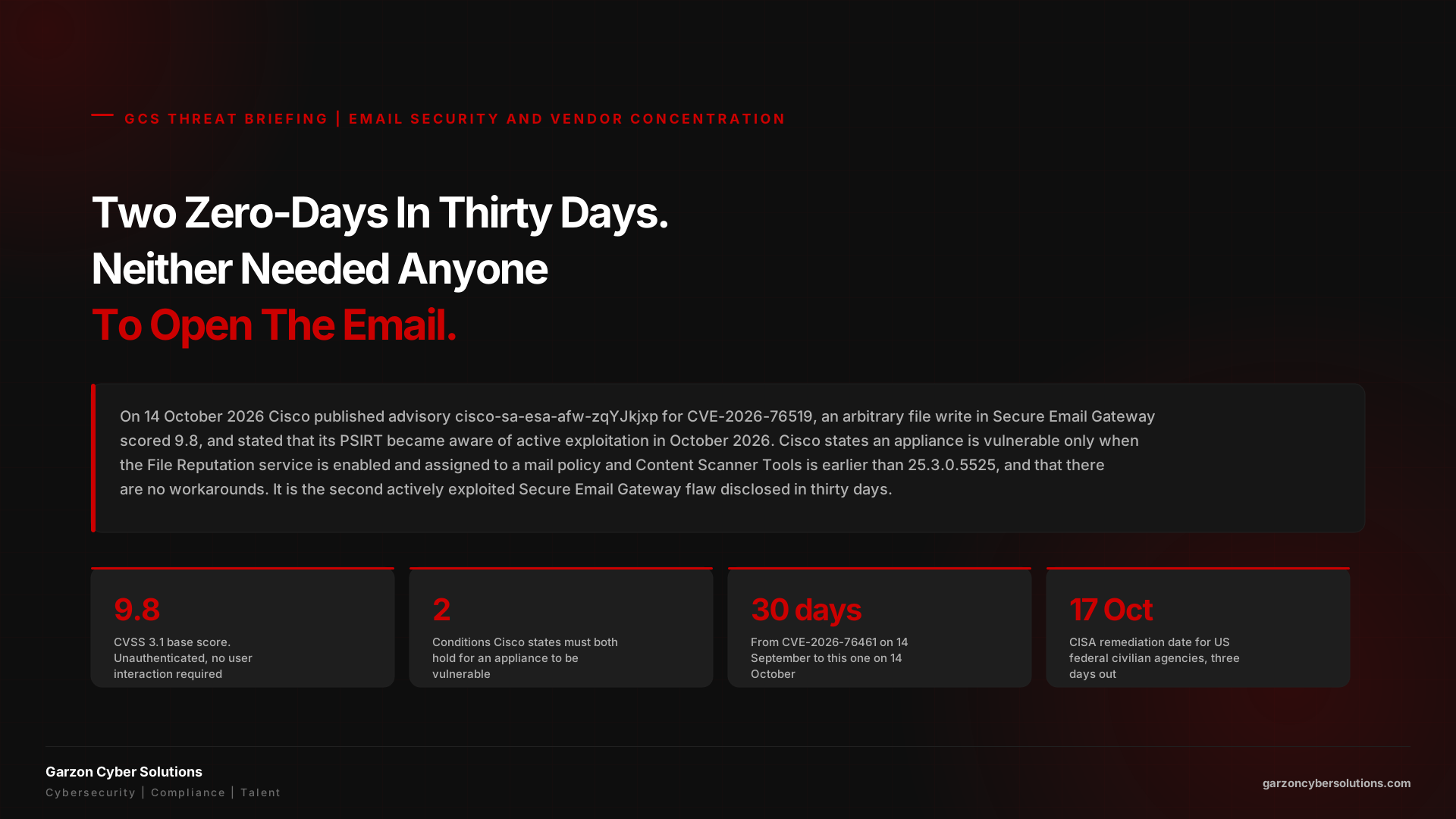
On Wednesday Cisco disclosed a critical flaw in Secure Email Gateway and said its own incident response team had become aware of active exploitation in October. That is the second actively exploited flaw in that product in thirty days, and the second in which Cisco says a crafted email can lead to command execution with root privileges, without anybody logging in and without anybody opening anything. What makes this one worth a board's attention is not the score. It is the two conditions Cisco says decide whether you were exposed, because neither of them is the version number your patch report tracks.
Most appliance briefings end at the same instruction, which is to patch. This one has a more awkward shape. Cisco states that the vulnerable condition is a feature being switched on and a scanning component being out of date, and that the fix for that component installs without a software upgrade and without a restart. Which means the appliances left exposed were not necessarily the ones carrying a patch backlog. They were the ones where an automatic update channel had been switched off years ago, for sensible change control reasons, with nobody assigned to watch it instead. That is a governance finding dressed as a technical one, and it stays useful long after this CVE closes.
What happened
On 14 October 2026 at 16:00 GMT Cisco published advisory cisco-sa-esa-afw-zqYJkjxp, version 1.0 and marked final, for CVE-2026-76519. The flaw is a relative path traversal, filed as CWE-23 and scored 9.8 on CVSS 3.1 with the vector AV:N/AC:L/PR:N/UI:N/S:U/C:H/I:H/A:H, which is to say reachable across the network, no credentials, nobody clicking anything. Cisco states that it arises from improper handling of email attachments when the file reputation service is enabled, allows an unauthenticated remote attacker to write arbitrary files on the underlying operating system, and that successful exploitation could also allow command execution with root privileges.
Cisco is precise about who is affected, and the precision is the story. An appliance is vulnerable when two conditions both hold: the File Reputation service, part of Cisco Advanced Malware Protection, is enabled and assigned to a mail policy, and the Content Scanner Tools component is earlier than version 25.3.0.5525. Cisco confirms that Secure Email and Web Manager, and Secure Web Appliance, are not vulnerable. There are, in the advisory's own words, no workarounds that address this vulnerability.
On exploitation, Cisco says only this: in October 2026, the Cisco PSIRT became aware of active exploitation of this vulnerability. No day, no actor. The Register reports Cisco describing the flaw as affecting a limited number of customers and declining to say how many appliances were compromised or what the attackers did next. The advisory itself records that Cisco has directly contacted customers who own Cisco Secure Email Cloud devices where indicators of possible compromise were identified. No exposure count has been published for this CVE and no victim has been named. Cisco records that it found the flaw during internal security scanning.
- 19 August 2026CVE-2026-76519 is reserved, according to the VulDB record. A reservation is an administrative step and says nothing about when the flaw was found or first used.
- Monday 14 September 2026CISA's alert adding CVE-2026-76461 to the Known Exploited Vulnerabilities catalogue is dated this day. That is a separate SQL injection in the same product, scored 9.8, which The Register reports Cisco found while resolving a support case and which Truesec, citing Cisco, records as exploitable through a malicious email processed by the gateway with no authentication required. The federal remediation date was 17 September.
- October 2026Cisco PSIRT becomes aware of active exploitation of CVE-2026-76519. Cisco gives the month and not the day, so the interval between first exploitation and disclosure is not established.
- Wednesday 14 October 2026, 16:00 GMTCisco publishes advisory cisco-sa-esa-afw-zqYJkjxp at version 1.0 final. The Canadian Centre for Cyber Security issues AV26-1042 the same day and records in an update that CISA added CVE-2026-76519 to the Known Exploited Vulnerabilities catalogue on 14 October 2026. The Hacker News reports that Cisco's September hardening advisory was updated on the same date to record that two of its flaws are known to be actively exploited.
- Saturday 17 October 2026The CISA remediation date for US federal civilian agencies, three days after the KEV listing. It does not bind a UK organisation. It is the clearest published statement of how fast a national authority thinks this needs closing.
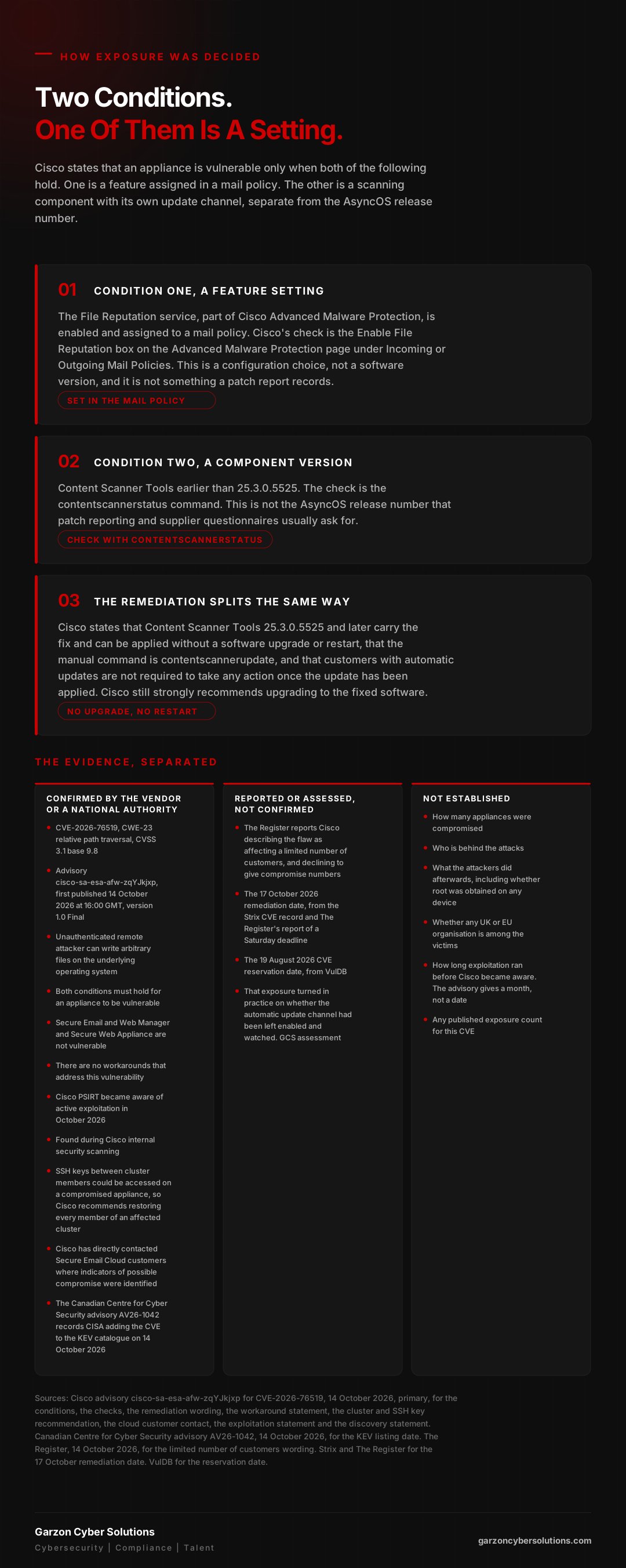
The remediation has the same two-part shape as the vulnerability. Cisco states that Content Scanner Tools 25.3.0.5525 and later contain the fix and can be applied without a software upgrade or restart, that the manual command is contentscannerupdate, that automatic updates are enabled under Security Services and then Service Updates, and that customers with automatic updates are not required to take any action once the update has been applied. Note the condition on that sentence. It is not a statement that the update has already landed on your devices, and the advisory separately and strongly recommends upgrading to the fixed software. The AsyncOS fixed releases are 15.5.5-014 and 16.5.0-780, with earlier releases recommended to move to 16.5.0-780. For the 16.0 line, the advisory names no fixed build and tells those customers to migrate.
Why this one is different
Put the September and October advisories side by side and a pattern appears that no single CVE would show you. Both flaws are in Cisco Secure Email Gateway, both scored 9.8, and in both the vendor's account an email sent through the appliance by an unauthenticated attacker can lead to commands running with root privileges. Neither came out of a public researcher disclosure: Cisco records finding this one during internal security scanning, and The Register reports it found the September flaw while resolving a support case. Both were already being exploited at disclosure, both carry a three day remediation date for US federal agencies, and both advisories say there are no workarounds.
That is not a patching story. It is a concentration story. The secure email gateway is the one device in the estate whose entire function is to accept unsolicited content from strangers and open it. A flaw in the scanning path of that device is not like a flaw in a web server, where the attacker has to find you first. Here, delivery is the attack, and all it requires is your mail domain, which is published.
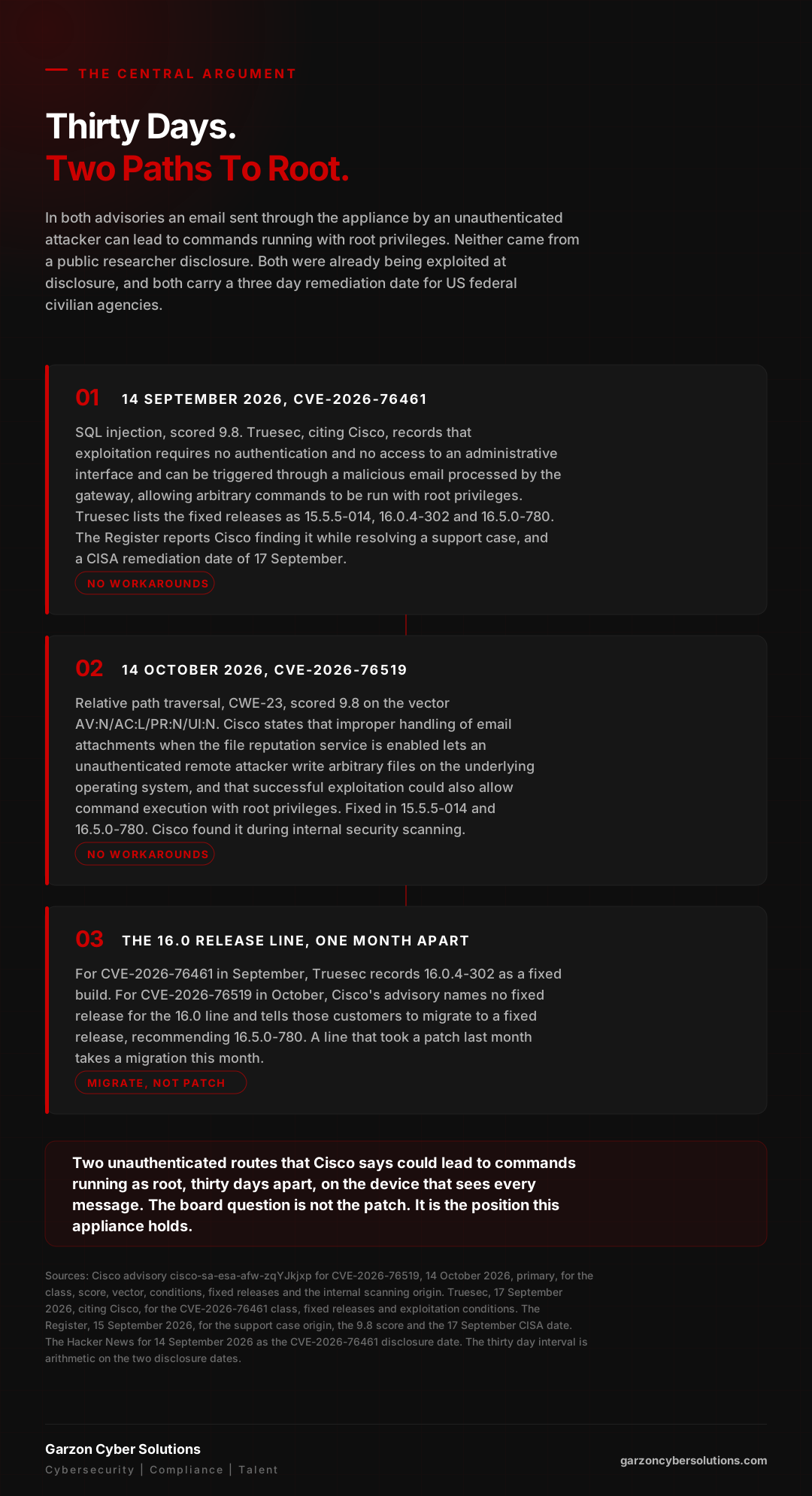
The second difference sits in the 16.0 release line. For the September flaw, Truesec records 16.0.4-302 as a fixed build. For the October flaw, Cisco's advisory names no fixed release for 16.0 and tells those customers to migrate, recommending 16.5.0-780. A line that accepted a patch last month requires a migration project this month. If your fourth quarter change calendar assumed your appliances stay on their current line until a planned refresh, that assumption changed on Wednesday, and nobody will write to tell you.
The third difference is the one for the audit committee. The component that had to be current is not the component most organisations report on. Supplier questionnaires ask for software versions and patch dashboards track the operating system release, while Content Scanner Tools updates on its own channel, is checked with its own command and applies without a restart. An organisation could have been fully current on AsyncOS, compliant on every metric it reports, and exposed anyway because somebody switched off automatic service updates years ago and the ticket that was meant to replace that with a manual check was closed as done.
The commercial exposure for UK organisations
Regulatory. No NCSC advisory specific to this vulnerability was located in its published feeds as at the morning of 15 October 2026, and absence of a UK notice is not absence of obligation. If root on a mail gateway led to personal data being accessed, the UK GDPR Article 33 duty applies, and the ICO states it plainly: you are required to notify the ICO of a personal data breach without undue delay and no later than 72 hours after having become aware of it, unless the breach is unlikely to result in a risk to the rights and freedoms of individuals. The ICO adds that without appropriate logs you may not generate the evidence to allow you to make an informed decision, and that in that case it may be helpful to determine if the attacker had the means, motivation and opportunity to exfiltrate the data, then use that as the basis of a risk-based decision. On a device where the vendor itself warns that root access lets an attacker hide evidence, that assessment carries more weight than most organisations realise.
Contractual. Supplier assurance questionnaires ask when you last patched and which software version you run. Neither question reaches the component that decided exposure here, so an honest answer to a customer this quarter involves naming a scanning package the questionnaire does not ask about. For organisations in scope of NIS2 through an EU entity, Article 23 of Directive (EU) 2022/2555 runs its clock from awareness of a significant incident rather than from certainty about it. An early warning is due without undue delay and in any event within 24 hours, indicating where applicable whether the incident is suspected of being caused by unlawful or malicious acts or could have a cross-border impact. An incident notification follows within 72 hours, updating the early warning and giving an initial assessment of severity and impact together with indicators of compromise where available. Note the construction: the 24 hour step asks for a suspicion, not a conclusion. An organisation that waits to be sure has already missed it.
Financial. The cost is not the update, which is free and needs no outage. It is the investigation and, where a cluster is involved, the recovery. Cisco's advisory states that SSH key pairs are used for authentication between cluster members, that private keys could be accessed on a compromised appliance, and that it strongly recommends restoring to a secure configuration each member of a cluster that contains at least one compromised appliance. That turns a single appliance question into a mail platform rebuild, and it is far cheaper to decide in advance than to discover at two in the morning with the queue backing up.
Governance. Two actively exploited flaws in thirty days in one product is a supplier performance question, and a board can ask it without it being a criticism of the team who chose the product. The answerable version is not whether to replace Cisco. It is what tolerance the organisation has for repeat critical findings in a single control point, what it would do if a third arrived next month, and whether the mail path is designed so that compromise of the scanning appliance is survivable. The UK's Cyber Security and Resilience (Network and Information Systems) Bill, which reached Lords committee stage on 1 September 2026 and is listed for Lords report stage on 26 October 2026, would bring data centres and third party IT products and services into the regulations and widen the range of reportable incidents. Dependencies of this kind are becoming reportable rather than merely inconvenient.
What leaders should do now
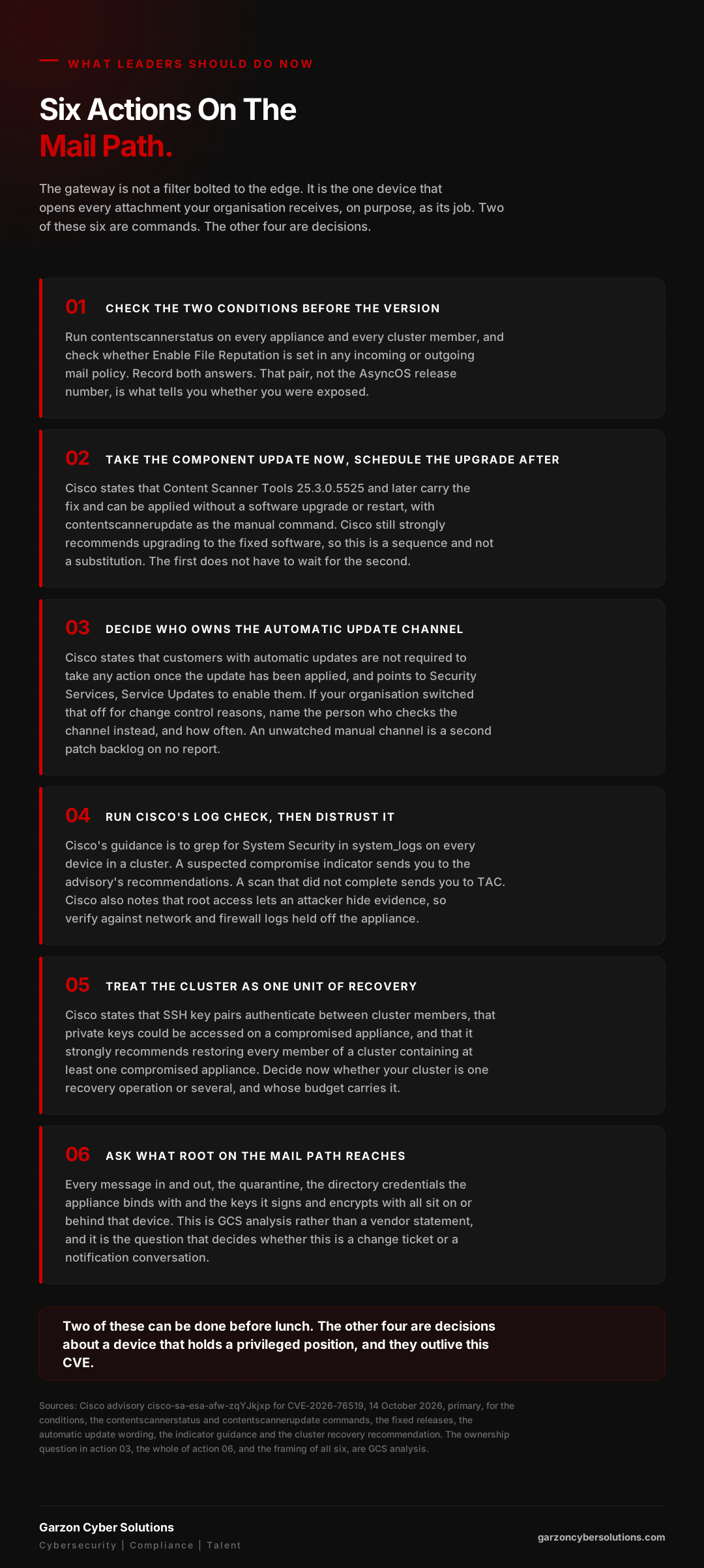
1. Check the two conditions before you check the version. Run contentscannerstatus on every appliance and every cluster member, and check whether Enable File Reputation is set in any incoming or outgoing mail policy. Write both answers down. That pair, not the AsyncOS release number, determines whether you were exposed.
2. Take the component update now and schedule the upgrade afterwards. Cisco states that Content Scanner Tools 25.3.0.5525 and later carry the fix and can be applied without a software upgrade or restart, with contentscannerupdate as the manual command. It still strongly recommends upgrading to the fixed software, so this is a sequence rather than a substitution. The move to 15.5.5-014 or 16.5.0-780 belongs in change control, and treating the two as one piece of work is how a no-outage fix ends up queued behind a maintenance window three weeks out.
3. Decide who owns the automatic update channel. Cisco's position is that customers with automatic updates are not required to take any action once the update has been applied, which puts the burden of knowing whether it has landed on you either way. If your organisation switched the channel off, that was probably a reasonable decision taken for change control reasons by somebody who has since moved on. Either turn it back on, under Security Services and then Service Updates, or name the person who checks it manually and how often. An unwatched manual channel is a second patch backlog that appears on no report.
4. Run Cisco's log check, then distrust it. The advisory's guidance is to grep for System Security in system_logs on every device in a cluster. A suspected compromise indicator means compromise has been detected and sends you to the advisory's recommendations. A message that the security scan did not complete sends you to Cisco TAC. A no compromise indicator result directs you to upgrade to a fixed release where applicable, and nothing more. The advisory also notes that root access lets an attacker hide evidence, and directs you to cross-check network and firewall logs held off the appliance, so a clean gateway log is the beginning of the enquiry rather than the end of it.
5. Decide now whether your cluster is one unit of recovery or several. Cisco's recommendation is to restore to a secure configuration every member of a cluster containing at least one compromised appliance, because the SSH keys used between members could be accessed on a compromised box. That is a decision about architecture, mail continuity and budget, and it should not be taken for the first time during an incident. Write down what you would do, who signs it off, and how mail flows while you do it.
6. Ask what root on the mail path reaches. This is GCS analysis rather than a vendor statement, and it decides whether this is a change ticket or a notification conversation. Every message in and out, the quarantine, the directory credentials the appliance binds with for recipient validation and the cryptographic material it uses to sign and encrypt all sit on or behind that device. The organisations that answer this quickly are the ones that already wrote it down.
Three questions for the board
1. Which of our controls are updated on a channel we have switched off? The durable question, and not about Cisco. Threat intelligence feeds, reputation services, signature sets, scanner engines and certificate bundles all update outside the patch cycle. Ask for the list and the name against each one. If the list does not exist, that is the finding.
2. Two critical flaws in thirty days in the same product. What is our tolerance, and what triggers a review? Not an instruction to replace anything. A written threshold, agreed in advance, so the decision is not taken in the week of the third one.
3. If the mail gateway were compromised, could we still receive mail while we rebuilt it? This is a resilience question with a procurement answer, and it can be worked out this quarter without knowing whether anything happened.
Strategic takeaway
The uncomfortable thing about this disclosure is how reasonable the losing decision was. Disabling automatic service updates on a production mail gateway is defensible practice. It stops a vendor changing the behaviour of a device in your critical path without your knowledge, which is the discipline auditors ask for. The organisations that did it were not careless. They did not notice that the switch they turned off was also a patching channel, and that nothing in their reporting would ever tell them.
That lesson travels well beyond this product. Modern security controls update themselves on channels that sit outside the change calendar, the vulnerability scanner and the supplier questionnaire. Each of those channels is a control, and every control needs an owner, a review date and a place on a report somebody reads. The ones with none of those things are not low risk. They are unmeasured, which is a different thing and usually worse.
The second lesson is about position rather than patching. The appliance at the centre of this story opens hostile content for a living. Two unauthenticated routes that Cisco says could lead to commands running as root, thirty days apart, do not make it a bad product, but they do make it a concentration point, and concentration points deserve a design that assumes eventual failure. Segmentation around the mail path, scoped and rotated credentials for the device, logs held somewhere it cannot reach, and a written answer to how mail keeps flowing during a rebuild. None of that needs a new budget line. All of it will still be useful the next time this box, or its replacement, has a bad Wednesday.
Confidence note
Confirmed by the vendor or a national authority. CVE-2026-76519 as a relative path traversal, CWE-23, scored 9.8 on CVSS 3.1 with the vector AV:N/AC:L/PR:N/UI:N/S:U/C:H/I:H/A:H. Advisory cisco-sa-esa-afw-zqYJkjxp, first published 14 October 2026 at 16:00 GMT at version 1.0 final. The improper handling of email attachments when the file reputation service is enabled, the arbitrary file write on the underlying operating system, and that successful exploitation could also allow command execution with root privileges. The two conditions for vulnerability and the two checks for them, the contentscannerstatus command and the Enable File Reputation check box on the Advanced Malware Protection page under Incoming or Outgoing Mail Policies. Secure Email and Web Manager and Secure Web Appliance as not vulnerable. That there are no workarounds. The fixed releases 15.5.5-014 and 16.5.0-780, the instruction to migrate from 16.0, the Content Scanner Tools remediation including that it needs no software upgrade or restart, that customers with automatic updates are not required to take any action once the update has been applied, and that Cisco nonetheless strongly recommends upgrading to the fixed software. The three indicator outcomes and where each one sends you. The warning that root access allows evidence to be hidden. The SSH key exposure between cluster members and the recommendation to restore every member of a cluster containing at least one compromised appliance. That Cisco has directly contacted customers who own Cisco Secure Email Cloud devices where indicators of possible compromise were identified. The statement that in October 2026 the Cisco PSIRT became aware of active exploitation. The statement that the flaw was found during internal security scanning. The Canadian Centre for Cyber Security advisory AV26-1042 of 14 October 2026, whose update note records that CISA added CVE-2026-76519 to the Known Exploited Vulnerabilities catalogue on 14 October 2026.
Reported, and not read from the advisory. That Cisco described the flaw as affecting a limited number of customers and declined to give compromise numbers, and that Cisco found the September flaw while resolving a support case, both from The Register. That Cisco's September hardening advisory was updated on 14 October to record two actively exploited flaws, from The Hacker News, which also gives 14 September 2026 as the disclosure date of CVE-2026-76461 in advisory cisco-sa-esa-inj-2bLVGmhX. The 17 October 2026 remediation date for US federal civilian agencies, stated by the Strix CVE record and corroborated by The Register's report of a Saturday deadline; it was not possible to read the CISA alert page directly during preparation of this briefing, and the 14 October listing date comes from AV26-1042. The 19 August 2026 CVE reservation date, from VulDB. The CVE-2026-76461 fixed releases including 16.0.4-302, from Truesec, which states the exploitation conditions as Cisco's rather than as its own finding, and that flaw's 9.8 score and 17 September remediation date, from The Register.
Not established at all. How many appliances were compromised. Who is behind the attacks. What the attackers did after exploitation, including whether root was in fact obtained on any device, which the advisory does not say. Whether any UK or EU organisation is among the victims. How long exploitation ran before Cisco became aware, since the advisory gives a month and not a date. Any exposure count for this CVE. The argument in this briefing does not depend on any of these being resolved in either direction.
Assessed, and labelled as ours. That exposure turned in practice on whether the automatic service update channel had been left enabled and watched. The reading of the September and October advisories as a concentration finding rather than a patching finding. The characterisation of the gateway as a device whose function is to open hostile content. The observation about the 16.0 line, which rests on comparing what Truesec records for September with what the October advisory says. The read across to UK GDPR Article 33, NIS2 Article 23 and the Cyber Security and Resilience Bill. The six actions and the three board questions. None of this is the stated position of Cisco, CISA, the NCSC, the ICO or any other authority and it should not be read as such. The Article 33 deadline is quoted from the ICO's published wording and the Article 23 staging from the directive text; the ICO's guidance on assessing exfiltration without logs is reproduced closely but not as a continuous quotation. The statement that no NCSC advisory specific to this vulnerability was located reflects its published feeds as checked on the morning of 15 October 2026.
Which of your security controls update on a channel nobody is named against?
Garzon Cyber Solutions was built around the argument that security, compliance and the people who sustain them are one capability rather than three cost lines. Listing the controls that update outside the patch cycle, naming an owner against each and deciding what the mail path does on a bad day is a short piece of work with a long shelf life, and it is considerably cheaper before an incident than during one. If you would like a view on where your estate carries an unexamined vendor dependency, start a conversation.
Start the Conversation →Vendor and regulator statements are the primary source for everything attributed to them. Reported detail is attributed to the outlet that reported it. Regulatory wording is quoted from the published instrument, not paraphrased.
Cisco, security advisory cisco-sa-esa-afw-zqYJkjxp, "Cisco Secure Email Gateway Arbitrary File Write Vulnerability", first published 14 October 2026 at 16:00 GMT, primary source for the CVE, the CWE, the score and vector, the two conditions, the unaffected products, the absence of workarounds, the fixed releases, the Content Scanner Tools remediation, the indicator guidance, the exploitation statement and the discovery statement · RedLegg, "Security Bulletin: Arbitrary File Write Vulnerability in Cisco Secure Email Gateway Advanced Malware Protection", for the contentscannerstatus and contentscannerupdate detail and the cluster restoration recommendation, carried as its restatement of Cisco's recommendations · The Register, "Cisco make-me-root email bug exploited as a 0-day by unknown crims", 14 October 2026, for Cisco's limited number of customers wording, the refusal to give compromise numbers and the Saturday federal deadline · The Hacker News, "Cisco Warns of Active Attacks Exploiting New Critical Secure Email Gateway Vulnerability", 14 October 2026, for the contact with Secure Email Cloud customers showing indicators of possible compromise and the 14 October update to the September hardening advisory · Strix, CVE record for CVE-2026-76519, for the CISA Known Exploited Vulnerabilities listing and the 17 October 2026 federal remediation date · VulDB, entry VDB-420091, for the 19 August 2026 CVE reservation date · Truesec, "Critical Cisco Secure Email Gateway vulnerability exploited in the wild", 17 September 2026, for the CVE-2026-76461 class, fixed releases and exploitation conditions · The Register, "Cisco email security boxes can be rooted by an email", 15 September 2026, for the CVE-2026-76461 score, the support case origin, the 14 September CISA alert and the 17 September remediation date · ICO, "Ransomware and data protection compliance", quoted on the 72 hour notification duty under UK GDPR Article 33 and on assessing exfiltration without logs · NIS2, Directive (EU) 2022/2555, Article 23(4), quoted for the 24 hour early warning and the 72 hour incident notification · UK Parliament, "Cyber Security and Resilience (Network and Information Systems) Bill: Stages", for the Lords committee stage from 1 September 2026 and the Lords report stage listed for 26 October 2026 · House of Lords Library, "Cyber Security and Resilience (Network and Information Systems) Bill: HL Bill 32 of 2026-27", for the bill bringing data centres and third party IT products and services into scope and widening reportable incidents
Garzon Cyber Solutions delivers cybersecurity advisory, compliance certification and specialist technology recruitment as one integrated capability for organisations in the UK, EU and beyond.